

The Specification Gap: What the United Nations Committee on Economic, Social and Cultural Rights Asks States to Measure on the Right to Health, 2014–2024
Omar Ouakkad and Abdelali Hamidine
Abstract
In General Comment 14, the United Nations Committee on Economic, Social and Cultural Rights envisaged the use of indicators, national benchmarks, and a joint “scoping” exercise through which the committee and each state would establish a basis for later assessment. We examined how often the committee itself explicitly identifies such parameters for assessment by analyzing all 134 concluding observations it adopted between 2014 and 2024, covering 110 state parties (24 of which were reviewed twice). Explicit references to these parameters are found in most reviews but occur infrequently within each: Approximately 3% of coded paragraphs mention an indicator, benchmark, target, or time frame, rising to 6% when requests for data and disaggregation are included. Most of these references appear in standard closing clauses and in recommendations about data; outside these, substantive recommendations on health and related rights seldom identify the parameters against which progress would be assessed. This pattern shows no clear change over time; instead, the most visible change occurred in the closing sections, where a standard recommendation on indicators receded as references to the 2030 Agenda became universal. Our findings concern the wording of recommendations, not whether they are assessable or effective. We argue for proportionate specification that identifies relevant evidence or assessment criteria where doing so would facilitate later assessment, while preserving contextual flexibility and legal judgment.
Introduction
In General Comment 14, issued in 2000, the Committee on Economic, Social and Cultural Rights (CESCR) set out what monitoring the right to health should look like. The general comment asked states to adopt national strategies resting on indicators and benchmarks, to collect disaggregated health data, and to join the committee in a process it called “scoping,” through which the state and the committee would agree on the targets against which the next report would be judged.[1] The instruction treated measurement as part of the legal content of the right: A state that cannot show what its health system delivers, to whom, and at what cost cannot show that it complies.
The quarter-century since has produced a rich apparatus for this task. The Office of the United Nations High Commissioner for Human Rights (OHCHR) developed a framework of structural, process, and outcome indicators; scholars built measures of economic and social rights fulfillment relative to available resources; and methodological frameworks tied outcomes to policy effort, budgets, and assessment.[2] A parallel critical literature warned that indicators can convert legal judgment into audit, conceal contestable choices behind apparently neutral numbers, and reward what is countable over what is owed.[3] Yet little systematic research has examined how the committee itself specifies the basis for assessing progress in its concluding observations, even though periodic review is a principal site in which measurement and legal assessment meet.
This paper provides that account, drawing on all concluding observations adopted by CESCR between January 2014 and December 2024. The dataset comprises 134 documents covering 110 state parties, 24 of which were reviewed twice in separate periodic cycles. The 5,557 coded paragraph units concern the right to health directly, determinants directly related to health, or general provisions bearing on all rights enshrined in the International Covenant on Economic, Social and Cultural Rights.[4] The paper asks how often, in what forms, and where the committee explicitly identifies the parameters for later assessment.
Concluding observations are the committee’s findings and recommendations issued at the end of each periodic review. Unlike its views on individual communications under the Optional Protocol to the International Covenant on Economic, Social and Cultural Rights, they do not resolve individual disputes. Neither type of document binds states in the manner of a court judgment, but both carry the authority of the body charged with monitoring the covenant. Concluding observations are also the committee’s most regular statement of what the treaty requires of a particular state.[5] They are treated here as authoritative recommendations rather than as jurisprudence in the judicial sense.
A recommendation can state an obligation clearly while leaving its evidentiary expectations open. For example, the repeal of a named provision can be verified from the resulting legal text, whereas progress in coverage, resources, or inequalities may require a baseline, comparator, or disaggregation. Demonstrability, as used here, concerns whether the basis for assessing implementation can be identified. The explicit evidentiary wording examined here is one—though not the only—way in which that basis may be stated.
The results unveil a consistent pattern. Explicit evidentiary language, though present in most reviews, is sparse and often generic, appearing mainly in recommendations about data and in the standard clauses that close each review. Substantive findings show no clear trend over time. One notable change concerns a boilerplate clause recommending that states “develop and apply appropriate indicators,” which spread through 2016–2019 and then all but disappeared.
Benchmarks promised, indicators debated
Article 12 of the International Covenant on Economic, Social and Cultural Rights recognizes the right of everyone to the highest attainable standard of physical and mental health.[6] General Comment 14 gave that right much of its working legal structure: availability, accessibility, acceptability, and quality (AAAQ) as dimensions of health facilities, goods, and services; underlying determinants such as water, sanitation, food, and housing; immediate obligations of nondiscrimination alongside progressive realization within maximum available resources; and minimum core obligations. Paragraphs 57 and 58 addressed right to health indicators, national benchmarks, and the scoping exercise through which subsequent performance could be assessed, and the committee’s reporting guidelines later requested disaggregated information across covenant rights.[7]
The wider treaty body system has also wrestled with the question of specificity. A 2014 note by the United Nations Secretariat proposed country-specific guidance and suggested indicators for programmatic recommendations and those requiring positive steps.[8] The framework agreed on that year by the treaty body chairs was more cautious, calling for specific and actionable guidance, contemplating time-bound targets or priorities where relevant, and leaving the incorporation of indicators for further reflection. CESCR endorsed this framework for its own concluding observations in 2015.[9]
Alongside these institutional developments, scholars have debated the role and limitations of human rights indicators. Gauthier De Beco and others have questioned what distinguishes human rights indicators from development statistics.[10] The OHCHR framework organizes indicators by the aspect of state conduct they capture, the Social and Economic Rights Fulfillment Index benchmarks outcomes against feasible resource use, and the OPERA framework joins outcomes, policy effort, resources, and assessment in a common sequence.[11] In this journal, empirical work has also highlighted the limitations of poorly chosen metrics. For example, universal health coverage measures can omit financial protection, and the Peruvian experience during COVID-19 showed favorable indicators coexisting with fragmentation and exclusion that those measures missed.[12] A newer strand builds monitoring infrastructure directly on treaty outputs. The CEDAW Index is designed to draw on state reports, shadow reports, and the concluding observations of the Committee on the Elimination of Discrimination Against Women to monitor government action, while civil society scorecards translate norms on the right to health into evaluative criteria.[13]
In conjunction with these efforts to develop and apply indicators, a critical literature has examined how measurement shapes institutional authority and legal judgment. The argument advanced in this literature is subtler than a rejection of evidence. Its authors argue that indicators help shape institutional work by establishing categories and comparisons that then govern in their own right; that treaty body reliance on indicators risks turning legal interpretation into audit; and that the appearance of objectivity can insulate contestable judgments from challenge. Kevin Davis, Benedict Kingsbury, and Sally Engle Merry show how indicators simplify complex information while influencing standard setting, decision-making, and the distribution of authority.[14] Merry’s study of human rights indicators adds that quantitative information can strengthen the factual basis of assessment, whereas treaty interpretation remains a legal exercise, often historically and contextually specific.[15] AnnJanette Rosga and Margaret Satterthwaite argue not for abandoning measurement but for keeping the judgments it embeds visible and open to participation and contestation.[16] We therefore treat specificity and flexibility as values to be balanced case by case, with the form of specification suited to the obligation.
A related literature examines the quality and domestic use of treaty body recommendations. Michael O’Flaherty situates clarity, detail, accuracy, and specificity within the long debate over the quality of concluding observations and emphasizes how hard it is to attribute domestic outcomes to the text itself.[17] Jasper Krommendijk later found broadly and vaguely formulated recommendations to be prominent among concluding observations linked to no identifiable domestic effect, while his analysis also showed how domestic and transnational mobilization could convert treaty body outputs into political and legal resources.[18] Specificity can facilitate use and follow-up without being a necessary or sufficient condition for implementation.
Other work situates reporting within a broader accountability ecology. Cosette Creamer and Beth Simmons show how self-reporting can generate effects through information gathering, justification, dialogue, and domestic engagement, and Alicia Yamin places accountability at the center of a human rights framework for health.[19]
Merry found limited treaty body uptake of the OHCHR indicators and few references to benchmarks in state reports, highlighting a gap between indicator design and reporting practice. CESCR’s concluding observations have also been content-coded. Benjamin Mason Meier and colleagues examined content on the right to health in state reports and intervening concluding observations from 2001 to 2013, coding public health topics, normative attributes, and committee sentiment, and tracing what later appeared in state reporting.[20] The present corpus covers all reviews from the subsequent decade and shifts attention to the committee’s explicit evidentiary requests: whether its concluding observations specify the evidence (indicators, benchmarks, baselines, targets, deadlines, and disaggregation) by which later implementation could be assessed. To our knowledge, this specific feature of CESCR’s concluding observations has not been systematically measured.
Methods
Corpus
The corpus comprises all 134 concluding observations adopted by CESCR between January 2014 and December 2024, which we identified and verified against the committee’s sessional records; we did not sample any documents. A final verification against those records identified 11 concluding observations missing from an earlier corpus of 124, which also contained one duplicate. We coded these additional observations using the same codebook and used the corrected set for all analyses. Of the 110 state parties, 86 underwent one CESCR review and 24 underwent two reviews. The repeated reviews belong to separate periodic cycles; they are neither follow-up documents nor a selected subsample. Income group follows the World Bank classification for the year of adoption.
Within each document, we coded a paragraph whenever it addressed any of the following three categories: the right to health directly (n = 1,766); a determinant directly related to health, such as housing, food, water, working conditions, or social protection (n = 1,835); or a general or procedural matter bearing on all covenant rights (n = 1,956). These three mutually exclusive categories are called families. Paragraphs on other rights without a direct-health dimension were not coded. The unit of analysis is the coded paragraph unit, defined as a numbered paragraph or, where its sub-items are entered separately, a lettered sub-item, with no text counted twice. The corpus contains 5,557 such units.
Variables
We manually coded family, topic, paragraph type (recommendation, concern, mixed, or positive aspect), targeted groups, and related variables using the published codebook. We identified measurement-related language using fixed, case-insensitive expressions applied to the paragraph text.
We treated seven forms of specification as parallel, non-exclusive dimensions: data collection, disaggregation, indicators, baselines, numerical targets, benchmarks, and time frames. A single paragraph may contain several of these dimensions; their number is neither a quality score nor a sign of evidentiary strength. Two composite measures are defined as follows. Measurement specification captures language stating how progress would be measured or timed, using the vocabulary of quantified assessment invoked in General Comment 14, such as indicators, benchmarks, numerical targets, and deadlines or time frames. Evidentiary specification is broader and also includes requests to collect or disaggregate data. Baselines are reported separately and are not included in either composite measure. Only two coded paragraphs contain baseline language, and both also contain at least one of the other six dimensions. Their exclusion therefore does not affect the number of paragraphs classified under the broader evidentiary-specification measure.
Further flags, listed in Table 1, identify legal citations and doctrinal vocabulary. The standard indicator clause is marked by the phrase “appropriate indicators,” and the scoping flag records explicit references to scoping, the procedure described in General Comment 14 through which the committee and a state would agree on indicators and benchmarks for the next report.[21] The standing closing section comprises paragraphs under the heading “other recommendations,” which contains recurring standardized recommendations concerning reporting, indicators, and dissemination. Paragraphs outside this section are called substantive.
Neither composite captures everything that makes a recommendation assessable. For example, a recommendation to repeal a specific legal provision may be verifiable without any measurement-related language, whereas the standard indicator clause mentions “indicators” without identifying a specific measure.
Reliability
A stratified random sample of 300 paragraphs, drawn in roughly equal parts from the three families, was independently recoded by a second researcher who was blind to the original codes and used the same codebook. The sample was drawn from the 5,218 units of the earlier corpus, before its correction; it represents 5.7% of those units and 5.4% of the final corpus. Raw agreement and Cohen’s kappa are reported, with Krippendorff’s alpha as a robustness check.[22] Agreement was substantial for paragraph type (86.7%; κ = 0.79), moderate for topic and the AAAQ dimensions, and only slight to fair for interpretive doctrinal categories (obligation type, immediate or core obligations, retrogression, and minimum core; κ = 0.16–0.36). Low agreement for these categories may reflect textual ambiguity, overlapping legal categories, or codebook definitions. We therefore treat them as exploratory and do not base any principal claims on them. Separately, two members of CESCR each reviewed a purposively selected set of difficult paragraphs with their assigned codes (15 and 13 paragraphs, respectively) and concurred. They also provided interpretive notes that informed the final codebook. This review supports the codebook’s treatment of difficult cases but does not constitute parallel coding.
We checked the lexical measures separately. We screened the 5,400 paragraphs without a measurement match using a broad paraphrase net and manually reviewed the 520 hits identified. Of these, 40 contained measurement language missed by the fixed expressions, mostly measurable objectives or specific targets in poverty and employment strategies, with 34 occurring outside the direct-health findings. The strict measure thus captures 157 of the 197 instances identified through either route (≈ 0.80), providing an upper bound on sensitivity because paraphrases outside the net remain uncounted.
Analysis
Paragraphs are not independent. They are nested within concluding observations, and a standing clause reflects one drafting decision rather than several, so logistic models use standard errors clustered by document. Results are reported as odds ratios (ORs). An OR above 1 indicates that the wording is more likely in the first of two groups being compared, in later years, or at higher income; a 95% confidence interval (CI) that includes 1 indicates no detectable difference. General-versus-health contrasts are re-estimated after excluding the closing section; the indicator clause; the data, monitoring, and indicators topic; or both the closing section and the data, monitoring, and indicators topic. Income is examined with a clustered trend model across ordered categories and an exploratory four-group comparison. Because trends proved sensitive to the inclusion of standing closing recommendations, temporal models are reported for the whole corpus, for substantive findings, and for direct-health paragraphs. A two one-sided equivalence test, with bounds corresponding to halving or doubling the odds over 2014–2024, assesses whether an undetected trend can be interpreted as stability.
Because concerns and recommendations often occupy separate paragraphs and because recommendations are divided into lettered sub-items, we test the effects of segmentation using reconstructed directive units, in which each numbered recommendation or mixed paragraph is assessed together with its merged sub-items and the immediately preceding concern. Two further comparisons are exploratory. Recommendations designated for follow-up are identified by matching paragraph numbers and sub-item letters to those specified in each review’s follow-up paragraph, and recommendations immediately preceded by a concern reporting a percentage or population rate are compared with other recommendations. We conducted all analyses in R 4.6.1. Detailed supplementary methods and results are available from the corresponding author upon reasonable request.
Results
A large, critical, and sparsely specified discourse
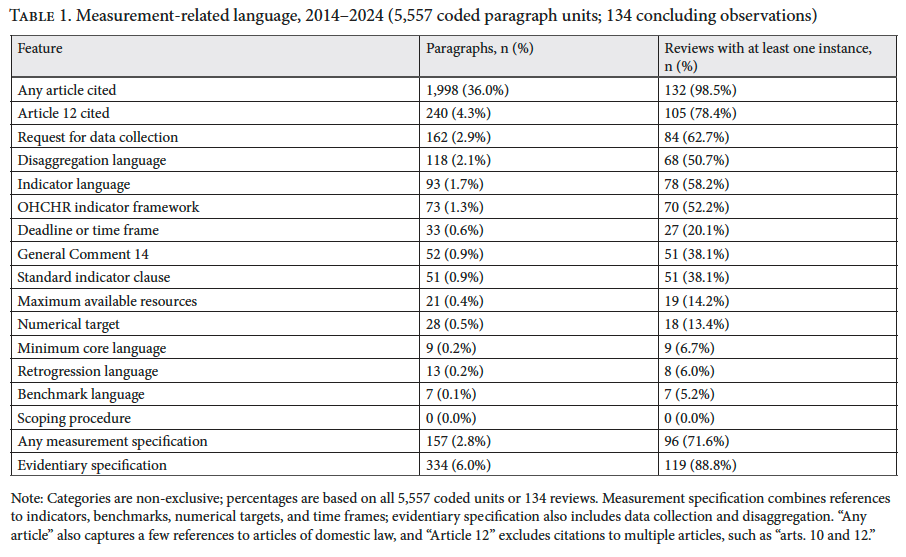
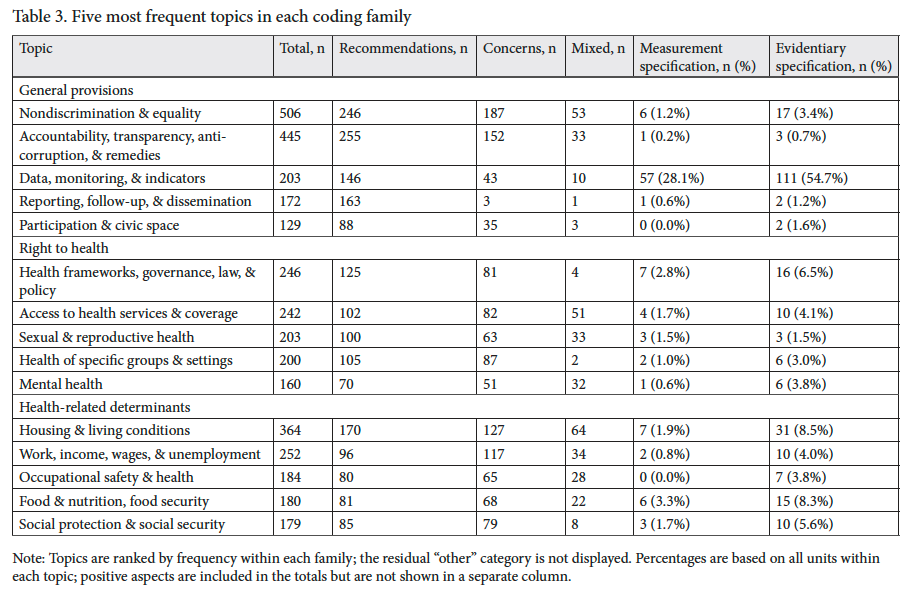
CESCR’s engagement with health is extensive and overwhelmingly critical or prescriptive. Of the 5,557 coded units, just over half are recommendations and about a third are concerns; the rest combine the two or record positive aspects. General provisions focus on equality, accountability, data, reporting, and participation; health findings focus on governance, access to services, sexual and reproductive health, specific groups, and mental health; and findings on determinants focus on housing, work, occupational safety, food, and social protection (Table 3).
Legal anchoring is more common at the document level than at the paragraph level. References to treaty articles appeared in 132 of the 134 reviews and about a third of coded units; references to article 12 and General Comment 14 were less common. Doctrinal terms emphasized in the general comment—such as maximum available resources, minimum core, and retrogression—appear even less frequently. The scoping procedure outlined in General Comment 14 is never invoked; no coded paragraph contains the word “scoping” (Table 1).
The specification gap
Measurement specification appears in 157 of the 5,557 coded units (2.8%) and evidentiary specification in 334 (6.0%). Among paragraphs directly addressing the right to health, the rates are 1.8% and 4.0%. Among recommendations alone, more than nine in ten name none of the seven forms.
Rarity within documents coexists with breadth across them: Measurement specification occurs in 96 of the 134 reviews and evidentiary specification in 119. The median review contains one and two such paragraphs, respectively. A reader of a single concluding observation will usually find some language specifying how progress is to be assessed, but only in a handful of its paragraphs.
The forms of specification emphasized in General Comment 14 are the rarest. Requests for data collection are the most common, followed by disaggregation and references to indicators; numerical targets and time frames are less frequent, while benchmarks (seven paragraphs in 11 years) and baselines (two) are rarest of all (Tables 1 and 2). This rarity persists when lettered sub-items are merged and each recommendation is read together with the concern that precedes it: Measurement specification then rises from 3.8% to 5.1% of directive units, and evidentiary specification from 7.4% to 9.9%.
Measurement specification is somewhat more frequent in reviews of higher-income states. In the clustered model, its odds rise by about a quarter with each increase in income category (OR 1.25, 95% CI 1.04–1.50). The four-group comparison, which does not account for clustering, is also significant (χ² = 8.61, df = 3, p = .035), but rates remain low in every group. Neither analysis identifies a mechanism linking national resources to the committee’s drafting.
Parallel dimensions, usually one at a time
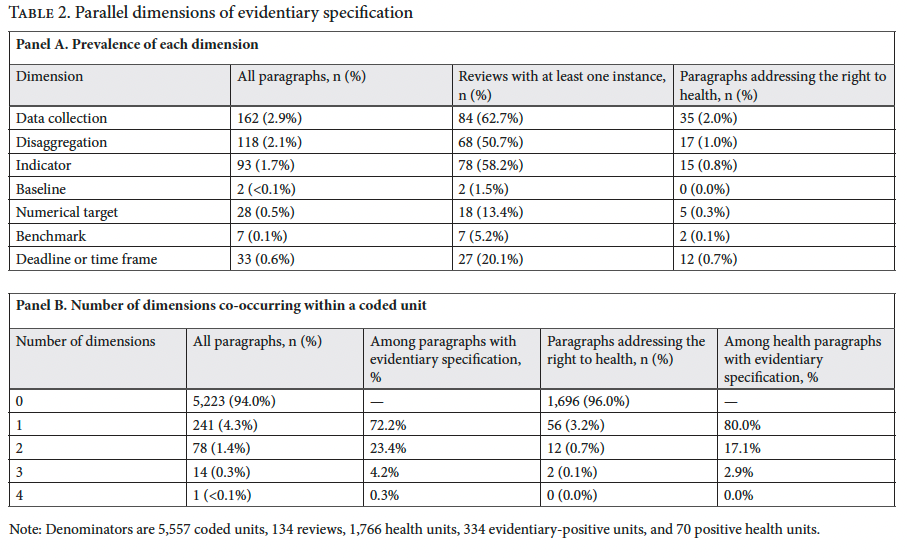
A request for data, an indicator, a benchmark, and a deadline each serve a different purpose in assessing progress, so Table 2 reports the seven dimensions side by side rather than as levels of strength. Paragraphs directly addressing the right to health contain fewer references to data collection, disaggregation, and indicators than the corpus as a whole, and references to the rarest dimensions are similarly sparse.
The rare dimensions also occur in substantive recommendations. In its 2022 review of Czechia, the committee called for a deinstitutionalization policy “with a clear time frame and benchmarks,” developed in consultation with persons with disabilities through their representative organizations.[23] A time frame would indicate when change is expected, while benchmarks would establish what change should be achieved; the recommendation asks for both but specifies neither. Such combinations are unusual. Nearly three-quarters of paragraphs containing evidentiary specification, and four-fifths of those directly addressing the right to health, contain a single dimension (Table 2). The typical paragraph containing specification asks for one kind of evidence—most often data—rather than setting out how progress would be judged.
Where specification sits
The clearest concentration is in the “data, monitoring, and indicators” topic within the General family, where more than half of all paragraphs contain evidentiary language. Because data and monitoring help define that topic, its high rate is partly a result of how the topic is defined. Outside this topic, the leading topics in the General family contain little explicit specification, as do direct-health topics. Within the Determinants family, broader evidentiary language is somewhat more common in “housing” and in “food and nutrition” (Table 3).
Locating the General–Health contrast
In the full comparison, paragraphs in the General family have higher odds of measurement specification than paragraphs in the Health family (OR 2.55, 95% CI 1.58–4.12). The same is true for evidentiary specification (OR 2.16, 95% CI 1.49–3.12). The contrast is concentrated in two parts of the text. The standing closing section contains 50 of the 51 recorded indicator clauses, which address covenant implementation as a whole without naming any health indicator, benchmark, or disaggregation. Excluding that section attenuates the measurement contrast to OR 1.51 (95% CI 0.83–2.75), while the broader evidentiary contrast remains detectable (OR 1.90, 95% CI 1.26–2.87). When the “data, monitoring, and indicators” topic is excluded, measurement rates are 1.8% in both the General and Health families, and neither composite shows a statistically detectable contrast. When both the standing closing section and the “data, monitoring, and indicators” topic are excluded, neither composite shows a statistically detectable General–Health contrast.
The apparent advantage of the General family thus largely reflects its composition, particularly the standing closing clauses and recommendations about data. Outside these, the General and Health families are similarly sparse, though not shown to be equivalent.
Recommendations selected for follow-up
Under a procedure adopted in 2017, the committee may select up to three urgent recommendations and request information on their implementation within 18 months, a reporting deadline that was extended to 24 months in 2018.[24] A follow-up request appears in the coded text of 48 of the 82 reviews adopted from 2017 onward. Of these 48 reviews, 47 contain traceable paragraph references, and in 33 at least one selected recommendation can be matched exactly to a coded substantive recommendation. The comparison is limited to follow-up recommendations that can be matched unambiguously to coded substantive units: One request lacks traceable paragraph references, and some selected recommendations either fall outside the health-related corpus or are combined with unselected sub-items in a single coded unit.
In those 33 reviews, none of the 73 coded paragraphs matching selected recommendations contains references to indicators, benchmarks, targets, or time frames, and only one asks for data. Among the other substantive recommendations in those reviews, 1.5% contain measurement language and 5.0% contain some evidentiary language. Because the subset is small and covers only selected recommendations represented in the coded corpus, it cannot show an effect of selection. Nevertheless, in these reviews, the matched follow-up recommendations are no more explicit than others about the evidence by which progress would be judged. An examination of how the committee subsequently assessed states’ replies is beyond the scope of this study, which is limited to concluding observations. Coding those assessments against the criteria specified in the selected recommendations would be a natural next step.
Where the committee’s own concern supplies a number
The text alone cannot establish how many recommendations warranted a benchmark, since that depends on the obligation and the state’s circumstances. One situation, however, makes a possible baseline readily available: when a recommendation immediately follows a concern reporting a percentage or population rate. Of 103 such recommendations, 91 contain none of the seven forms of specification. Both composites are more frequent in these recommendations than in other recommendations outside the closing section (measurement specification, 7.8% versus 2.2%; evidentiary specification, 11.7% versus 7.0%), yet only eight of the 103 contain measurement language. Even where the committee’s own concern supplies a possible baseline, the recommendation seldom specifies what change would count as progress.
Temporal patterns and changing closing-section practice
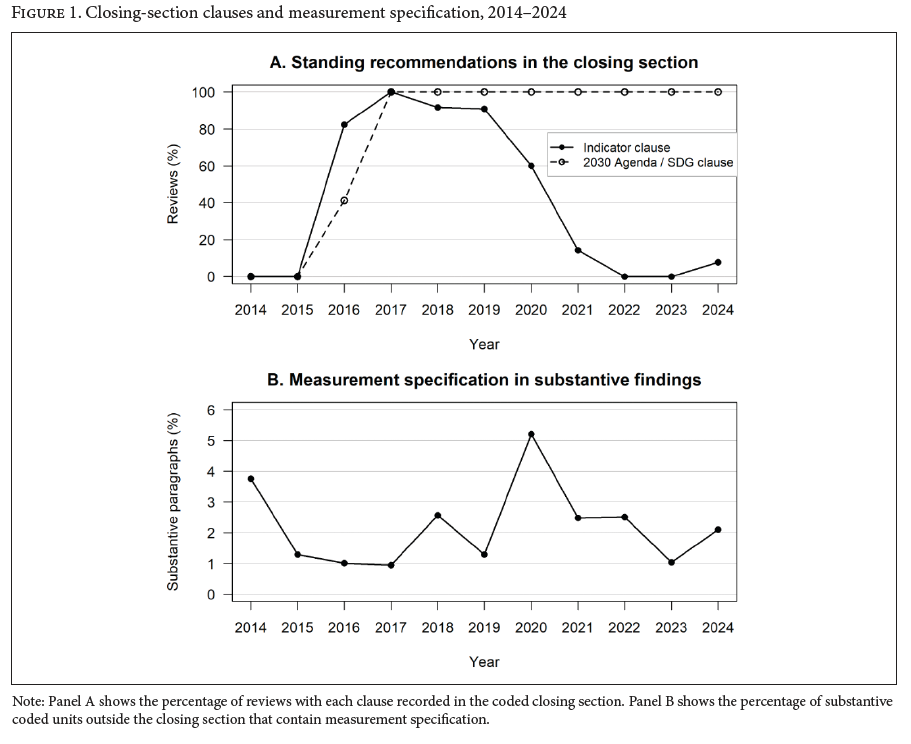
At the paragraph level, measurement specification declines over the study period across the corpus (OR per year 0.93, 95% CI 0.89–0.98). Outside the closing section, the measurement association is close to null (OR 1.00, 95% CI 0.93–1.08), and the other substantive and direct-health models likewise detect no clear trend. The absence of a trend is not proof of invariance, but the equivalence test (p = .036 and .032) rules out a halving or doubling of the odds over 2014–2024, though not smaller changes. In reconstructed directive units, even the decline observed in the full corpus is no longer statistically detectable (OR 0.97, 95% CI 0.92–1.02).
The change in the closing section is far easier to see (Figure 1). The standard indicator clause is absent at the start of the period, appears in most reviews from 2016 to 2019, and then recedes, reappearing in a single 2024 review after two years in which it was not recorded. Meanwhile, the formulation linking the covenant to the 2030 Agenda and the Sustainable Development Goals (SDGs) appears in every review from 2017 onward. For several years, the two formulations appear side by side. In its 2018 review of Argentina, the committee observes that the SDGs would be advanced by “independent mechanisms to monitor progress” and, in the next paragraph, asks the state to “develop and apply appropriate indicators” for covenant implementation.[25] The sequence reflects a change in drafting but does not establish deliberate substitution. The committee has not stopped asking states to monitor progress; rather, its standing closing recommendations now seldom call explicitly for indicators of covenant implementation.
Discussion
What the gap means for accountability
The periodic review is structured as a loop: The state reports, the committee assesses and recommends, and the next report is supposed to show what changed. The loop closes most easily when the recommendation specifies what would count as implementation. A recommendation to strengthen mental health services leaves the form of supporting evidence open; one to report community-based service coverage against a baseline, disaggregated by region, within a stated period, identifies the evidence expected. Morocco’s 2015 review illustrates this difference. The committee expressed concern that 55% of rural women reportedly received qualified assistance at birth, compared with 92% of urban women. The recommendation seeks universal access to “high-quality sexual and reproductive facilities, services, materials and information, particularly in rural areas,” and also asks the state to repeal its law prohibiting abortion.[26] The legal change is directly verifiable. The service recommendation sets a direction, and the concern supplies a comparison, but the recommendation does not specify the measure or time frame for assessing progress in closing that disparity. States are told what to do; they are seldom told what evidence would show that it has been done.
A recommendation that states its evidentiary basis gives the domestic and transnational actors who mobilize around it a common reference for judging progress—one that does not require them to infer the criterion from its context, the wider legal framework, or later reporting.[27]
Follow-up brings the issue into focus. The committee assesses replies using categories that distinguish between sufficient progress, insufficient progress, and information insufficient for assessment.[28] In its 2023 review of France, the committee selected for follow-up a recommendation calling for hospitals to have “sufficient numbers of health professionals and other qualified medical staff.”[29] The obligation has a clear direction; the selected clause leaves the operational criterion of sufficiency unstated. Leaving the criterion open may affect who defines the evidence used to assess progress. When a recommendation does not indicate what progress would look like, the state’s reply may largely determine the evidence available to the committee when it classifies progress, and civil society has no explicit operational criterion in the recommendation against which to contest that reply. The remedy, however, is not to narrow follow-up to easily counted acts. O’Flaherty warns that excluding long-term policy or legislative measures through an unduly restrictive notion of implementability would confine treaty bodies to palliative responses.[30]
Specificity, flexibility, and changing drafting practice
The disappearance of the clause has several possible explanations, none of which are tested here. Word limits may have rewarded compression; the COVID-19 pandemic may have disrupted committee sessions as the clause was disappearing; drafting practices may vary among rapporteurs; and a body wary of audit-like reliance on indicators may retreat from measurement language without institutionalizing an alternative. Nor does a lexical comparison establish the rigor, rights orientation, or effectiveness of SDG monitoring.
The reform debate has long distinguished specificity from quantification, as demonstrated by the 2014 framework agreed on by the treaty body chairs.[31] Krommendijk’s case for fewer, more focused concluding observations that are specific, measurable, achievable, relevant, and time-bound likewise acknowledges the limitations of a one-size-fits-all model and notes that reporting delays can leave information outdated by the time of review.[32] Because several years separate successive reviews, and political, economic, epidemiological, or humanitarian circumstances may change sharply between them, it is often more useful to specify a baseline, a direction of change, or a point at which progress will be reviewed than to establish a fixed endpoint in advance.
Read against the critical indicator literature, the committee’s sparse evidentiary language has two faces. It may avoid false precision and preserve room for contextual legal judgment. Davis, Kingsbury, and Merry show how indicators can shape the distribution of authority.[33] We extend this concern to recommendations that leave their evidentiary basis unspecified. Such openness may give actors at later stages of review, including the state, greater scope to determine what evidence is presented. The present analysis identifies this possibility without tracing those choices. The issue is thus where evidentiary choices become visible and contestable, and who participates in making them.
This trade-off is particularly relevant to complex health interventions such as health system strengthening, institutional reform, trust-building, and action on structural determinants. Guidance on evaluating complex interventions stresses context, implementation processes, adaptation, and the use of qualitative and mixed methods to address questions beyond effectiveness.[34] For treaty monitoring, this suggests prioritizing evidence suited to the intervention rather than fixing a single numerical endpoint in advance.
What could change
The remedy does not require a new doctrine. It simply requires the committee to use the instruments available to it since 2000, in proportion to the obligation at stake. A legal act may supply its own basis for assessment, changes in coverage or inequalities may need a baseline or comparator, and complex reforms may call for process evidence. The scoping idea of General Comment 14 could be revived in modest form. One measurable commitment per review, agreed in the dialogue and carried into follow-up, would generate more benchmark language in a typical year than appeared over the entire study period.
The covenant’s own structure suggests where explicit evidence matters most. Progressive realization and non-retrogression are claims about change over time, which can be assessed most readily against a baseline; nondiscrimination is a claim about differences between groups, made visible through disaggregated evidence. General Comment 14’s scoping logic is useful in this narrower sense because it ties indicators and benchmarks to the right and to the state’s circumstances rather than to a universal metric.[35] Where the committee’s concern already reports a disparity, as in the case of Morocco, the recommendation could specify what change in that disparity would count as progress. Where unequal enjoyment of rights between groups is central, the evidentiary request could call for disaggregation by the relevant prohibited grounds, consistent with the committee’s own guidance on monitoring nondiscrimination.[36] Where SDG indicators align with an obligation, using them could connect the review to existing national monitoring systems, provided that the committee specifies which indicators and forms of disaggregation it wants.
Specification does not require quantification. A named dataset, a defined comparator, and a date are often enough to make a claim of implementation assessable, while leaving the evaluative judgment where it belongs. Merry’s account of the OHCHR indicator project identifies the trade-off: Resisting rankings and excessive simplification can make a framework less immediately communicable while preserving the multidimensional character of rights assessment.[37] Proportionate specification keeps those judgments visible and allows the evidentiary basis to be revised when circumstances change.
Implications for measurement research
The study also shows why a “measurement gap” needs an explicit definition. Data requests, disaggregation, targets, benchmarks, and time frames perform different functions; collapsing them into an ordinal score would impose a hierarchy the analysis cannot justify.[38] Human rights measurement has been criticized for opaque coding and unverifiable claims. The answer here is an open corpus with a published codebook and fixed expressions, explicit reporting of reliability results, and transparent treatment of interpretive doctrinal categories with low inter-coder agreement as exploratory, rather than as a basis for the paper’s principal claims.
Limitations
Concluding observations are one part of a longer exchange. State reports, lists of issues, dialogue records, follow-up replies, the committee’s assessments of those replies, and implementation outcomes were not coded. Thus, silence in a concluding observation does not establish silence in the review as a whole. Nor can the study show whether specification improved domestic implementation, which other research has linked to institutions, political context, and mobilization.[39] Because the selection of paragraphs was based on their relevance to health, the findings do not describe all substantive covenant rights. Some closing sections are only partly coded, so closing-clause counts represent lower bounds. The contextual comparisons cannot establish how many recommendations required a benchmark.
Coding used English-language versions. Fixed expressions can miss equivalent wording, a limitation that the paraphrase check addresses only within the scope of its own net, and can also match wording that does not carry the intended meaning in context. Primary coding was done by a single coder; the independent recoding sample predates the corpus correction and tests coding consistency within the sampled material, not selection completeness or independent reliability in the subsequently added reviews. Finally, using paragraphs as the unit of analysis severs argumentative chains that span multiple paragraphs, a limitation accepted for the sake of reproducibility and checked by reconstructing directive units.
Conclusion
CESCR wrote the case for measurable accountability for the right to health into its own general comment a generation ago, and the surrounding field has spent that generation building the tools. Yet the committee’s practice between 2014 and 2024 reveals a gap between the two. Explicit evidentiary language, though present in most reviews, appears in only a small share of paragraphs. Most such language clusters in standard closing clauses and in recommendations about data; the doctrinal vocabulary that would give indicators their legal meaning rarely appears in country-specific recommendations; and the standard clause that carried indicator language into most reviews between 2016 and 2019 has all but disappeared, with no obligation-specific clause taking its place. Substantive recommendations concerning health and related rights seldom identify the parameters by which progress would be judged, even when they are selected for follow-up or immediately follow a concern reporting a figure. The gap is less a decline to be reversed than a drafting practice that could be changed.
The finding concerns how rarely the committee outlines its evidentiary expectations, not whether its recommendations can be assessed at all.
Read together, scholarship on the use of concluding observations and critical work on indicators support evidentiary clarity proportionate to the obligation, while allowing room for contestation and changing circumstances.[40]
The significance extends beyond CESCR and the right to health. The 2014 framework on concluding observations addresses treaty bodies that conduct periodic reporting reviews, and several committees use comparable follow-up procedures and SDG-linked closing recommendations. Coding their concluding observations in the same way, with attention to thematic selection and document structure, would show whether low evidentiary density is characteristic of the treaty body genre or specific to this committee’s drafting. For monitoring tools such as the CEDAW Index, specificity in concluding observations can clarify the recommendations to be tracked alongside evidence from state and civil society reports. A body that asks states to govern by evidence can reasonably be asked to say, where it matters, what evidence its own findings require.
Acknowledgments
Mohamed Saddiki independently recoded the reliability sample. Charafat Afailal and Santiago Manuel Fiorio Vaesken, members of the Committee on Economic, Social and Cultural Rights, reviewed purposively selected coded paragraphs and provided interpretive comments; they bear no responsibility for the analysis or conclusions.
Disclaimer
The database and codebook are deposited openly.[41] They were developed within the first author’s doctoral thesis, originally in Arabic, titled The Actualization of the Right to Health in Morocco: From Legal Obligation to Accountability Indicators (Mohammed V University, 2026); this paper reports one analysis from that resource.
Declaration of generative AI and AI-assisted technologies
Generative AI tools (Anthropic, Claude Opus) were used for language editing, proofreading, and limited assistance in reviewing and correcting coding errors. All analyses, code, data processing decisions, interpretations, and conclusions were performed and verified by the authors, who remain fully responsible for the manuscript.
Omar Ouakkad, PhD, is a part-time lecturer in the Faculty of Legal, Economic and Social Sciences–Agdal, Mohammed V University, Rabat, Morocco.
Abdelali Hamidine, PhD, is a professor of constitutional law and political science at Mohammed V University, Rabat, Morocco.
Please address correspondence to Omar Ouakkad. Email: omar.ouakkad@um5r.ac.ma.
Competing interests: None declared.
Copyright © 2026 Ouakkad and Hamidine. This is an open access article distributed under the terms of the Creative Commons Attribution-Noncommercial License (http://creativecommons.org/licenses/by-nc/4.0/), which permits unrestricted noncommercial use, distribution, and reproduction in any medium, provided the original author and source are credited.
References
[1] Committee on Economic, Social and Cultural Rights, General Comment No. 14, UN Doc. E/C.12/2000/4 (2000), paras. 43(f), 57–58.
[2] Office of the United Nations High Commissioner for Human Rights, Human Rights Indicators: A Guide to Measurement and Implementation (2012); S. Fukuda-Parr, T. Lawson-Remer, and S. Randolph, Fulfilling Social and Economic Rights (Oxford University Press, 2015), pp. 19–20, 40–42; Center for Economic and Social Rights, The OPERA Framework (2012).
[3] A. Rosga and M. L. Satterthwaite, “The Trust in Indicators: Measuring Human Rights,” Berkeley Journal of International Law 27/2 (2009); S. E. Merry, The Seductions of Quantification (University of Chicago Press, 2016), pp. 11–12, 19–21, 218–220; K. E. Davis, B. Kingsbury, and S. E. Merry, “Indicators as a Technology of Global Governance,” Law and Society Review 46/1 (2012).
[4] O. Ouakkad, CESCR Concluding Observations Coding Database (2014–2024): Right to Health, Health Determinants, and General ESR Notes (Zenodo, 2026), https://doi.org/10.5281/zenodo.23260540.
[5] International Law Association, Committee on International Human Rights Law and Practice, Final Report on the Impact of Findings of the United Nations Human Rights Treaty Bodies (2004), paras. 15–19; H. Keller and G. Ulfstein, “Introduction,” in H. Keller and G. Ulfstein (eds), UN Human Rights Treaty Bodies: Law and Legitimacy (Cambridge University Press, 2012), pp. 3–4, 6.
[6] International Covenant on Economic, Social and Cultural Rights, G.A. Res. 2200A (XXI) (1966), art. 12.
[7] Committee on Economic, Social and Cultural Rights (2000, see note 1), paras. 57–58; Committee on Economic, Social and Cultural Rights, Guidelines on Treaty-Specific Documents to Be Submitted by States Parties Under Articles 16 and 17 of the International Covenant on Economic, Social and Cultural Rights, UN Doc. E/C.12/2008/2 (2009), annex, paras. 3(b), 3(g).
[8] United Nations, Concluding Observations: Note by the Secretariat, UN Doc. HRI/MC/2014/2 (2014), paras. 22–23, 33(d)(iii).
[9] Report of the Chairs of the Human Rights Treaty Bodies on Their Twenty-Sixth Meeting, UN Doc. A/69/285 (2014), paras. 102–106 and annex II; United Nations, Implementation by Treaty Bodies of the Conclusions and Recommendations of the Treaty Body Chairpersons at Their Twenty-Sixth Meeting, UN Doc. HRI/MC/2015/2 (2015), paras. 27–30, 35; United Nations General Assembly, Strengthening and Enhancing the Effective Functioning of the Human Rights Treaty Body System, UN Doc. A/RES/68/268 (2014), para. 6.
[10] G. de Beco, “Human Rights Indicators for Assessing State Compliance with International Human Rights,” Nordic Journal of International Law 77/1–2 (2008); A. R. Chapman, “A ‘Violations Approach’ for Monitoring the International Covenant on Economic, Social and Cultural Rights,” Human Rights Quarterly 18/1 (1996).
[11] Office of the United Nations High Commissioner for Human Rights (see note 2); Fukuda-Parr et al. (see note 2), pp. 19–20, 40–42; Center for Economic and Social Rights (see note 2).
[12] A. R. Chapman, “The Problems with the Proposed Indicators for Monitoring Universal Health Coverage in the Sustainable Development Goals,” Health and Human Rights (March 17, 2016), https://www.hhrjournal.org/2016/03/17/the-problems-with-the-proposed-indicators-for-monitoring-universal-health-coverage-in-the-sustainable-development-goals/; C. Gianella, R. Iguiniz-Romero, M. J. Romero, and J. Gideon, “Good Health Indicators Are Not Enough: Lessons from COVID-19 in Peru,” Health and Human Rights 22/2 (2020).
[13] J. Shanthosh, G. White, E. Feeny, et al., “Women’s Rights and Gender Equality: A Global Index to Monitor Government Action,” Health and Human Rights 28/1 (2026), p. 72; R. Turkie and P. Parwani, “Deepening Accountability: The Fair Pharma Scorecard and Access to Medicines in a Fragmented Global Health Law Landscape,” Health and Human Rights 27/2 (2025), p. 80.
[14] Davis et al. (see note 3), pp. 80–81.
[15] Merry (see note 3), pp. 164, 186–187.
[16] Rosga and Satterthwaite (see note 3).
[17] M. O’Flaherty, “The Concluding Observations of United Nations Human Rights Treaty Bodies,” Human Rights Law Review 6/1 (2006), pp. 37–38, 47–48, 51–52.
[18] J. Krommendijk, “The Domestic Effectiveness of International Human Rights Monitoring in Established Democracies: The Case of the UN Human Rights Treaty Bodies,” Review of International Organizations 10/4 (2015), pp. 499–500, 507–508; J. Krommendijk, “Less Is More: Proposals for How UN Human Rights Treaty Bodies Can Be More Selective,” Netherlands Quarterly of Human Rights 38/1 (2020), pp. 8–10.
[19] C. D. Creamer and B. A. Simmons, “The Proof Is in the Process: Self-Reporting Under International Human Rights Treaties,” American Journal of International Law 114/1 (2020), pp. 24–25, 36–40; A. E. Yamin, “Beyond Compassion: The Central Role of Accountability in Applying a Human Rights Framework to Health,” Health and Human Rights 10/2 (2008).
[20] B. M. Meier, M. De Milliano, A. Chakrabarti, and Y. Kim, “Accountability for the Human Right to Health Through Treaty Monitoring: Human Rights Treaty Bodies and the Influence of Concluding Observations,” Global Public Health 13/11 (2018), pp. 1562–1564; Merry (see note 3), pp. 200–203.
[21] Committee on Economic, Social and Cultural Rights (2000, see note 1), paras. 57–58.
[22] J. Cohen, “A Coefficient of Agreement for Nominal Scales,” Educational and Psychological Measurement 20/1 (1960); J. R. Landis and G. G. Koch, “The Measurement of Observer Agreement for Categorical Data,” Biometrics 33/1 (1977), p. 165; K. Krippendorff, Content Analysis: An Introduction to Its Methodology, 4th edition (SAGE, 2018).
[23] Committee on Economic, Social and Cultural Rights, Concluding Observations on the Third Periodic Report of Czechia, UN Doc. E/C.12/CZE/CO/3 (2022), para. 43(a).
[24] Committee on Economic, Social and Cultural Rights, Note on the Procedure for Follow-Up to Concluding Observations, UN Doc. E/2018/22-E/C.12/2017/3 (2018), annex I, paras. 4–5, 11; Committee on Economic, Social and Cultural Rights, Report on the Sixty-Third and Sixty-Fourth Sessions, UN Doc. E/2019/22-E/C.12/2018/3 (2019), para. 36 and annex I, para. 4.
[25] Committee on Economic, Social and Cultural Rights, Concluding Observations on the Fourth Periodic Report of Argentina, UN Doc. E/C.12/ARG/CO/4 (2018), paras. 65–66.
[26] Committee on Economic, Social and Cultural Rights, Concluding Observations on the Fourth Periodic Report of Morocco, UN Doc. E/C.12/MAR/CO/4 (2015), paras. 45–46.
[27] O’Flaherty (see note 17), pp. 37–38; Krommendijk (2015, see note 18), pp. 507–508.
[28] Committee on Economic, Social and Cultural Rights (2018, see note 24), annex I, para. 11.
[29] Committee on Economic, Social and Cultural Rights, Concluding Observations on the Fifth Periodic Report of France, UN Doc. E/C.12/FRA/CO/5 (2023), paras. 49(b), 65.
[30] O’Flaherty (see note 17), p. 48.
[31] Report of the Chairs (see note 9).
[32] Krommendijk (2020, see note 18), pp. 8–10.
[33] Davis et al. (see note 3), pp. 80–81; Merry (see note 3), pp. 11–12, 19–21, 219–220; Rosga and Satterthwaite (see note 3).
[34] K. Skivington, L. Matthews, S. A. Simpson, et al., “A New Framework for Developing and Evaluating Complex Interventions: Update of Medical Research Council Guidance,” BMJ 374 (2021), n2061, pp. 2, 4–7.
[35] Committee on Economic, Social and Cultural Rights (2000, see note 1), paras. 57–58.
[36] Committee on Economic, Social and Cultural Rights, General Comment No. 20, UN Doc. E/C.12/GC/20 (2009), paras. 8(b), 41.
[37] Merry (see note 3), pp. 205–206.
[38] Davis et al. (see note 3); Rosga and Satterthwaite (see note 3).
[39] Krommendijk (2015, see note 18).
[40] O’Flaherty (see note 17), pp. 47–48, 51–52; Krommendijk (2015, see note 18), pp. 507–508; Krommendijk (2020, see note 18), pp. 8–10; Rosga and Satterthwaite (see note 3); Merry (see note 3), pp. 11–12, 19–21.
[41] Ouakkad (see note 4).