

Are Opioid Settlement Funds Underwriting the US Surveillance State?
VIEWPOINT
Roxanne Saucier, Diederik Lohman, and Kasia Malinowska
Companies accused of catalyzing the United States’ overdose crisis are paying nearly US$60 billion dollars in settlements to jurisdictions across the country for “opioid abatement.”[1] Appropriately, many localities choose to spend this money on improving drug treatment services, introducing or expanding harm reduction programs, and undertaking other interventions that mitigate harm associated with drug use and excessive drug enforcement.[2] But states also steer it toward law enforcement and carceral structures that criminalize people who use drugs, which can drive people underground, away from the very services these dollars should support.[3] In a worrying trend, a growing number of places are equipping these law enforcement agencies with technologies such as Flock cameras, drones, and tools to unlock personal electronic devices—equipment that may be used not just for drug enforcement but also for broader public surveillance and law enforcement efforts. Routing settlement money toward agencies responsible for many of the excesses of war on drugs—racially biased enforcement, overincarceration, and more—and empowering them to conduct mass surveillance raises profound health and human rights concerns. US states should adopt clear guidance on the use of opioid settlement funds to preclude perpetuating the drug war or advancing a surveillance state.
What are opioid settlement funds?
The “opioid settlements” represent a collection of legal settlements between states, counties, cities, and a growing number of pharmaceutical companies, distributors, marketers, and others that worsened the US overdose epidemic that has caused more than a million preventable deaths since the start of this century.[4] Initial payments began in 2021 and will be disbursed for at least the next dozen years.[5]
Unlike some other legal settlements, where individuals receive payouts, in this case defendants pay thousands of local jurisdictions, with county commissioners and city council members typically making spending decisions. There is a broad sentiment that leaders should use these funds to heal the harms of drug use and the drug war, given the many deaths that gave rise to the settlements.[6] Indeed, they are a unique opportunity to change the US approach to substance use disorder from one of criminalization and punishment to one that respects rights and advances health.[7]
With thousands of jurisdictions making their own rules on opioid settlement spending—and many decision-makers having little prior knowledge about what works to address substance use disorders—there is wide divergence in spending. The national opioid settlement agreements contain a 15-page list of allowable uses of funds, which identifies as core strategies investments in harm reduction, evidence-based treatment and prevention, recovery support services, and data collection.[8] Most states follow this list, but it is not exhaustive, meaning that local jurisdictions can spend funds on other “opioid abatement” uses.
Opioid settlement spending on surveillance technologies
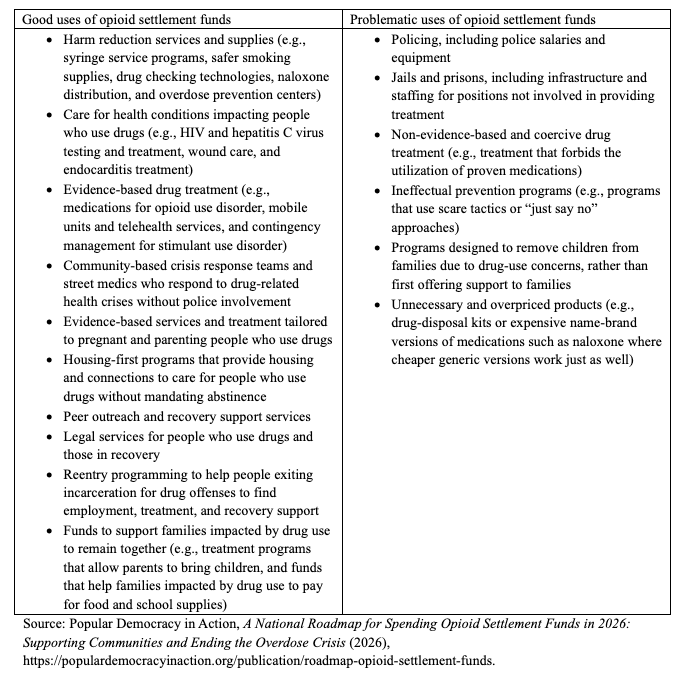
For several years, a coalition of grassroots organizations has published the National Roadmap for Opioid Settlement Funds, a yearly report that recommends which programs should and should not be funded and includes an appendix of good and problematic spending from the prior year (see Table 1).[9] The roadmap documents numerous instances of funds being routed to prisons, jails, and law enforcement, including, increasingly, for new surveillance technologies. Jurisdictions—such as Franklin County, Illinois; Ohio County, West Virginia; and Terrebonne Parish, Louisiana—have spent large amounts on Flock cameras and other automated license plate readers (ALPRs).[10] These cameras capture images of passing vehicles and use artificial intelligence to analyze those images without a warrant or probable cause, often sharing that information with networks of other local departments across the country as well as myriad federal agencies.[11] Boulder County, Colorado, and Franklin County, Tennessee, have used opioid settlement funds for Cellebrite and Graykey, technologies that help law enforcement bypass security on an electronic device to extract and analyze data.[12] Some police departments—such as in Amherst County, Virginia, and Monroe County, West Virginia—have used the funds to purchase drones.[13]
TABLE 1. Good and problematic uses of opioid settlement funds
Police departments contend that these technologies enhance drug investigations.[14] Once installed, however, cameras undoubtedly are not used only for drug enforcement and may also be used to infringe on the civil rights of other populations. Watchdog groups have raised alarms about Immigration and Customs Enforcement (ICE) and Customs and Border Protection using ALPR cameras to pursue immigrants without warrants.[15] In one case, police used the cameras to target a man who had written an op-ed criticizing local police for collaborating with ICE.[16] ALPRs could similarly have implications for reproductive rights: A Texas sheriff used Flock camera networks to track a woman across state lines to try to enforce Texas’s abortion ban following her self-managed abortion.[17] A Washington Post investigation suggests that civil rights violations involving ALPRs happen at a concerning scale, finding that “authorities have charged or accused at least 50 law enforcement officers of using license plate readers for unauthorized purposes, including to stalk women without their knowledge or consent.” [18] In the absence of federal or consistent state laws governing the use of these cameras, many more cases may go unreported and uninvestigated.
Conclusion
Opioid settlement funds are meant to address drug-related harms. Yet a growing portion of that money goes not just to law enforcement agencies but to equipping them with surveillance technologies that have little or no relationship to “opioid abatement” and may be used to infringe on civil rights more broadly. It is imperative that localities steer funds toward programs that work, such as harm reduction and treatment, especially given that they remain grossly underfunded.[19]
Some states, including Indiana, Kansas, Massachusetts, Michigan, and South Carolina, have introduced limits on using settlement funds for technologies such as cell phone extraction software, drones, and license plate cameras.[20] States should adopt or broaden lists of unallowable expenditures, and attorneys general and comptrollers should take a greater role in auditing spending to ensure that opioid settlement funds are not misused.
In addition, civil society must play a vital role. Advocates supporting the health and rights of people who use drugs should connect with defenders of civil liberties, reproductive health advocates, and domestic violence survivors to demand greater transparency around opioid settlement spending and speak out against their use for law enforcement and surveillance technologies.
The drug war often serves as a proving ground—a space to audition new technologies or tactics on a population that society sometimes deems less worthy of concern. But these tactics rarely remain limited to this population and may be especially harmful in the era of artificial intelligence. If we are not watchful, opioid settlement funds may be a boon to the surveillance state.
Roxanne Saucier, MPH, is a principal consultant at Surya Consulting, North Carolina, United States.
Diederik Lohman, MSPH, MA, is an independent health and human rights consultant.
Kasia Malinowska, DrPH, is the director of Advancing Global Drug Policy Reform at Open Society Foundations.
Please address correspondence to Roxanne Saucier. Email: saucier.roxanne@gmail.com.
Competing interests: None declared.
Copyright © 2026 Saucier, Lohman, and Malinowska. This is an open access article distributed under the terms of the Creative Commons Attribution-Noncommercial License (http://creativecommons.org/licenses/by-nc/4.0/), which permits unrestricted noncommercial use, distribution, and reproduction in any medium, provided the original author and source are credited.
References
[1] Opioid Settlement Tracker, “Global Settlement Tracker,” https://www.opioidsettlementtracker.com/globalsettlementtracker.
[2] “Payback: Tracking the Opioid Settlement Cash,” KFF Health News, https://kffhealthnews.org/opioid-settlements/.
[3] Ibid.
[4] B. Mann, “More Than a Million Americans Have Died from Overdoses During the Opioid Epidemic,” NPR (December 30, 2021), https://www.npr.org/2021/12/30/1069062738/more-than-a-million-americans-have-died-from-overdoses-during-the-opioid-epidemi.
[5] Plaintiff’s Executive Committee, “National Opioids Settlements,” https://nationalopioidsettlement.com/.
[6] Popular Democracy in Action, A National Roadmap for Spending Opioid Settlement Funds in 2026: Supporting Communities and Ending the Overdose Crisis (2026), https://populardemocracyinaction.org/publication/roadmap-opioid-settlement-funds/.
[7] J. S. Sorensen, “America’s Opioid Epidemic: A Rights-Based Approach,” Health and Human Rights (January 8, 2019), https://www.hhrjournal.org/2019/01/08/americas-opioid-epidemic-a-rights-based-approach/.
[8] Plaintiff’s Executive Committee, “Exhibit E: List of Opioid Remediation Uses,” https://nationalopioidsettlement.com/wp-content/uploads/2023/02/TEVA-Exhibit-E.pdf.
[9] Ibid.
[10] Franklin County Board (Illinois), Minutes of Meeting (April 21, 2025), https://franklincountyil.gov/wp-content/uploads/2022/07/Apr-21st-Regular-County-Board-Meeting-Minutes.pdf; D. Redd, “Ohio County Commissioners Approve Opioid Funding for License Plate Readers,” Intelligencer (September 17, 2025), https://www.theintelligencer.net/news/community/2025/09/ohio-county-commissioners-approve-opioid-funding-for-license-plate-readers/; A. Pattani, “A State Gave Sheriffs 20% of Its Opioid Settlement Cash. We Followed the Money,” KFF Health News (August 27, 2026), https://kffhealthnews.org/public-health/louisiana-sheriffs-opioid-settlement-spending-addiction-law-enforcement/.
[11] J. Koebler, “How Cities Are Forced to Funnel License Plate Data to a Massive Federal Surveillance Program,” 404 Media (September 30, 2026), https://www.404media.co/how-cities-are-forced-to-funnel-license-plate-data-to-a-massive-federal-surveillance-program-hidta/.
[12] VOCAL-US, A Roadmap for Opioid Settlement Funds: Supporting Communities and Ending the Overdose Crisis (2023), https://www.vocal-ny.org/wp-content/uploads/2023/08/A-Roadmap-for-Opioid-Settlement-Funds-Final-Updated.pdf; Franklin County Commission (Tennessee), Regular Session, Franklin County Commission Meeting (November 24, 2025), https://www.franklincotn.us/assets/pdfs/agendas_minutes_commission/minutes/2025/11242025.pdf.
[13] Amherst County Board of Supervisors (Virginia), “VA Opioid Abatement Funds Expenditure Proposals,” agenda item VIII.C (April 1, 2025), https://amherstcova.portal.civicclerk.com/event/2481/files/report/7405; “Monroe County Commission Enhances Sheriff’s Office Capabilities with Advanced Drone Technology Funded by Opioid Settlement Funds,” West Virginia Daily News (May 29, 2025), https://wvdn.com/164822/.
[14] S. Mitchell, “Police Are Spending Opioid Settlement Funds on Flock Cameras,” Mother Jones (August 27, 2026), https://www.motherjones.com/politics/2026/08/police-opioid-funding-flock-alpr-camera-surveillance-tech/.
[15] American Civil Liberties Union, “Fight Creepy ALPR Cameras” (last updated October 6, 2026), https://www.aclu.org/campaigns-initiatives/get-the-flock-out.
[16] J. Stanley, “Kansas Town Uses License Plate Readers to Go After Man Who Wrote Op-Ed,” American Civil Liberties Union (February 3, 2026), https://www.aclu.org/news/privacy-technology/tracking-alpr-cameras/alpr-against-op-ed-writer.
[17] D. Maass and R. Alajaji, “Flock Safety and Texas Sheriff Claimed License Plate Search Was for a Missing Person. It Was an Abortion Investigation,” Electronic Frontier Foundation (October 7, 2025), https://www.eff.org/deeplinks/2025/10/flock-safety-and-texas-sheriff-claimed-license-plate-search-was-missing-person-it.
[18] D. Harwell, D. MacMillan, and A. Schaffer, “How Rogue Officers Turned a Nationwide Camera Network into a Tool for Stalking,” Washington Post (August 2, 2026), https://www.washingtonpost.com/technology/2026/08/02/how-police-officers-used-vast-network-cameras-spy-their-exes/.
[19] B. Saloner and P. Lagisetty, “The Opioid Crisis: Scaling Up Treatment and Harm Reduction Programs to Reach More People Who Would Benefit,” Health Affairs 44/9 (2025).
[20] J. J. K. Stoltman and A. Peterson, Stop Wasting Opioid Settlement Money: Best Practices for Building Unallowable Opioid Settlement Spending Guidance (Opioid Policy Institute, 2026), https://opioidpolicy.org/pdfs/Opioid%20Settlement%20Unallowable%20Spending%20-%202026%20-%20Opioid%20Policy%20Institute.pdf; Michigan Department of Attorney General, “Settlement Spending Guidance and Non-Remediation List” (last revised May 12, 2026), https://www.michigan.gov/ag/initiatives/opioids/opioid-settlement-general-guidance-folder/settlement-spending-guidance-and-non-remediation-list.