

Asking Uncomfortable Questions: Ensuring Human Rights and Upholding the Evidence
Special Section: Health, Rights, and the Future of Global Drug Control
Ann Fordham Interviews Laura Gil
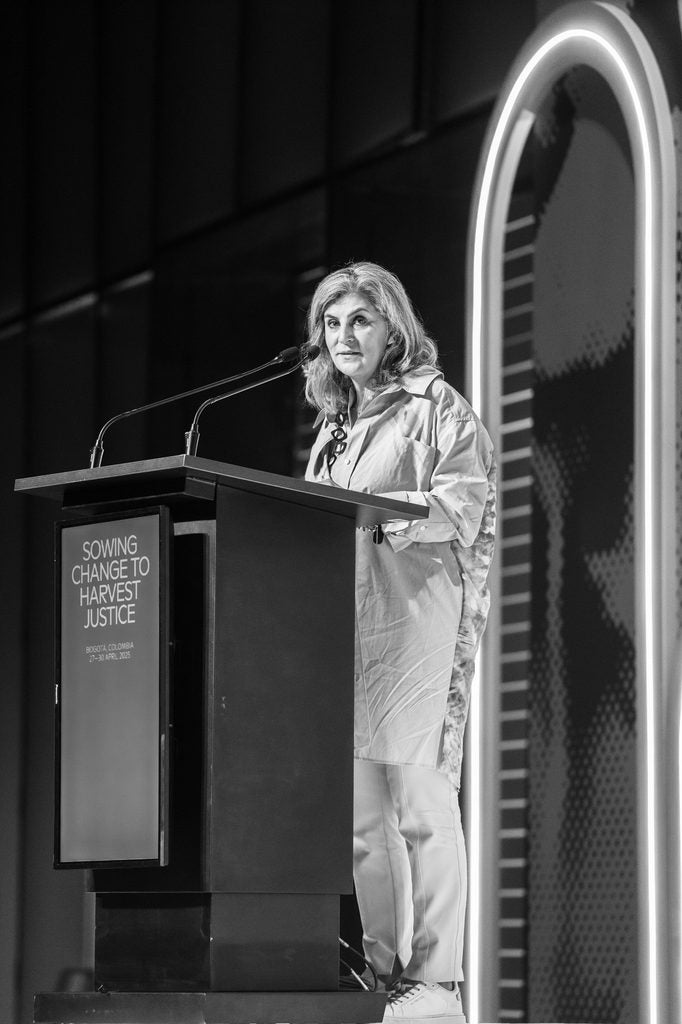
Laura Gabriela Gil Savastano is an internationalist, political scientist, and journalist. She served as Colombia’s vice minister for multilateral affairs (2022–2023) and as ambassador to Austria and permanent representative to the United Nations in Vienna (2023–2025), where she led a landmark resolution to initiate a review of the international drug control regime. She holds degrees from St. John’s College and the Fletcher School at Tufts University. She gave this interview as a former Colombian ambassador to the United Nations.
Photo of Laura Gil by Nigel Brunsdon www.nigelbrunsdon.com
Ann: One of your key achievements as Colombia’s ambassador to the UN in Vienna was to get a resolution at the Commission on Narcotic Drugs, which has established an independent panel of experts to review the functioning of the UN drug control machinery. What was the driving motivation for Colombia to seek a new review?
Laura: Colombia has been the good kid on the block in the drug control regime. We have taken our legal obligations seriously and have made enormous efforts to comply with everything that the international order asked of us, with very little success. Measured by traditional metrics, success has been painfully limited and unsustainable. Despite decades of effort and an extraordinarily high cost in human lives, institutional capacity, security, and the environment, Colombia remains the highest producer of cocaine in the world. It is not a title we carry with pride, but it is a fact. So, that was the driving motivation for Colombia to put on the table the urgent need to assess the system and the approach—what we are doing right and what we are doing wrong within the framework of the drug control regime.
International legal regimes are to be respected, but respect for a legal regime cannot mean that we stop asking whether it is achieving its objectives. It is our duty to ask this question, not just for Colombians but for every single person on the planet. We need to put our heads together and ask ourselves what the best way will be to move forward to guarantee human rights—the right to life, the right to security, the right to health, the right to a healthy environment.
Colombia cannot do this thinking alone because we belong to a community of nations. The only way to move forward is to move forward together. That is why we took this discussion to the multilateral forum of the UN, to the Commission on Narcotic Drugs—because that is where these matters are dealt with and discussed.
Ann: So now the panel has been formed and has begun to meet. In your view, what are the most urgent issues that it should address?
Laura: I think there is an elephant in the room that must be acknowledged. This international legal regime has too many interpretations. These interpretations vary widely, from repressive to liberal. How can a single legal regime accommodate so many different national policies? At both the liberal and repressive ends, countries claim that their policies are based on the global drug policy regime. Of course, there is a margin of discretion for how national policies are to interpret the global norm, but the current widely diverse national approaches show that there is no basic consensus on what the legal regime imposes. I think it’s time for countries to recognize this.
This means that member states have to go back and draft basic agreements. Even if this ultimately doesn’t change the legal regime, we need clear political agreements on two things: first, the priority of truly ensuring the right to health and human rights more broadly over any other consideration, and second, the recognition that any step forward must be based on scientific evidence. The panel has to be ready to ask some uncomfortable questions.
Ann: If the panel is willing to ask uncomfortable questions, what is the one assumption at the center of the international drug control system that it should most urgently challenge?
Laura: The most urgent? It has to challenge the premise that legal regimes cannot be reformed. I think we treat this legal drug control regime as sacred. But even constitutions can be reformed. We should acknowledge that we failed catastrophically at protecting public health and societies from the violence of transnational organized crime while trying to stop the drug trade, and we need to go back to the drafting table.
When we negotiated this Commission on Narcotic Drugs resolution for the panel, we never viewed it as an expressway towards the legal regulation of drugs. We are not suggesting that legal regulation is a blanket answer. We don’t have the answers, but we do have the questions. What we want is for this panel is to ask the questions to the people who can answer them—to scientists rather than to politicians. We think the protection of public health and public order are two legitimate aims that in our view are absolutely reconcilable. The debate needs a little bit more reason and less emotion.
Ann: The preamble of the 1961 Single Convention on Narcotic Drugs indicates that international drug control efforts are driven by a global concern for the health and welfare of humankind. What would fundamentally need to change in the way that governments deal with drugs to genuinely protect, respect, and promote the right to the highest attainable standard of health?
Laura: I would say that we need to move that consideration from the preamble to the heart of the legal agreements. Our talks in Vienna about public health are a salute to the flag. And our debates mimic the ones you see in the news where some make reference to scientific evidence and in the same sentence deny basic scientific facts and data.
We have to go back to basics, and governments need to agree that there is such a thing as scientific findings. It is not for each government to bring their own scientific facts to the table. Of course, science is an evolving discipline, and findings change with time, but there is a basic consensus, a scientific consensus, that we need to go back to. For me, that’s the key to going back to some reasonable discussion on global drug policy.
If you ask me what governments need to agree on, I would answer that one is the pre-eminence of scientific evidence in the debates, and two is the recognition that we’re failing at what we’re doing. I think we do have a broad recognition that we are failing, from the most repressive policies to the most liberal.
Ann: During your time in Vienna, you consistently advocated for the meaningful participation of civil society, affected communities, people who use drugs, and farmers involved in illegal cultivation of drug-linked crops. What advice would you give the independent panel regarding its consultations with civil society?
Laura: I believe the panel should listen to everyone involved: governments, scientists, civil society, affected communities, people who use drugs, farmers who cultivate crops linked to illicit drug markets, and others whose lives are shaped by current drug policies. The guiding principle must be “nothing about us without us.”
In Colombia, we consulted civil society as broadly as possible. Those exchanges were extraordinarily valuable, and they helped build a critical mass of support for reform. If the panel’s report is to have legitimacy and ultimately any real impact, it must demonstrate that it listened widely and did not exclude inconvenient or dissenting voices. Exclusion inevitably undermines legitimacy.
What we need is an intellectually honest panel: one that listens to every side—once again, every side—and assesses what it hears with common sense, scientific rigor, empathy, and sensitivity. That means recognizing the suffering of people exploited by the drug trade, the realities faced by farmers and communities, the experiences of people who use drugs, the serious public health consequences of dependence, and the violence the drug trade brings to our societies.
The panel must also be honest with itself. It must be willing to acknowledge that we are failing. And once its report is published, the rest of us must read it with fresh eyes, not simply judge it against conclusions we had already decided it should reach.
This is an opportunity for a fresh start: a conversation without dividing the world into the good and the bad, or those supposedly on the right side and those on the wrong one. It is an opportunity for a frank and serious discussion.
I know that may sound naïve in today’s deeply polarized international environment. But I still believe sincere debate is possible and that our duty as diplomats is to keep creating the space for it.
The other day, I was walking in Washington, DC, when I saw a man who appeared to be under the influence of some substance, perhaps an opioid. He was clearly in distress and trying to cross the street. I was afraid he might be hit by a car. We followed him for some time because we were genuinely concerned for his safety. That experience brought me back to a fundamental question: What is the best way to protect public health and, above all, to protect this person standing in front of us? I have been thinking a great deal about what we achieved in Vienna and about the work of the independent panel. I do not know whether legal regulation is the answer. What I do know is that we need to be able to have an honest conversation about it, one guided by evidence rather than ideology or predetermined conclusions.
For me, an intellectually honest panel would be able to say, for these substances, the scientific evidence is sufficiently clear; for others, it is not, and we need further research before drawing conclusions. That would be a serious and responsible outcome. We should not pretend to know what we do not know, but neither should we refuse to act on what the evidence already tells us. Seeing that man frightened me for his future. But more than anything, it made me wonder, What could we do that would truly help the man on the street that I saw that day?
Ann: Thank you for sharing that story—it is so illustrative of the current context in which drug policy operates.
For decades, countries like Colombia have been on the frontlines of a global drug control system, shaped by systems and political forces beyond their control. What would change if countries like Colombia were no longer treated as passive sites of implementation but as leading voices in reimagining the system itself?
Laura: I believe we would have a more compassionate system. Colombia has buried far too many people in this war on drugs. We know its human cost, not as an abstraction, but as a lived national experience. That experience would bring greater humanity to the way the international system defines both its policies and its measures of success.
Synthetic drugs have profoundly transformed global drug markets, but they have not transformed perceptions of countries associated with plant-based drugs. Colombia continues to carry the stigma, even though the geography and nature of drug production have changed. We are no longer the leading producer overall: Developed countries now dominate the production of certain drugs. Yet the old labels and the unequal allocation of blame remain largely intact.
Colombia has always tried to play by the book, but we must also be honest: The book is no longer working. It is not working for Colombia, and it is increasingly clear that it is not working for anyone. If countries such as Colombia—countries that have borne the consequences of these policies most directly—had a greater role in leading this debate, I believe the drug control regime would become more practical, more pragmatic, and more responsive to reality. We might also achieve better results, but only if we redefine what results mean. Success cannot be measured solely in hectares eradicated, drugs seized, or people arrested. It must be measured, above all, by whether we are protecting life, improving health, reducing violence, ensuring public security, and strengthening communities.
Ann: What is your greatest hope for the future of the global drug control system?
Laura: To have a reasonable system, one that recovers the common sense that was lost a long time ago.
Ann: And lastly, looking ahead 20 years from now, what would make you say that the international community finally rose to the challenge of rethinking global drug policy?
Laura: A total abandonment of the 1961 Single Convention and the posterior conventions, and their replacement with a legal regime that is widely accepted by every single signatory. Not a regime where countries pick and choose what they respect and what they abide by.
Ann: Is there anything else you want to share?
Laura: The honest answer—and I say this with complete sincerity—is that I do not know what conclusions the panel should reach. I do not have all the answers. In fact, the more I speak with scientists, the more conscious I become of how much evidence is still missing. In some cases, the legal regime itself has restricted the research necessary to produce that evidence. That is one of the contradictions the panel should examine.
What I do know is that if the panel produces a report in which each expert simply sets out an individual position, we will effectively receive eight or nine separate reports. That would be a missed opportunity. It might still generate some useful material, but it would not provide the shared analysis capable of provoking the serious international debate we need.
The current regime is also being weakened by increasingly divergent interpretations. In practice, countries are stretching the same legal framework in very different directions. I recognize the dilemma in saying this openly: Reform-minded countries have used the flexibility they found, or they themselves created, within the system to make important progress. I would not want an assessment of the regime to close that space or reverse those advances.
But we must also confront what this divergence reveals: The international community may no longer share a common understanding of the regime’s purpose, its limits, or even the results it is supposed to achieve. A system in which every country interprets the rules according to its own needs may preserve the appearance of consensus, but not necessarily its substance.
That is why the independence of the experts will be so important. If they are prepared to move beyond established national positions, examine the evidence honestly, and identify both what unites and what divides us, the panel may bring us closer to the real conversation we have postponed for too long.
Ann Fordham is an expert on international drug policy and human rights. She stepped down as executive director of the International Drug Policy Consortium in July 2026 and is a guest editor of this special section: Health, Rights, and the Future of Global Drug Control
Please address correspondence to Ann Fordham. Email: fordham.ann@icloud.com
Competing interests: None declared.
Copyright © 2026 Fordham. This is an open access article distributed under the terms of the Creative Commons Attribution-Noncommercial License (http://creativecommons.org/licenses/by-nc/4.0/), which permits unrestricted noncommercial use, distribution, and reproduction in any medium, provided the original author and source are credited.