

The Anti-Rights Movement is Organised. Are We?
Edwin J Bernard
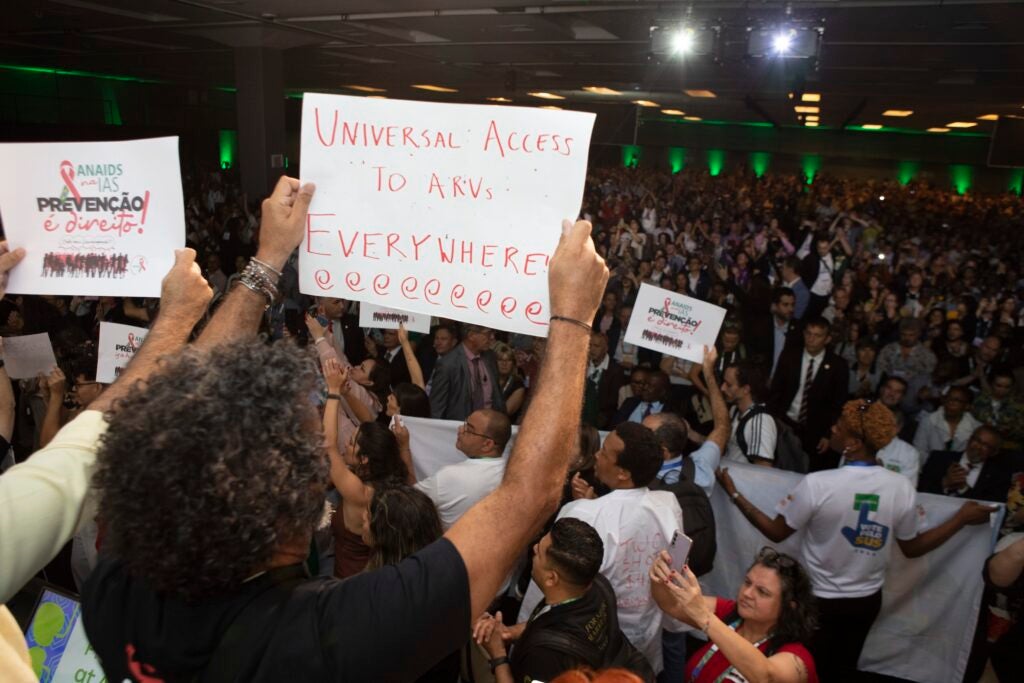
27 July 2026.
OP01. Openning Session.
In the photo: Protests
AIDS 2026, the biennial global conference on all things HIV, closed on July 31 after a week of presentations on scientific advances (including twice-yearly lenacapavir and long-acting cabotegravir plus rilpivirine; advances in cure and vaccine research, with reports of sustained remission in the “Kansas City Patient”) and ongoing funding crises and key populations under threat, with anti-LGBTQ legislation in Uganda, Ghana, Senegal, and Côte d’Ivoire.
During the week, I attended more than a dozen sessions. As always, the most important conversations took place not only in formal sessions, but in the Global Village, in corridors, at community events, and over coffee. By the end of the week, I realised they all revolved around the same question: How do we build a movement capable of confronting an increasingly organised anti-rights agenda?
The question first crystallised for me during Wednesday’s session, Law, Power and Access: Overcoming barriers to HIV services. During the discussion I asked how we can overcome what increasingly feels like a successful “divide and rule” strategy. Across the world, the forces seeking to roll back human rights appear remarkably coordinated. They target communities already facing marginalisation—including people living with HIV, LGBTQ+ people, women, migrants, sex workers, and people who use drugs—as they always have. Reproductive rights, civil society, and scientific evidence are under fire as well, not as separate issues, but as part of a broader political project.
Meanwhile, those of us working to defend rights too often continue to organise ourselves in silos.
The same theme emerged again later that day during a conversation between Georgetown University’s Matthew Kavanagh and Mariângela Simão, who begins her role next week as the UN Special Rapporteur on the right to health. Simão spoke of the growing cohesion of anti-rights forces internationally, while Kavanagh posed what may be the defining question for the years ahead: what would it take to build an equally effective pro-rights force?
It struck me that this wasn’t simply another conference discussion; it was the thread connecting so many conversations throughout AIDS 2026.
The HIV movement knows better than most that progress has never come from science alone. Scientific breakthroughs have transformed HIV from a life-threatening diagnosis into a manageable condition and have given us extraordinary tools to prevent transmission. But while HIV itself may no longer be life-threatening for most people with access to treatment, the political environment has become increasingly rights-threatening. Evidence alone has never guaranteed equitable access, ended stigma or repealed punitive laws. Those achievements have always depended on organised communities, strategic advocacy, political leadership, and solidarity.
Throughout AIDS 2026 there were outstanding sessions on criminalisation, gender equality, community leadership, access to medicines, funding, and shrinking civic space. Each highlighted a different piece of the puzzle. Yet we still too often approach these as separate struggles, competing for scarce funding and political attention. Our opponents do not.
Anti-rights alliances reinforce each other
The anti-rights movement has spent decades building alliances across countries and political movements. It understands that attacks on LGBTQ+ rights, sexual and reproductive health and rights, gender equality, migrant rights, civil society, and science reinforce one another. Divide and rule is effective precisely because those defending rights are so often divided.
Another session that stayed with me was No retreat, no surrender: The future of philanthropy in HIV. Richard Borain of the Children’s Investment Fund Foundation (CIFF) argued that philanthropy’s greatest contribution is not simply funding projects but strengthening the “connective tissue” that brings together governments, communities, donors, and civil society around shared goals.
That phrase resonated with me. We have become very good at investing in programs, but less intentional about investing in the relationships, trust, and collaboration that allow organisations and movements to reinforce one another.
I was reminded of this again at the Robert Carr Fund’s celebration of 15 years of supporting global HIV and health movements. At a time when the Fund has faced an uncertain future following the withdrawal of support from both the United States and the Netherlands, there was welcome news: CIFF has joined as a new donor, while ViiV Healthcare announced a further year of support.
For more than a decade, the Robert Carr Fund has demonstrated a different model of philanthropy—trust-based, multi-year, flexible core funding combined with peer learning and movement building. The HIV Justice Global Consortium, which first united regional and global HIV criminalisation networks, was made possible through Robert Carr Fund support, and the HIV Justice Network remains proud to be one of its grantees.
Yet even within the Robert Carr Fund family there is greater potential to work across movements and constituencies. That is not a criticism of the Fund; rather, it reflects how deeply siloed our sector has become. If organisations already committed to rights-based approaches can collaborate more intentionally, imagine what could be achieved with greater investment in those connections.
The anti-rights movement invests in networks, long-term relationships, shared strategies, and patient coalition-building. We need to become equally serious about investing in the infrastructure of solidarity. AIDS 2026 made clear: our greatest challenge is no longer simply defending individual rights. It is building a movement capable of defending them together.
Edwin J Bernard is Executive Director of the HIV Justice Network and a global advocate for human rights and HIV justice.
Email:edwin@hivjustice.net
Photo credit: Felipe Varanda, IAS 2026