

Women’s Rights and Gender Equality: A Global Index to Monitor Government Action
Vol 28/1, 2026, pp. 71-84 PDF
Janani Shanthosh, Georgia White, Emma Feeny, Shiming Zheng, Uday Adavi, Jane Hirst, Nadia Mohd Rasidi, Bronwyn Pithey, and Anna Palagyi
Abstract
Globally, gender inequality is deepening, with nearly 40% of countries experiencing regression between 2019 and 2022 and significant backlash against women’s rights in 2025. The Convention on the Elimination of All Forms of Discrimination Against Women (CEDAW) provides a legally binding framework for accountability, yet the potential of the Committee on the Elimination of Discrimination Against Women—the body that monitors state compliance with CEDAW—is constrained by the absence of systematic monitoring tools. This paper introduces the CEDAW Index, an artificial intelligence-supported digital dashboard designed to strengthen accountability by consolidating state reports, civil society shadow reports, and committee concluding observations. The current pilot focuses on recommendations regarding gender-based violence, with a framework designed to be extended across the full scope of CEDAW. We describe how the CEDAW Index assigns implementation status to each recommendation; tracks variables such as region, income group, and humanitarian crisis context; and integrates civil society perspectives to counterbalance government reporting. Pilot analyses of the most recent CEDAW reviews from 117 countries between 1997 and 2020 informed the dashboard’s design and identified 423 laws that governments implemented or amended in response to law-related recommendations, representing 46% of such recommendations made by the committee during those reviews. We examine challenges associated with government opacity, artificial intelligence, and oversimplification, while arguing that the index offers a novel pathway to enhance transparency, amplify advocacy, and reinforce women’s rights implementation globally.
Introduction
Globally, gender inequality not only persists but is deepening. Examples from both the Global North and South, including restrictions on abortion care in the United States and a law permitting girl children to be married in Iraq, demonstrate some of the ways that women and girls’ autonomy and rights are being eroded around the world. Advancing gender equality enhances the health, stability, and prosperity of all nations. Yet as we approach the 2030 deadline for the Sustainable Development Goals, not a single indicator under Goal 5 (gender equality) has been fully achieved.[1] Further, between 2019 and 2022, nearly 40% of countries, home to over 1.1 billion women and girls, experienced either stagnation or regression in advancing gender equality.[2]
One of the most pervasive manifestations of gender inequality is gender-based violence (GBV), which represents a major and well-documented public health concern. An estimated 736 million women—almost one in three globally—have been subjected to physical or sexual intimate partner violence, non-partner sexual violence, or both at least once in their life.[3] In 2022, almost 50,000 women and girls worldwide were killed by their intimate partners or other family members—an average of more than five women or girls every hour.[4]
GBV has profound and long-term impacts on women’s health. Women at risk of violence face a disproportionate burden of ill health, including depression and suicidal ideation and a twofold risk of being diagnosed with cervical cancer.[5] They often have poor access to life-saving, quality services that provide health and psychosocial support, particularly in low-resource settings.[6] These impacts extend beyond health, shaping women’s ability to participate fully in social and economic life.[7]
The year 2025 marked the 30th anniversary of the seminal global blueprint for advancing women’s rights, the Beijing Declaration and Platform for Action, adopted by 189 countries at the Fourth World Conference on Women. Three decades on, however, progress has been uneven and fragile. The anniversary is a milestone but also a reminder that despite rhetorical commitments, governments have fallen short of delivering the systemic reforms needed to secure women’s rights in practice. The urgency of developing tools that can support advocates and policy makers in advancing timebound and effective government action has become increasingly clear. International women’s rights scholars and advocates have called for the more strategic use of global institutions, including the Convention on the Elimination of All Forms of Discrimination Against Women (CEDAW), to enhance the accountability of United Nations (UN) member states with regard to women’s rights.[8] Civil society advocates have argued that such institutions have the leverage and mechanisms needed to hold UN member states accountable.[9]
For over four decades, the Committee on the Elimination of Discrimination Against Women (CEDAW Committee) has monitored state compliance with obligations set out in the convention, issuing legally binding recommendations to 189 ratifying countries through a four-yearly periodic review process, as well as through individual communications and inquiry procedures. Grounded in a treaty that spans all areas of social, economic, and political life, the committee’s work addresses issues across health, education, justice, labor, and beyond. GBV is not confined to a single provision of the convention and is addressed across multiple articles, including those relating to health, equality before the law, and nondiscrimination, and elaborated through the committee’s general recommendations, which provide authoritative guidance on how states should interpret and implement their obligations in practice. As a result, recommendations and corresponding government actions relating to GBV are often diverse, spanning legal reform, service provision, data collection, and institutional change. This cross-sectoral approach has driven major legal and policy reforms in contexts as diverse as Paraguay, Mauritius, the Netherlands, Uzbekistan, and Mexico, including legal and institutional changes to address GBV.[10] However, many recommendations remain unimplemented, unacknowledged, or insufficiently resourced, limiting their impact and visibility over time.
At the same time, the CEDAW Committee’s work is under increasing strain. Some sessions in 2025 were canceled due to funding shortages across the UN treaty body system. In a period of upheaval for the UN, strengthening tools that can extend and complement the committee’s monitoring function has never been more critical.
To respond to this gap, we are developing the CEDAW Index, a digital dashboard supported by artificial intelligence (AI) that is designed to strengthen accountability by consolidating state reports, civil society organization shadow reports, and CEDAW Committee concluding observations (hereafter recommendations). While these materials are publicly available, they are dispersed across multiple platforms and formats, making them difficult to access and compare over time. Our index goes beyond aggregation by applying a structured analytical framework to assess the nature and extent of government action in response to recommendations.
Using a combination of AI-assisted methods and expert review, the index identifies reported actions, categorizes them, and assigns an implementation status. The current pilot focuses on GBV-related recommendations. However, the framework underpinning the CEDAW Index is designed to assess implementation across the full scope of women’s rights obligations.
By translating legal obligations into transparent, comparable data, the index offers advocates, researchers, and policy makers a shared evidence base to assess progress, identify barriers, and sustain pressure for reform. Over time, it aims to reduce the analytical burden on under-resourced institutions and enable a more coordinated response across civil society, research, and policy domains.
This paper explores the rationale for the tool, the methodological processes behind data capture, the interpretation of outputs, and the tool’s intended application and impact.
The need for coordinated data and tools in CEDAW monitoring
While the CEDAW Committee provides a comprehensive framework for advancing international women’s rights, no tool currently exists to systematically tracks the implementation of the committee’s recommendations across the 189 state parties to the convention. Periodic state reports differ widely in scope, structure, and specificity, reflecting national diversity but making cross-country comparison challenging. The result is fragmented, descriptive data that can obscure whether commitments translate into action.
In this context, implementation is often difficult to evaluate. In some cases, states may take steps that are ineffective, poorly designed, or misaligned with the needs and experiences of the women they are intended to assist.[11] Without effective scrutiny, government inaction or superficial reforms can go unchecked and unchallenged.
Compounding the absence of a systematic monitoring tool, the CEDAW Committee relies heavily on the contributions of often under-resourced civil society organizations to provide shadow reports that serve as a critical “reality check” on state party compliance.[12] These reports often highlight discrepancies between government claims and lived experiences, bringing to light persistent barriers to implementation, including policy failures that undermine access and equity. For example, our research on state responses to committee recommendations identified common challenges, including ongoing government inaction, gender-discriminatory legal provisions, and the chronic underfunding of health and social support systems.[13]
A further limitation lies in the disconnect between different knowledge communities, including public health researchers and human rights advocates. Public health and development researchers generate extensive evidence on violence against women, service delivery, and intervention effectiveness, while human rights advocates focus on legal accountability and state compliance.[14] These domains are often only partially integrated. Researchers may not engage directly with human rights frameworks, while human rights advocates may have limited access to comparative or evaluative evidence on what interventions are effective. This fragmentation reduces opportunities to link evidence with accountability.
Several tools already exist to rank or categorize government action as it relates to CEDAW. For example, the Gender Legislative Index ranks and scores legislation against CEDAW’s international standards on women’s rights in four countries.[15] The Danish Human Rights Institute’s SDG–Human Rights Data Explorer links CEDAW Committee recommendations to the Sustainable Development Goals.[16] The UN Women Global Database on Violence Against Women and Girls serves as a descriptive repository of national laws, policies, and services, including some CEDAW data.[17] However, none of these tools systematically tracks the implementation or outcomes of CEDAW Committee recommendations. This led us to begin development of the CEDAW Index.
To address this gap, we undertook a pilot analysis of CEDAW reviews from 117 countries between 1997 and 2020. This analysis identified 423 laws that governments reported implementing or amending, including 85 concerning GBV, the rights of refugees and migrants, and protections for LGBTQIA+ individuals.[18] While these reforms cannot be attributed solely to CEDAW Committee recommendations, they reflect areas where domestic legal change aligns with issues raised through the CEDAW review process.
These findings challenge some common assumptions. Implementation patterns were broadly similar across World Bank income groups (low-, lower-middle-, upper-middle-, and high-income countries). Governments facing resource constraints or humanitarian crises took meaningful steps, although implementation remained lower in crisis-affected countries, where 34% of recommendations were implemented compared with 53% in non-crisis settings. At the same time, the presence of legal change does not necessarily indicate effective implementation or improved outcomes for women. Many reforms are under-resourced or unevenly enforced, limiting their impact in practice.
By systematically structuring and analyzing these data, the CEDAW Index highlights both the potential and limitations of existing accountability processes. It demonstrates how more coordinated monitoring can reveal patterns of response across contexts, while underscoring the need to interpret legal and policy change alongside evidence on implementation and lived experience.
The CEDAW Index: A new framework for monitoring implementation
The CEDAW Index will offer a systematic approach to tracking and analyzing the CEDAW Committee’s recommendations, government actions, and responses from civil society organizations. Findings will be visualized through a digital dashboard that consolidates recommendations from periodic reviews, categorizing them by nature, scope, and extent of implementation, while distilling key insights from local, regional, and global contexts.
Here, the key unit of analysis is individual CEDAW recommendations. The term “index” is used to denote a systematic framework for organizing and analyzing implementation data across multiple dimensions, rather than a composite indicator that aggregates performance into a single score.
The CEDAW Index has been designed for human rights advocates, researchers, and policy makers, as well as the CEDAW Committee itself. It offers a unique opportunity to monitor government actions on women’s rights by providing robust data and insights. The index will provide advocates with the opportunity to communicate effectively, craft evidence-based arguments, and contribute to mobilizing grassroots movements. We believe that these insights will be instrumental in strengthening women’s rights advocacy, shaping global accountability processes, and driving systemic change. At the same time, it is important to note that the index tracks reported state actions and patterns of response; it does not, on its own, measure the effectiveness of those actions or their impact on women’s lived experiences. Rather, it provides a foundation that can be complemented by qualitative insights and outcome-focused research.
Primary data sources
The index will draw from three key data sources: periodic reports submitted to the CEDAW Committee by governments (state reports), shadow reports submitted by civil society organizations, and the concluding observations issued after review by the committee. All reports are publicly accessible through the UN Treaty Body Database, hosted by the Office of the United Nations High Commissioner for Human Rights.[19]
To analyze implementation, the index links recommendations issued in a given review cycle with information reported in subsequent state and civil society submissions (each country’s most recent report). State reports often describe legislative, policy, or programmatic developments since the previous review, while shadow reports provide additional context, including critiques of implementation gaps. By aligning these sources across reporting cycles, the index identifies instances where governments report legal or policy changes in areas addressed by prior recommendations. This approach allows for systematic analysis of how reported actions correspond to issues raised through the CEDAW review process.
Participatory development
The development of the CEDAW Index followed an iterative, participatory design process involving researchers, data scientists, and civil society organizations to ensure both methodological rigor and utility for end users. In March 2024, two virtual workshops were held to test the dashboard’s design. The first, hosted by the George Institute for Global Health, focused on the needs of researchers; the second, co-hosted by the George Institute for Global Health and International Women’s Rights Action Watch Asia Pacific, engaged civil society organizations from South Africa, Kenya, India, and Indonesia to explore how the index could strengthen advocacy and accountability.
Across both workshops, participants emphasized methods transparency, noting that the tool’s credibility depends on open access to data protocols, clear inclusion criteria, and acknowledgment of limitations. This led to the inclusion of a dedicated methods section within the dashboard, providing users with access to data sources, methodology, and the rationale underpinning each classification. This includes brief model-generated justifications alongside human analyst explanatory notes. Each data point links back to its original UN report, ensuring traceability and building trust in the findings.
Accuracy and reliability were prioritized. Researchers recommended robust quality control systems for all AI-assisted processes. The index will therefore use a human-in-the-loop workflow, whereby machine learning supports, but does not replace, expert review. All AI-generated outputs are reviewed by human experts prior to inclusion, with particular attention given to cases where the classification of government actions in relation to a recommendation is not straightforward.
Participants also underscored the need for responsiveness to end users, recommending continuous engagement through usability testing and feedback channels. Collaboration with civil society organizations was viewed as essential by both researchers and civil society organizations for expanding coverage, particularly to spotlight populations and forms of violence underrepresented in human rights monitoring. The index’s data model will therefore accommodate perspectives from both government and civil society reports, and civil society organizations can highlight implementation barriers and local context.
Civil society partners highlighted the importance of going beyond implementation to measure the impact and effectiveness of the index. This feedback informed the plan to integrate case studies and qualitative insights from civil society organizations and researchers, positioning the index not only as an accountability tool but as a learning platform on what drives and hinders reform.
Key features of the CEDAW Index dashboard
Building on the design principles developed through the participatory design process, the index will provide both summary and raw data for each CEDAW Committee recommendation and corresponding government action. Raw data consist of excerpts from state and civil society reports, which are often lengthy and heterogeneous in format. These are complemented by concise summaries that synthesize relevant information while preserving key details, enabling users to quickly interpret findings while retaining access to source material. Each data point is linked to its original periodic report via a direct hyperlink, allowing users to review the information in the context of the full country submission where needed.
Each recommendation is assigned an implementation status based on predefined criteria:
- Fully implemented: The action meets all elements of the recommendation.
- Partially implemented: Only some aspects are addressed.
- Inadequate response: The action taken diverges from or falls short of what was recommended.
- Unacknowledged: The recommendation is not mentioned or acted upon.
Recommendations and corresponding actions will be tracked across multiple variables, including country and region, World Bank income group, humanitarian crisis status, form of GBV, and affected population groups.
Technologies such as AI offer fresh opportunities to strengthen women’s movements by making information and solutions more accessible. Over the last two years, the annual United Nations Commission on the Status of Women has convened global stakeholders to assess progress on gender equality through the lens of innovation, technology, and digital education. UN Women and other groups have recognized AI’s vast potential to transform how employment, public services, and education benefit women and girls. At the same time, they have highlighted the risks of AI, including its relatively unregulated nature, rapid pace of advancement, and inequities in access to the technology and opportunities to shape it. UN Women has noted that the gender digital divide—where, for example, only 20% of people in low-income countries have internet access—creates a data gap that contributes to gender bias in AI. Who develops AI systems, and what assumptions or biases are embedded within them, can either perpetuate or reduce gender inequalities. These biases manifest in multiple ways, including discriminatory hiring algorithms, stereotyping in digital assistants, and exclusion of women’s health data from training datasets. Yet insufficient attention has been paid to how these biases can be addressed, as well as how we can harness the transformative potential of AI for women’s rights.
Analyses for the CEDAW Index will be undertaken by health, policy, and human rights experts, supported by AI and large language models (LLMs). The analysis draws on the team’s grounding in global health research, particularly in areas such as GBV, while applying a framework that spans the full scope of CEDAW obligations.
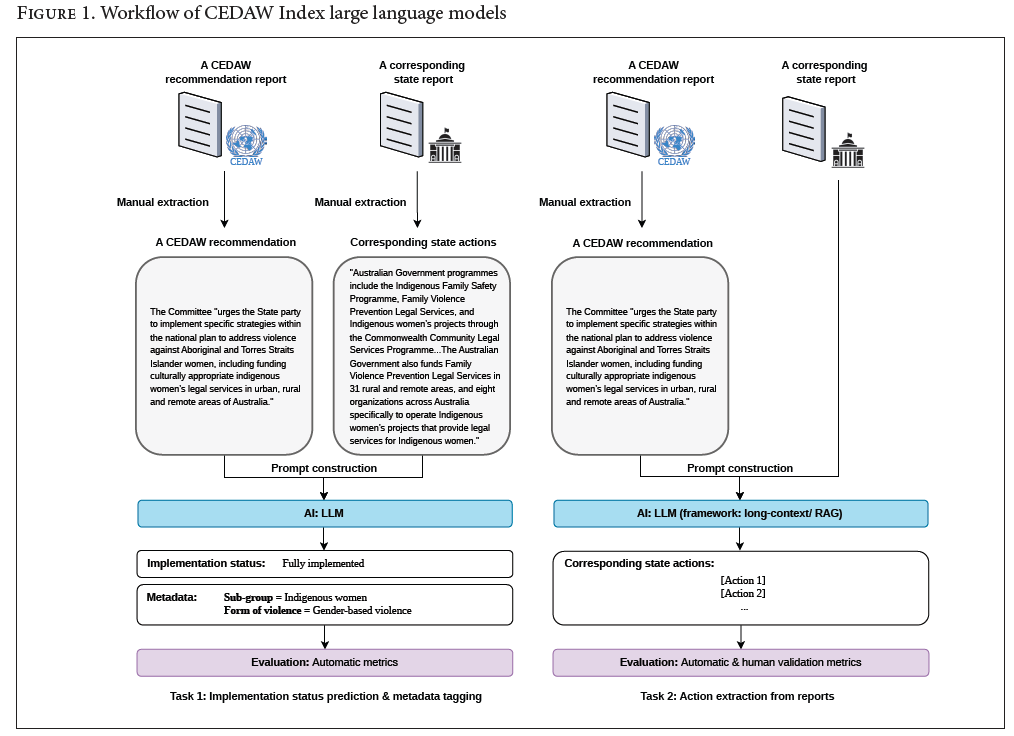
To assess how well LLMs perform across different tasks in the CEDAW reporting process, proof-of-concept workflow (Figure 1) comprises three components. First, using human-extracted CEDAW recommendations, an LLM, prompted using structured instructions developed and validated by a team of data scientists (SZ and UA) is used to assign an implementation status. Second, based on the same inputs, the LLM is used to generate metadata tags by classifying recommendations and government actions by theme, facilitating systematic monitoring and comparative analysis. Third, using human-extracted recommendations paired with the original state reports, the LLM is used to extract relevant government actions for inclusion in the database.
Preliminary analyses led by SZ evaluated recent, well-performing open-source LLMs (LLaMA 3 and LLaMA 3.1 series) at the time, and the best-performing configurations were selected for each task. As an initial feasibility assessment, the analysis was conducted using data from five countries (n = 36) to enable a focused and controlled evaluation prior to scaling up the approach. All periodic reports used in this analysis are publicly available through the Office of the United Nations High Commissioner for Human Rights database in English (as well as other official UN languages), and no additional translation was required for this study. Given the limited sample size, a formal train-test split was not performed, as the objective was to assess feasibility and to examine whether the tasks could be effectively addressed under optimized prompting conditions.
Model performance for the first two tasks was assessed using overall accuracy. The model (Llama-3.1-70B-Instruct with 4-bit quantization) achieved high accuracy on the first task, correctly identifying implementation status in about 91.67% of cases. Meanwhile, the model (Llama3-8B-instruct) exhibited robust performance on the second task, accurately categorizing recommendations across 15 themes, such as forms of violence and population subgroups (e.g., women within lower socioeconomic communities or lower socioeconomic status), with an overall accuracy of 82.93%. While accuracy varied for categories with few data points, these results establish a baseline for future analyses.
For the third task, two context-engineering approaches to providing context to the LLM were explored. In a long-context approach, the full document is provided as input, allowing access to complete contextual information, although performance may be affected for longer or more complex documents. In a retrieval-augmented generation (RAG) approach, documents are segmented into smaller text units and encoded using an embedding model (infloat/e5-mistral-7b-instruct), and semantic similarity is used to retrieve the most relevant segments, which are then provided as context to the LLM. This approach focuses the LLM on the most relevant portions of the text.
The performance of the third task was assessed using both an automated similarity measure (measured as the average cosine similarity between the model outputs and reference text, where values closer to 1 indicate higher similarity) and human validation. The long-context approach achieved higher cosine similarity than the RAG approach (0.69 vs. 0.63), whereas human validation scores were higher for the RAG approach (63% vs. 60%), indicating improved relevance and completeness. Across both approaches, the model (Llama-3.1-8B-Instruct) consistently achieved the strongest performance. Human validation was conducted by a data scientist (SZ) and a global health lawyer (JS), with agreement reached through consensus based on the proportion of extracted actions judged to be correct by both reviewers.
Additional analyses were conducted for the third task. First, we assessed whether our solution introduced bias in the model’s ability to distinguish between cases where governments had acted and those where no action was taken. No statistically significant difference was observed between the two cases (p > 0.05, two‑proportion Z‑test), suggesting that the method performs comparably across both scenarios without favoring one over the other. Second, we assessed generalizability by applying the approach to an independent held-out external dataset (n = 19) from additional countries. When applied to new country reports, accuracy declined, with long-context and RAG approaches achieving approximately 0.41 and 0.39 (cosine similarity), and 35% and 42% (human validation), respectively, reflecting the diversity of reporting formats and the limited size of the development dataset. These results should be interpreted cautiously. The evaluation applies a strict binary criterion, where partially correct or semantically similar outputs may be classified as incorrect, making the metric inherently conservative. Notably, in several instances the model identified relevant government actions not captured in manual review, suggesting its value as a complementary analytical tool.
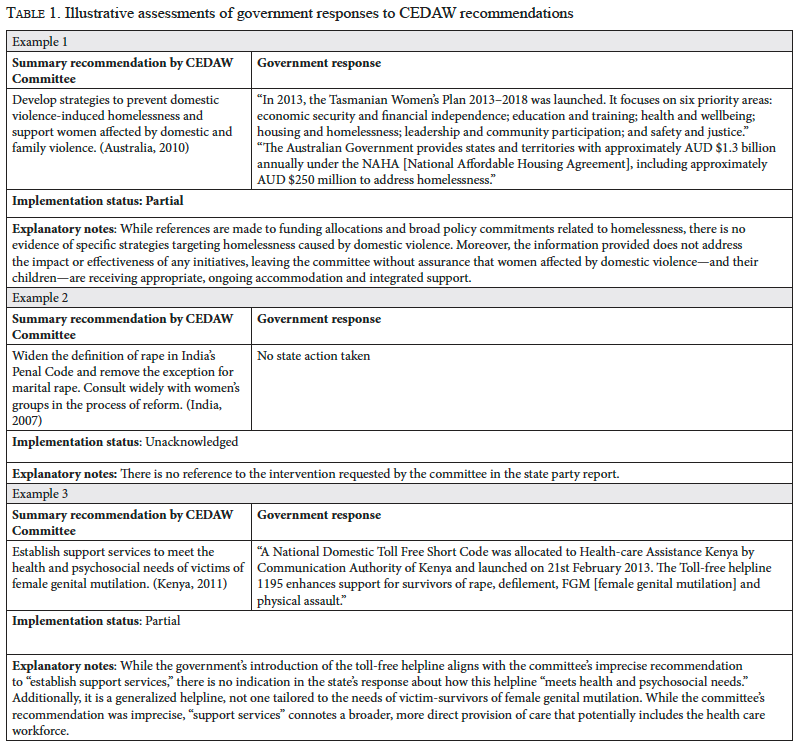
During the development of the dataset that will support the CEDAW Index, we recorded explanatory notes for each committee recommendation, documenting the reasoning behind the assigned implementation status.
The explanatory notes provide an implementation assessment—a structured reasoning process that documents how each recommendation’s implementation status is determined. It ensures transparency, consistency, and traceability in the analyst’s judgment.
As discussed earlier, each CEDAW Committee recommendation from cycle 1 is compared against the government’s cycle 2 report to assess what actions were taken. Analysts first identify the corresponding state actions and then evaluate the extent of implementation, classifying it as fully implemented, partially implemented, inadequate response, or unacknowledged.
The explanatory notes record the reasoning behind each classification, drawing on key interpretive dimensions that guide analysts in determining implementation quality and completeness, including action specificity, timelines (when and over what period government action occurred), legal or institutional status (whether the measure is binding, adopted, and operational), and resourcing (evidence of budget allocation or implementation capacity).
Analysts use these dimensions to explain why a particular implementation status was assigned, especially in ambiguous cases where state reporting is vague or incomplete. This reasoning is documented within the index dataset as a transparent “audit trail,” enabling others to understand the interpretive logic behind each assessment by connecting textual evidence, contextual understanding, and expert judgment to produce a reproducible implementation status.
These analyses allowed us to demonstrate, for example, how broad policy commitments without targeted measures were classified as only partially implemented, or how the absence of any state response was recorded as unacknowledged. By systematically applying this method across countries, our analysis highlighted where governments had taken meaningful action, where they had failed or declined to act, and where responses were inadequate. It also revealed recurring gaps in implementation, such as vague or generalized measures that did not address the specific focus of a recommendation, while situating these findings within wider global trends. Table 1 provides illustrative assessments of government responses to CEDAW recommendations, including the implementation status assigned in each case.
Findings of the analyses will be presented on the dashboard through data visualizations that enhance accessibility for advocates, researchers, and decision-makers, enabling them to easily identify patterns and trends. These visualizations also aim to foster collaboration between researchers and civil society organizations, facilitating the generation of empirical research findings that support advocacy efforts, while providing valuable real-world insights into implementation challenges.
By mapping implementation across countries, the index will reveal common enablers and barriers—political, fiscal, cultural, and otherwise—that impact governments’ abilities to fulfill their CEDAW obligations. For instance, prior analyses using pilot data distinguished between instances where governments required additional time to introduce GBV legislation and those where they refused to implement it. Those analyses showed that Haiti had drafted a framework law criminalizing marital rape, which was awaiting inclusion in the next legislative agenda, while Uruguay had presented similar legislation to the House of Representatives. Conversely, the governments of the Democratic Republic of Congo, Malaysia, and Sri Lanka defended their existing legislative frameworks, which lacked specific provisions criminalizing domestic violence and marital rape.[20]
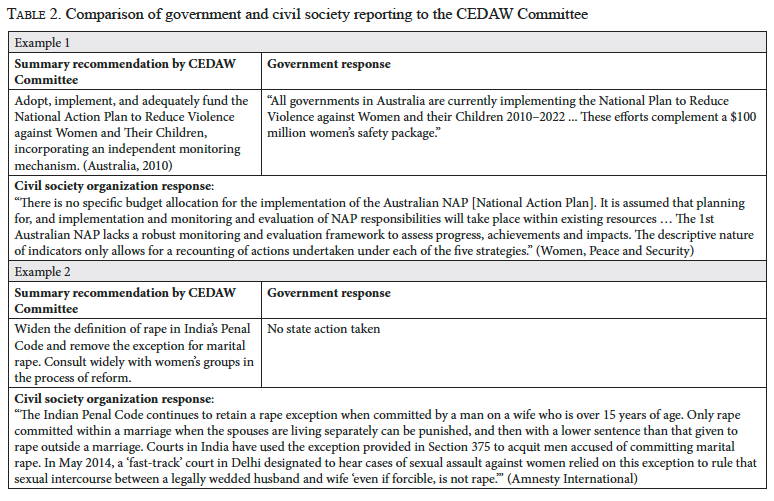
Where available, civil society insights into government actions will accompany each of the index’s published recommendations and actions, capturing nuances related to the quality, scale, resources, and reasons for implementation failures that may not be reflected in official government reporting. This dual perspective offers a more comprehensive view of the implementation process and highlights persistent barriers to effective action. Table 2 illustrates the value of this dual perspective, showing how civil society reporting can provide detail that is absent from state reports.
Additionally, the CEDAW Index will feature case studies that illustrate real-world examples of both successes and challenges in implementation. Informed by data from civil society organizations and empirical research findings, these case studies will provide detailed insights into the impact of policies, programs, and laws, enabling the index to be used to identify successfully implemented legislative and policy models (as reported by governments) that can be replicated or scaled in other jurisdictions. It is hoped that over time, showcasing the ongoing effectiveness and acceptability of interventions years after their introduction can help ensure that implementation is treated not as a final goal but rather as an ongoing process requiring evaluation and refinement.
As an example, following its 2007 review of Brazil, the CEDAW Committee recommended the systematic monitoring of the Maria da Penha Law on domestic violence. While the Brazilian government highlighted at its subsequent review that the law had led to over 300,000 prosecutions and 100,000 judgments, civil society organizations have highlighted that its benefits remain concentrated largely in urban areas. This uneven implementation raises concerns in relation to article 14 of CEDAW, which obliges states to ensure that rural women enjoy equal access to legal protections and services. The ongoing CEDAW review process will allow for continued refinement of legal and policy models over time.[21]
Ultimately, at a systems level, the CEDAW Index could enhance the review process in several ways: (1) by providing historical data on previous periodic reports submitted by state parties, highlighting areas where recommendations were made but not implemented; (2) by providing implementation insights to inform constructive dialogue and the design of new recommendations; and (3) by providing research and information regarding best-practice interventions that can be used by the CEDAW Committee and civil society organizations in the follow-up process at the national level.
Challenges associated with the CEDAW Index
Despite its potential, the CEDAW Index faces several challenges. First, governments largely control the narrative surrounding their human rights records and have been known to engage in practices that may obscure the reality of their actions, particularly when there are perceived political consequences to human rights failures.[22] Where governments are not forthcoming about their implementation of recommendations, this can hinder the index’s ability to present an accurate picture of global progress in addressing GBV. Here, the voice of civil society is essential: Shadow reports, advocacy, and independent monitoring can counterbalance state narratives and provide a reality check that strengthens the accuracy and legitimacy of the index.
Another major hurdle is the involvement of AI. While AI can enhance efficiency, automating data extraction and enabling large-scale comparative analysis, it also carries inherent limitations. Effective use demands human oversight, rigorous data curation, and a commitment to ensuring data quality, completeness, and objectivity in model training. AI may be constrained in addressing the complex and context-dependent nature of women’s rights, since local gender norms, religious beliefs, and political power structures shape implementation in ways that AI models may not adequately capture. Moreover, the “black-box” nature of deep learning models can hinder transparency in decision-making. To mitigate these risks, the index combines machine learning with expert human assessment: Models are trained only on approved datasets and are required to produce a replicable reasoning pathway (explanatory notes) that is reviewed by human experts before findings are finalized. In this way, AI augments rather than replaces human judgment.
A further challenge is that while visualizing human rights data can support international collaboration and shared understanding, it also has drawbacks. Applying a status to complex women’s rights issues may oversimplify social phenomena and obscure rich contextual factors that are needed for a comprehensive analysis.[23] For example, countries making significant legislative reforms may appear to have higher implementation rates simply because they have more ground to cover, while countries with already higher levels of gender equality may register fewer new reforms—a phenomenon often described as “the last mile.”[24] To avoid the impression of a ranking exercise, the index does not assign comparative “scores.” Instead, it classifies implementation status and provides contextualized analyses that situate country actions within their specific political, legal, and social contexts. While the current dataset is cross-sectional, future iterations of the index may incorporate historical data to track change over time.
As an illustration, our pilot report using cross-sectional data in the Asia-Pacific region showed that Afghanistan—a context in which women have been prohibited from speaking in public, and more recently praying aloud in front of other women—had fully implemented 63% and partially implemented 21% of the CEDAW Committee’s recommendations.[25] These results were higher than those recorded for Australia and New Zealand, underscoring that the index measures willingness and capacity to respond to the committee’s recommendations, rather than overall progress in achieving gender equality. To provide a more nuanced picture beyond the limited scope of the four-year review cycle, forthcoming country case studies will integrate historical data to identify patterns of progress and regression. By incorporating these perspectives, we hope to contribute to more constructive and transparent dialogue between the CEDAW Committee and government representatives.
Another challenge lies in the ongoing push for sex-based frameworks within women’s rights advocacy and UN processes. These frameworks, while presented as protective, often intentionally exclude trans, non-binary, and gender-non-conforming people from effective protections. For the index, resisting this narrowing of rights is essential: The tool is designed to reflect the diverse ways violence manifests across relational dynamics, geopolitical privilege, and economic disparities, and to avoid perpetuating epistemic violence.
A final challenge in leveraging the index to drive change is the persistent issue of government inaction. Despite CEDAW imposing legal obligations on state parties, the CEDAW Committee lacks the ability to compel states to address repeated implementation failures.[26] While the index cannot enforce compliance, it can expose gaps, mobilize civil society, and equip advocates with the data needed to push for meaningful reform. By amplifying the work of the committee and civil society organizations, and by combining data transparency with independent voices, the index aims to strengthen accountability through visibility and evidence.
Conclusion
The fight for gender equality is at a crossroads. Despite the significant strides made over recent decades, stagnation and backsliding on women’s rights remains a formidable challenge. While mechanisms such as the CEDAW review process provide a framework for accountability, the lack of systematic and accessible monitoring continues to hinder efforts to hold governments to account.
The CEDAW Index described here aims to address these challenges by providing a comprehensive, systematic approach to tracking and analyzing the CEDAW Committee’s recommendations, related government actions, and civil society reporting. In its pilot form, this tool offers a unique opportunity to evaluate how well states are meeting their CEDAW obligations relating to GBV. Despite the challenges outlined above, the index offers a pathway to strengthening transparency and accountability in international women’s rights implementation.
While the CEDAW review process may often represent a tipping point—spurring governments to act only after extended periods of advocacy—it remains one of the strongest global mechanisms available to leverage international legal obligations for women’s rights. Our review of laws implemented following CEDAW reviews demonstrated that 47% of law-related recommendations were implemented in low-income countries, 48% in lower-middle and upper-middle-income countries, and 53% in high-income countries.[27] Additionally, we found that 14 countries had implemented or amended laws after initially failing to acknowledge the CEDAW Committee’s recommendations during their reviews. For example, in Nepal, penalties for marital rape were increased from up to six months to five years, while Angola updated its Penal Code to criminalize female genital mutilation. Bolivia legalized abortion in cases of rape, and Lesotho introduced a bill addressing domestic violence. These examples highlight that while the process of women’s rights implementation is often non-linear and drawn out, the strategic actions of advocates and women’s movements continue to play a critical role in getting GBV reforms and essential programs and services over the line.[28]
Ultimately, the development of tools such as the CEDAW Index, coupled with sustained advocacy efforts, offer a powerful pathway to enhancing the transparency, accountability, and impact of government actions on women’s rights. By providing robust, data-driven insights, fostering collaboration across sectors, and ensuring that diverse voices—particularly those of civil society—are amplified in the process, we can move closer to realizing the global commitment to gender equality and advancing the rights of women and girls everywhere.
Janani Shanthosh, PhD, is a conjoint senior lecturer at the University of New South Wales and honorary senior research fellow at the George Institute for Global Health, Sydney, Australia.
Georgia White is a policy and advocacy advisor for the impact and engagement team at the George Institute for Global Health, Sydney, Australia.
Emma Feeny is chief impact officer at the George Institute for Global Health, London, United Kingdom.
Shiming Zheng is a conjoint associate lecturer at the University of New South Wales and data scientist in the Biostatistics and Data Science Division of the George Institute for Global Health, Sydney, Australia.
Uday Adavi is a conjoint associate lecturer at the University of New South Wales and head of data science in the Biostatistics and Data Science Division of the George Institute for Global Health, Sydney, Australia.
Jane Hirst, PhD, is a professor and chair in global women’s health, the George Institute for Global Health, Imperial College London, and visiting professor at the University of Oxford, London, United Kingdom.
Nadia Mohd Rasidi, PhD, is a feminist research lead at International Women’s Rights Action Watch Asia Pacific, Kuala Lumpur, Malaysia.
Bronwyn Pithey is an admitted advocate in the High Court of South Africa who works for the Women’s Legal Centre, Cape Town, South Africa.
Anna Palagyi, PhD, is a conjoint associate professor at the University of New South Wales and program lead of the Ageing and Health Systems Program, Health Systems Science at the George Institute for Global Health, Sydney, Australia.
Please address correspondence to Janani Shanthosh. Email: janshanthosh@gmail.com.
Competing interests: None declared.
Copyright © 2026 Shanthosh, White, Feeny, Zheng, Adavi, Hirst, Rasidi, Pithey, and Palagyi. This is an open access article distributed under the terms of the Creative Commons Attribution-Noncommercial License (http://creativecommons.org/licenses/by-nc/4.0/), which permits unrestricted noncommercial use, distribution, and reproduction in any medium, provided the original author and source are credited.
References
[1] UN Women, Progress on the Sustainable Development Goals: The Gender Snapshot 2024 (2024).
[2] Equal Measures 2030, “2024 SDG Gender Index,” https://equalmeasures2030.org/2024-sdg-gender-index/.
[3] World Health Organization, Global Status Report on Alcohol and Health 2018 (2018).
[4] United Nations Office on Drugs and Crime and UN Women, Gender-Related Killings of Women and Girls (Femicide/Feminicide): Global Estimates of Female Partner/Family-Related Homicides in 2022 (2023).
[5] World Health Organization (2021), Violence Against Women Prevalence Estimates, 2018: Global, Regional, and National Prevalence Estimates for Intimate Partner Violence Against Women and Global and Regional Prevalence Estimates for Non-Partner Sexual Violence Against Women (2021).
[6] United Nations Population Fund, State of the World Population 2020: Against My Will—Defying the Practices That Harm Women and Girls and Undermine Equality (2020).
[7] World Bank, Violence Against Women and Girls Resource Guide (2015).
[8] J. Klugman, Gender Based Violence and the Law (2017).
[9] International Women’s Rights Action Watch Asia Pacific, Annual Report 2023 (2024).
[10] J. Shanthosh, Redressing the Balance: Using Human Rights Law to Improve Health for Women Everywhere (George Institute for Global Health, 2023).
[11] M. L. Satterthwaite and A. Rosga, “Measuring Human Rights: UN Indicators in Critical Perspective,” in K. Davis et al. (eds), Governance by Indicators: Global Power Through Quantification and Rankings (Oxford University Press, 2013).
[12] M. A. Freeman, “The Committee on the Elimination of Discrimination Against Women and the Role of Civil Society in Implementing International Women’s Human Rights Norms,” New England Journal of International and Comparative Law 16/1 (2010).
[13] Shanthosh (see note 10).
[14] R. Vijeyarasa, “Quantifying CEDAW: Concrete Tools for Enhancing Accountability for Women’s Rights,” Harvard Human Rights Journal 34 (2021).
[15] Gender Law Index, “Gender Legislative Index,” https://www.genderlawindex.org/.
[16] Danish Institute for Human Rights, “SDG–Human Rights Data Explorer,” https://sdgdata.humanrights.dk/en.
[17] UN Women, “Global Database on Violence Against Women,” https://data.unwomen.org/global-database-on-violence-against-women.
[18] Shanthosh (see note 10).
[19] J. Shanthosh, K. Muvva, M. Woodward, et al., “Assessing the Reach, Scope and Outcomes of Government Action on Women’s Health and Human Rights: A Protocol for the Development of an International Women’s Rights Dataset,” International Journal of Qualitative Methods 21 (2022).
[20] Shanthosh et al. (see note 10).
[21] Ibid.
[22] H. Charlesworth and E. Larking (eds), Human Rights and the Universal Periodic Review: Rituals and Ritualism (Cambridge University Press, 2015).
[23] S. E. Merry, The Seductions of Quantification: Measuring Human Rights, Gender Violence, and Sex Trafficking (University of Chicago Press, 2016).
[24] P. Alston (ed), The Complexity of Human Rights: From Vernacularization to Quantification (Bloomsbury Publishing, 2024).
[25] OECD, Is the Last Mile the Longest? Economic Gains from Gender Equality in Nordic Countries (2018).
[26] J. Shanthosh, Launching the CEDAW Implementation Map on Women’s Health: Progress on the Journey Towards Health and Human Rights for All Women (George Institute for Global Health, 2021).
[27] Shanthosh et al. (see note 10).
[28] S. E. Merry, “Transnational Human Rights and Local Activism: Mapping the Middle,” American Anthropologist 108/1 (2006).