

Social Injustice, Public Health, and Human Rights
BOOK REVIEW Vol 28/1, 2026, pp. 199-202 PDF
Audrey R. Chapman
Social Injustice and Public Health, fourth edition, edited by Barry S. Levy (Oxford University Press, 2026)
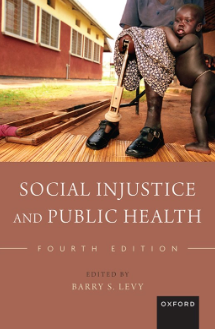
Social Injustice and Public Health is a comprehensive collection of 31 essays, each written by leading experts in public health and medicine, that document the profound impacts of social injustice on public health. The volume is edited by Barry Levy—a former director of the American Public Health Association, editor of numerous textbooks, and author of From Horror to Hope: Recognizing and Preventing the Health Impacts of War—who also contributed several chapters.[1] The goals of the volume, according to Levy, are to provide a better understanding of the roots of social injustice and its impacts on public health, to promote education and research on this important issue, and to stimulate action to reduce social injustice and minimize its health consequences. It is the fourth edition of a text first published in 2005 and includes several new chapters.
As conceptualized in the volume, social injustice “is the denial or violation of economic, sociocultural, political, civil, or human rights of specific population groups in society based on the erroneous perception of their inferiority by those with more power or influence” (pp. 3–4). Alternatively, the book offers a second definition of social injustice based on the US Institute of Medicine’s conceptualization of public health as what we do as a society collectively to assure the conditions in which people can be healthy. Social injustice, then, refers to policies or actions that adversely affect the conditions that enable people to be healthy. The book explains that while social injustice is often community-wide or even global, its effects fall disproportionately on the groups identified in the first definition above, such as people living in poverty, people of color, women, and older people. As Levy points out, social injustice creates conditions that prevent individuals and groups from having their basic needs met and that, in the process of doing so, violate human rights (p. 4).
Social Injustice and Public Health is organized into four parts. The first part comprises an introduction by Levy on the nature of social injustice and its impact on public health, as described above.
The second part examines how social injustice impacts the health of ten population groups. The chapter by Michael Marmot and Ruth Bell explores the impact of social injustice on socioeconomically disadvantaged populations and assesses the root causes and underlying factors of socioeconomic disadvantage. In considering what needs to be done, the authors draw on recommendations from The Marmot Review Ten Years On, including those aimed at giving every child the best start in life (pp. 33–34). The remaining chapters explore how social injustice affects the health of people of color (Carol Easley Allen and Cheryl Easley), women (Gina Maranto), children (Luz Claudio and Juan Antonio Ortega-Garcia), older people (Carroll Estes et al.), lesbian, gay, bisexual, transgender, and queer or questioning people (Emilia Lombardi and Talia Mae Bettcher), people with disabilities (Nora Ellen Groce), incarcerated people (David Cloud), people experiencing homelessness (Howard Padwa et al.), and forced migrants (Michael Toole). Many of these chapters not only profile the impacts of social injustice on these communities and examine their causes but also identify what needs to be done now.
The third part addresses how social injustice affects specific aspects of public health, including medical care (Oliver Fein), communicable diseases (Joia Mukherjee), nutrition (J. Larry Brown), noncommunicable diseases (Mariachiara Di Cesare et al.), violence (Colleen Ray et al.), war (Barry Levy), mental health (Carles Muntaner et al.), environmental health (Barry Levy), occupational health and safety (Linda Rae Murray), oral health (Myron Allukian et al.), and global health (Barry Levy). Some chapters are US oriented, while others are international in scope. As in the second part, these chapters both discuss the underlying causes and offer recommendations for action.
The fourth part sets out an agenda for action. It features contributions addressing social justice in a human rights context (Sofia Gruskin and Paula Braveman), promoting social justice through public health policy (Kathleen Rest et al.), promoting social justice through public health practice (Joshua Sharfstein et al.), strengthening communities and the roles of individuals in building community life (Robert Aronson et al.), promoting social justice through education in public health (Robert Lawrence), developing a critical research agenda for social justice and public health (Nancy Krieger), protecting human rights through international and national law (Henry Freedman and Martha Davis), learning from the social movements of the 1960s (Oliver Fein and Charlotte Phillips), and promoting health with equitable and sustainable human development (Richard Jolly and Mark Sidel).
As indicated above, this volume is not explicitly about human rights and health. In the introduction, Levy acknowledges that social justice is closely linked to human rights and specifically identifies three foundational human rights documents—the Universal Declaration of Human Rights, the International Covenant Civil and Political Rights, and the International Covenant on Economic, Social and Cultural Rights—as the basis for identifying the rights to which all people are entitled (p. 6). However, this theme is not then expressed in the contents of the book. Only two of the volume’s 31 chapters focus on human rights, and both appear to be written primarily for public health specialists unfamiliar with human rights. A third chapter advocates for incorporating human rights into public health and medical curricula.
The chapter by Sofia Gruskin and Paula Braveman on addressing social injustice in a human rights context (chapter 23) considers the relevance of human rights to public health in three major spheres: as legal standards and obligations of governments, as a conceptual framework for analysis and advocacy, and as guiding principles for designing and implementing policies and programs. It describes what human rights are and, more specifically, conceptualizes the right to health. Perhaps the most helpful section of the chapter, especially for public health specialists, is the section that explores how human rights principles and standards can be used to promote social justice. As the authors note, most public health actions are intended to benefit entire populations, which means that poor or marginalized populations may benefit too little, even from the best-intentioned initiatives. They therefore argue that using human rights norms along with the routine assessment of potential health implications should become standard practice at all stages of public policy formation, including its design, implementation, and evaluation (pp. 542–543). They conclude that “health workers should be aware that human rights principles, norms, standards, laws, and accountability mechanisms are relevant tools to help achieve social justice in health … Human rights principles provide a framework that can guide health workers and others in pursuing social justice in health” (p. 546).
The second chapter with a human rights theme (chapter 29), written by Henry Freedman and Martha Davis, examines the protection of human rights through international and national law. It describes the United Nations Charter as the taproot of a tree, the Universal Declaration of Human Rights as the trunk, and the various covenants based on the Universal Declaration as branches addressing a range of individual rights (p. 653). It provides descriptive information on how the system functions, presumably for health care professionals unfamiliar with the international human rights system. Various sections of the chapter illustrate how US national and state laws can be used to reduce social injustice. The chapter also provides a human rights and legal agenda and identifies some resources for advancing social justice. The authors conclude that when the domestic rule of law is under stress, as is currently the case in the United States, human rights law becomes even more important as a bulwark against injustice. They go on to observe that establishing enforceable social, economic, and cultural rights represents the only sure defense against social injustice. They recommend that “lawyers must go to court, targets of social injustice and their supporters must take to the streets to demonstrate nonviolently, and activists must lobby their elected representatives” (p. 671). Hopefully that will occur.
The chapter by Robert Lawrence on promoting social justice through education in public health (chapter 27) also stresses the importance of incorporating human rights into the curricula of schools of public health, medical schools, nursing schools, and departments of community and preventive medicine. Lawrence identifies human rights as one of the two major developments in the past eight decades relevant to the development and implementation of a social justice curriculum for public health students. The second is the significant progress that has been made in qualitative and quantitative analyses of the social determinants of health. According to Lawrence, these two developments provide the foundation for education that places social justice at the heart of the public health curriculum (p. 611). However, the chapter does not offer details about how or which human rights should be integrated into the various curricula.
Beyond these chapters, the volume is broadly relevant to the pursuit of health and human rights in several ways. Both the public health community and the human rights community are committed to overcoming social injustice and achieving greater fairness and equity. Both acknowledge that the lack of justice, fairness, and equity results from social structures and discriminatory policies that harm individuals and groups. I think that greater collaboration between these two communities would strengthen each in advancing its commitments and goals. I write this as a human rights specialist in a public health academic department.
Over the past 25 years, the human rights community has become increasingly aware of the importance of the social determinants of health for health outcomes. The United Nations Committee on Economic, Social and Cultural Rights’ General Comment 14 interprets the right to health as an inclusive right extending not only to timely and appropriate health care but also to the underlying determinants of health. Providing these underlying determinants to everyone is identified as a core obligation of state parties that is immediately realizable and not dependent on the availability of resources.[2] For this reason, rights-based approaches to health need to engage in a meaningful way with the growing body of public health research that shows the significant impact of health inequalities and the social determinants of health on health status. Social Injustice and Public Health provides a valuable resource for that purpose.
Additionally, one of the hallmarks of a human rights approach is a commitment to protecting the rights and well-being of vulnerable and disadvantaged groups. To that end, the need to protect the rights and needs of these communities has been a recurrent theme in the work of the United Nations human rights oversight committees. It finds expression, for example, in the work of the Committee on Economic, Social and Cultural Rights, whose General Comment 14 interpreting the right to health identifies the special obligations of states to provide for the satisfaction of the health needs of individuals and groups whose poverty, disabilities, or background make them vulnerable. The text specifically highlights duties to women, children and adolescents, older persons, persons with disabilities, and Indigenous people.[3] This concern is also reflected in the work of other United Nations human rights committees focused on the rights of several of these communities, including their health rights and status and general well-being. These include the Committee on the Rights of the Child, the Committee on the Elimination of Racial Discrimination, the Committee on the Elimination of Discrimination Against Women, and the Committee on the Rights of Persons with Disabilities.
The impact of the COVID-19 pandemic has made it even more important for the human rights community to address the situation of disadvantaged and vulnerable communities. As I have noted elsewhere, during the pandemic, individuals and communities that were already disadvantaged and vulnerable frequently experienced a disproportionate burden of illness, death, and social and economic dislocation. The measures imposed to reduce exposure to COVID-19, such as lockdowns and school closures, also tended to impose a greater burden on already disadvantaged groups.[4]
Many of the groups highlighted in the volume are communities that have been of continuing concern to the human rights community. The chapters exploring how social injustice affects various disadvantaged and vulnerable groups can thus provide a valuable foundation for human rights analysis and policy recommendations.
Audrey R. Chapman, PhD, is Healey Professor of Medical Ethics and Humanities at the University of Connecticut School of Medicine, Hartford, United States.
References
[1] Barry S. Levy, From Horror to Hope: Recognizing and Preventing the Health Impacts of War (Oxford University Press, 2022).
[2] Committee on Economic, Social and Cultural Rights, General Comment 14, UN Doc. E/C.12/2000/4 (2000), see especially paras. 11, 43.
[3] Ibid., see especially paras. 22, 25, 26, 27.
[4] Audrey R. Chapman, The Unequal Pandemic: The Impact of the Pandemic on Vulnerable and Disadvantaged Communities (Cambridge University Press, forthcoming).