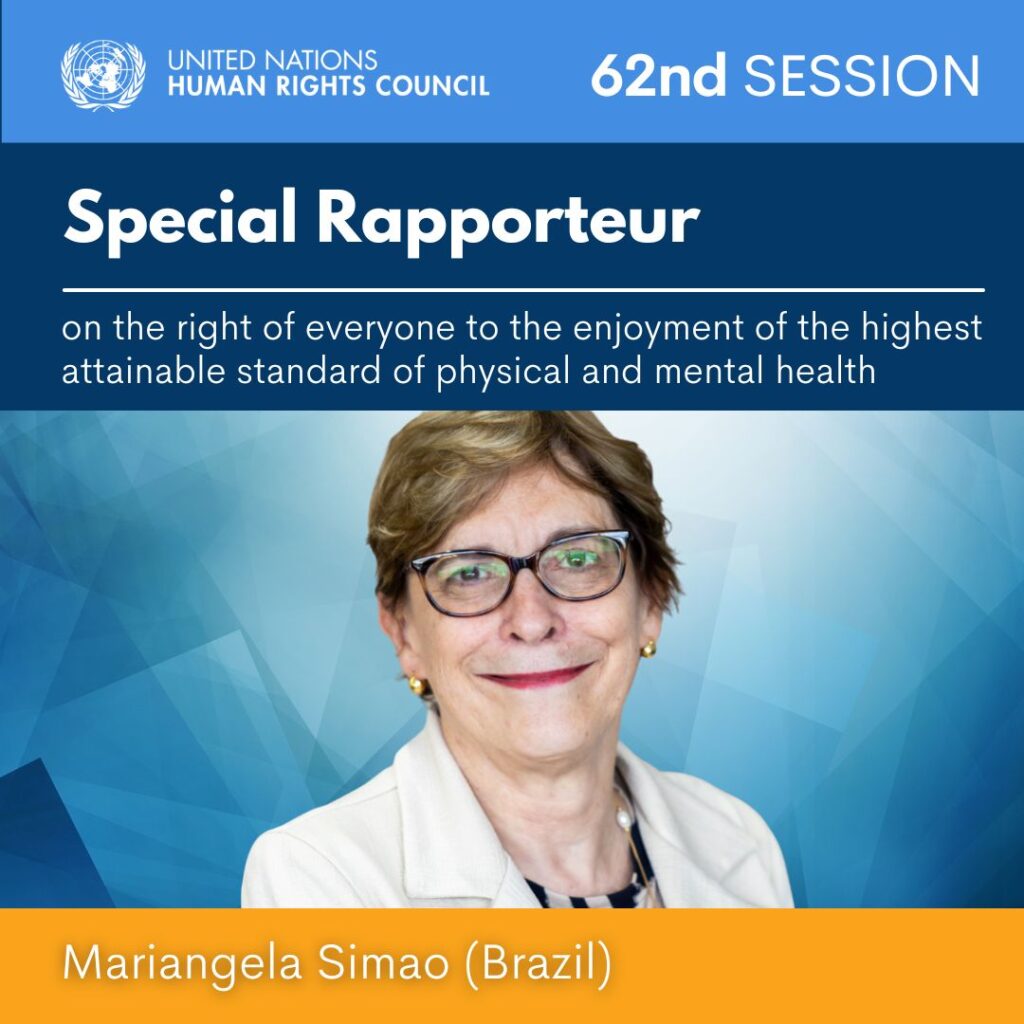
Priorities and Vision of the New Special Rapporteur on the Right to Health
Joseph Amon in conversation withMariângela Simão
At its 62nd session in July 2026, the United Nations (UN) Human Rights Council appointed Mariângela Batista Galvão Simão as Special Rapporteur on the right of everyone to the enjoyment of the highest attainable standard of physical and mental health. Simão is a pediatrician by training and has worked extensively in public health policy and the promotion of the right to health at local, national, and international levels. Her work has focused on ensuring equitable, nondiscriminatory access to health services, medicines, vaccines, and other health products.
In Brazil, she held senior public health positions in disease surveillance and research before leading the national program on HIV/AIDS, sexually transmitted infections, and viral hepatitis, where she worked to ensure sustainable access to treatment, combat stigma and discrimination, and strengthen mechanisms for civil society participation in Brazil’s Unified Health System. She subsequently served as director of the Gender, Rights and Social Inclusion Department at the Joint United Nations Programme on HIV/AIDS (UNAIDS), where she advanced rights-based approaches and global guidance concerning key populations, including gay men and other men who have sex with men, sex workers, and people who use drugs. She later served as assistant director-general for access to medicines and health products at the World Health Organization (WHO), where she worked to improve access to medicines and other health products, including through initiatives on fair pricing, transparency, and inequities exposed by the COVID-19 pandemic.
At the start of her mandate as Special Rapporteur on the right to health, she joined Health and Human Rights’ editor-in-chief, Joe Amon, for a discussion of her new role, priorities, and vision for advancing the right to health.
Joe:It’s so nice to see you again, Mariângela. We have a lot to talk about, so let’s dive in! The first question I have for you is this: Each of your predecessors emphasized building on prior mandate work rather than “reinventing the wheel.” Which specific thematic reports or frameworks from Paul Hunt, Anand Grover, Dainius Pūras, and Tlaleng Mofokeng do you intend to build upon most directly, given your own background? What new issues are you keen to address?
Mariângela: This is a very good question, but the way I think about it is less about “reinventing the wheel” and “new issues” and more about the fact that, within public health, there are always some issues that are unresolved and continue to need attention. And then there are also new issues and challenges that emerge.
A few issues that always need attention are sexual and reproductive health and rights; health care and health care workers in conflict situations; the rights of key populations; and stigma and discrimination. And I would add that for stigma and discrimination, I’m not only thinking about HIV and AIDS but infectious diseases that are possible to eliminate from a public health perspective and are not eliminated.
There are other key issues, too, such as access to medicines and vaccines. This is an issue I’ve long been passionate about—it’s in my DNA—and is an overarching interest. But there are other pressing issues, too! One is aging and the other is mental health, which of course Dainius Pūras focused on. Both are very difficult to tackle. And there is also something that I had to deal with in Brazil when I was the vice minister for health surveillance and environment, which was climate change and health. This is also a critical and difficult issue to address and illustrates why it’s important for Special Rapporteurs to collaborate. For example, there is a Special Rapporteur on climate change and a Special Rapporteur on environmental issues, and there is value in sharing expertise and in thinking across rapporteurs on how to ensure that new technologies are accessible to all and can make people’s lives better.
Joe:The next question I have for you is this: You worked in Brazil and subsequently at UNAIDS and WHO to strengthen civil society participation mechanisms. How do you see this important principle going forward? Will WHO do more? Why is this important? How can individual countries be encouraged to incorporate community participation in national health systems? There’s a lot of questions within that one question!
Mariângela: There is a lot of uncertainty and a lot of choices that will be made. At WHO, there’s both a financial crisis and the upcoming selection of the next Director-General. What I think is worth keeping in mind is that the UN is what member states want out of it. There’s all this discussion about the future, but I think we need to remember that fact.
From the start of my working on HIV, I heard the saying—which I think comes from the disability rights movement—“nothing about us without us.” This principle is not about one health issue or another. It is a foundation for participation at every level. With HIV, we had a Security Council session on HIV and a UN General Assembly resolution on HIV. There are very successful examples of community engagement in HIV, and we need to continue to ensure that there is that kind of involvement. During my time at UNAIDS, civil society had a seat on the board, and influence. At WHO, there wasn’t the same structured engagement with civil society. But civil society organizations can get involved at national levels to pressure their governments to take action on critical issues domestically and to engage with WHO through the World Health Assembly.
In Brazil, from the beginning of the organization of the country’s public health system (known as SUS), we have had additional regulations set up in Congress, such as complementary laws defining the ways that civil organizations should be involved in the SUS’s decision-making. For example, 50% of the seats in national health councils, state councils, and municipal health councils are for civil society organizations. So it is super important to have formal mechanisms to ensure that civil society voices are heard and taken into account. Countries need to move toward creating these mechanisms where they do not exist. And the UN has to help as well and set an example.
What I see also in this question—and it’s quite current in what we are seeing around the world—is a stronger and more coordinated conservative movement that is trying to silence the voices of key populations, including through repressive laws that criminalize identities and deny fundamental rights to all.
Global organizations and multilateral organizations have to help ensure that civil society’s voice is heard. It cannot be an afterthought, with civil society given just a few minutes here or there before or after business has begun. There has to be active listening. The same is true at the national level, but you need to create mechanisms for that to happen as a routine, so nobody can question it.
Joe:Are there multilateral institutions that are doing a good job trying to support that process? I don’t feel like there’s a lot of championing for civil society voices to be at the table. I think it’s a lot rarer than it used to be.
Mariângela: That’s part of this wave of conservatism, right? But there are still positive examples. The Global Fund has been a good example of engaging civil society and promoting human rights, but we’ll have to see what happens with a new Global Fund executive director, and what changes might happen next year with a new WHO Director-General. Even though WHO operates differently, as a normative agency, it’s important for it to continue to strengthen its engagement with civil society.
In terms of UNAIDS, I think it remains essential that it is not just shut down. HIV and AIDS is not over. There’s a lot of naivete from the agency’s 11 cosponsors[*] thinking that they can take on UNAIDS’s role and that the money will go to them directly. I don’t think that that is necessarily what will happen. The responsibilities could go to the cosponsors, but the money might not follow.
We live in complicated times, always. We have to figure things out and move forward. And while there are so many good people within all of these institutions, politics can get in the way. Good intentions, I always say, are not enough. You have to be doing the right thing at the right moment in the right context. And even if you are doing all that, you still may face powerful, organized obstruction. When I was at UNAIDS, I saw a shift during World Health Assembly sessions, from a time when only one or two countries would speak out, for example, against sexual and reproductive health and rights, to a time where a single country would speak out on behalf of more than 50 conservative member states. That speaks to the organization, and power, that civil society faces in trying to advance health and human rights.
Joe:Focusing on your WHO role, where you were at the center of debates on fair pricing mechanisms, what specific policy tools, compulsory licensing, patent pools, regional manufacturing hubs, or pricing transparency mandates do you consider most promising for advancing equitable access to medicines and technologies? And how will you champion these through the Special Rapporteur mandate?
Mariângela: I think the single most important discussion that’s happening right now is the ongoing negotiation in Geneva on the Pathogen Access and Benefit Sharing (PABS) annex to the Pandemic Agreement. As you know, at WHO I was the assistant director-general for access to medicines and other health products during the pandemic. When the pandemic started, I remember two things: Someone saying that the pandemic was not going to be a marathon, it was going to be an Ironman competition and we would need to keep up our stamina and energy. And the second was the recurrent sentiment that we should try not to make the same mistakes that were that were made in response to the H1N1 and HIV pandemics. Specifically, with H1N1, by the time the vaccine became available to the developing world, the pandemic had ended. With COVID-19, we tried to make sure that didn’t happen again, but we didn’t fully succeed.
Perhaps even more important than (or at least as important as) the WHO Director-General election is how we will solve this problem: How will the world share the benefits of technology and ensure equitable access? People are resurrecting the Pandemic Influenza Preparedness framework, but when I was at WHO we avoided using that framework because we didn’t think it worked very well. But now it’s like a gold standard despite its shortcomings. It is a way to find common ground, I suppose.
There are new ideas that we should also be looking at. I was recently in Geneva for the Social Forum of the Human Rights Council, and there were two panels on access. It seems like it shouldn’t even need to be said, but a rights-based approach to development means that human rights should not be trumped by intellectual property laws. At the meeting, the Special Rapporteur on economic, social, cultural, and environmental rights of the Inter-American Commission on Human Rights, Soledad García Muñoz, highlighted how, in the Americas, COVID-19 had worsened already extreme inequalities. She noted that states should adopt an intersectional perspective focused on the principles of equality, nondiscrimination, and the indivisibility of rights, taking into account vulnerability levels and risks due to age, gender, disability, race, ethnicity, sexual orientation, and socioeconomic background. The commission had recommended that vaccines be considered universal public goods and that intellectual property should not impose barriers to universal and equitable vaccine distribution.
But it’s not only new technologies. For example, medication for epilepsy isn’t available everywhere, even though there are generic versions that are safe and affordable. You need to have political will. Intellectual property is important for innovative products, but we need a framework that will help the world see medicines and vaccines as global public goods different from other products. We are seeing this with HIV (once again) with the discussions around access to lenacapavir. The licenses that Gilead issued excluded upper-middle-income countries, where most people living with HIV are located. This is just not acceptable, and it has to change if we really are aiming for equitable access to health technologies that can have a public health impact. In a way, I think the Pandemic Agreement and the PABS annex, at least for infectious diseases that have a pandemic potential, can help us with the next pandemic. I think it’s a moral obligation. And that’s why my first report as Special Rapporteur will be focusing on the pandemic PABS system.
Diversifying production is also important. Even though we do have a WHO framework for global production, we need to think more about local production. Brazil championed the G20 initiatives, and this work has continued with India and South Africa aiming to diversify local and regional production. It is also important to build more capacity globally, not just in developed countries, China, or Russia. For example, the know-how around mRNA technologies needs to be expanded. The mRNA technology transfer hub that WHO developed in South Africa was a good way to expand capacity for vaccine development and promote regional health security. It’s not that you need to produce everything everywhere, but you need to have key countries producing—key countries that have strong regulatory agencies and so on. Joe:All right, next question. Global health financing reforms increasingly emphasize country-led priority setting and “one-stop country compacts” that consolidate donor funding under national government control. From a right to health perspective, how do you ensure that this shift toward country ownership doesn’t become a mechanism for governments to deprioritize marginalized groups (e.g., sex workers, people who use drugs, and LGBTQ+ people) whose needs may not align with majoritarian political priorities? What human rights safeguards or accountability mechanisms should be built into these country-led financing structures to ensure that control flows beyond ministries to the communities most affected?
Mariângela: These are several million-dollar questions. First of all, I think it’s super important that all of us—and I include myself and my colleagues in the Special Procedures division of the Office of the High Commissioner for Human Rights—talk differently about human rights. We often talk about human rights like this ultimate and unattainable goal, and we need to make it more comprehensible, clearer, and speak in plain language about it. The right to health is about nondiscrimination, about availability, accessibility, acceptability, and quality. But let’s use less jargon and say that the right to health is about governments doing everything they can to ensure that people are as healthy as possible. That is going to require all of what is laid out in General Comment 14, in constitutions, and across multiple international human rights treaties. It also requires that we have mechanisms to ensure accountability.
My immediate predecessor, Tlaleng Mofokeng, recognized this and did a lot to make the right to health more accessible. I like the way she did it. And her last report emphasized justiciability, which I think we need to emphasize more. The right to health is actionable because health is actionable. Of course, there are issues like climate change that can be a challenge in terms of justiciability. But the health impacts of climate change are pretty concrete.
To loop back to what we were talking about earlier, about conservative global movements and how to ensure that key populations have a voice, I don’t believe that we can ensure that, unfortunately. In my own country, Brazil, the right to health is part of the Constitution, so you don’t have to define vulnerability—everyone should be protected. That means you can look at the bigger picture and ask, How well are health systems funded? Where is the money going? Brazil has a complex funding model in which the federal government sends money to state governments, city governments, and local authorities. And we tried to follow the money and see where it went. At the city level, we could look at how much funding went to sex workers, men who have sex with men, transgender people, and, of course, people who use drugs, who are always the last in line for funding. So we managed to track the money that we were targeting for specific populations, but it wasn’t easy.
But promoting understanding of the right to health is critical. When people understand that they have rights, they will ask questions and demand the services that they are entitled to. That’s an easier approach than trying to track funding flows through the system. But for that to work, we need to make rights language more accessible to everyone.
Joe:That’s certainly true in countries like the United States, where there’s just no history of looking at health as a human right. Although there’s a history of charity hospitals associated with specific religions or specific immigrant groups, the idea of health as a human right is really poorly understood. There is a lot of discussion around social and political determinants of health, but most public health professionals see the right to health as some kind of legal formulation rather than concrete interventions, such as training health workers in nondiscrimination or funding paralegals who can help people overcome barriers to accessing prevention and care.
Mariângela: It is unsurprising that people working in public health and medicine prefer thinking in terms of technocratic solutions rather than human rights. That’s what we’re trained in. But I do think there is increasing recognition of the downsides of this—for example, there is so much misinformation and disinformation around public health issues. The public health and medical community have been caught off guard. We are used to being authorities, and now we need to rethink how we connect with people, which is why my second report will be on misinformation and disinformation. And the report is, I’m sorry to say, largely inspired by vaccination denialism in the United States. But it’s also spreading. Public health decisions should not be based on opinions or ideology. They should be based on science and human rights.
Joe:Thank you so much, Mariângela, for this conversation. I very much look forward to further discussions, and I’m happy to give you the final word.
Mariângela: I will end by saying, simply, that the right to health is actionable. We have a moral obligation to demonstrate this and ensure that people understand that it’s their right. In Brazil, we value the right to health in part because we had to fight for it. And the way to fight for it is to show that it can be operationalized.
I often end an interview or a speech with the last lines from Pink Floyd’s song “Hey You.” I like rock’n’roll, and the lines speak to me:
Hey, you, don’t tell me there’s no hope at all
Together we stand, divided we fall
I’m a true believer that there’s hope to make things better for people, but we need to stand together. My career has been dedicated to realizing the right to health. It’s a moral obligation, and we must take it forward and keep talking—but not only talking, making sure that people understand and can operationalize it.
Joseph J. Amon, MSPH, PhD, is Desmond M. Tutu Professor in Public Health and Human Rights, director of the Center for Public Health and Human Rights, and a distinguished professor of the practice in the Department of Epidemiology, Johns Hopkins Bloomberg School of Public Health, Baltimore, United States, and editor-in-chief ofHealth and Human Rights.
Please address correspondence to Joseph J. Amon. Email: joe.amon@jhu.edu.
[*] UN Refugee Agency; United Nations Children’s Fund; World Food Programme; United Nations Development Programme; United Nations Population Fund; United Nations Office on Drugs and Crime; UN Women; International Labour Organization; United Nations Educational, Scientific and Cultural Organization; World Health Organization; and World Bank.