

Negotiating Mental Health in the Lithuanian Parliament: Human Rights, Social Control, and Moral Regulation
Daumantas Stumbrys and Dainius Pūras
Abstract
Mental health is increasingly recognized as a human rights issue, yet little is known about how mental health is debated within political institutions, particularly in post-socialist societies. This study examines how mental health issues were discussed in the Lithuanian parliament between 2012 and 2020. We conducted a thematic discourse analysis of 876 plenary sitting transcripts, drawing on theories of political fields, moral regulation, and social control. Four themes emerged: children’s mental health, mental health and gender, alcohol and drugs, and public mental health. Parliamentary debates revealed competing understandings of mental health as a matter of human rights, public health, traditional family values, public safety, and moral order. Human rights arguments were prominent in debates on violence against children, gender identity, access to services, and involuntary treatment, while evidence-based arguments were particularly prominent in debates on alcohol policy. At the same time, some discussions relied on stigmatizing and moralizing narratives portraying particular groups as threats to society, public safety, or moral order. The findings suggest how political discourse forms part of mental health governance by articulating competing understandings of vulnerability, risk, responsibility, and appropriate policy responses. The study contributes new evidence on mental health governance in a post-socialist context.
Introduction
Mental health is increasingly recognized as an integral component of the right to the highest attainable standard of physical and mental health.[1] International organizations and human rights bodies have expressed growing criticism of coercive, institutionalized, and overly medicalized approaches to mental health care and called for the development of person-centered, rights-based services.[2] Nevertheless, mental health remains a contested policy field in which competing understandings of rights, risk, responsibility, and social order continue to shape public debates and policy responses. Lithuania provides a particularly relevant context for examining these tensions. Although the country has undergone substantial mental health reforms since the 1990s, it continues to face major public mental health challenges, including persistently high suicide rates, elevated alcohol-attributable mortality, and ongoing concerns related to stigma, institutionalization, and the implementation of human rights standards in mental health care.[3]
Since the restoration of independence in 1990, Lithuania has undertaken significant reforms in mental health policy and care. These reforms have sought to move away from the soviet legacy of institutionalized psychiatry and develop a more community-based and rights-oriented mental health system.[4] However, research suggests that the implementation of these reforms has been uneven and that important structural challenges remain. Studies have documented the continued dominance of biomedical approaches, the insufficient development of community-based services, and persistent power asymmetries between mental health professionals and service users.[5] Concerns have also been raised regarding the limited implementation of human rights standards in mental health care, including barriers to meaningful participation, autonomy, and person-centered care.[6] At the same time, mental health problems in Lithuania continue to represent a major public health challenge. The country has experienced persistently high suicide rates and a substantial burden of alcohol-attributable mortality, both of which have been linked to broader social and historical processes associated with post-socialist transformation.[7] Qualitative research further highlights the persistence of stigma surrounding mental illness, low levels of trust in mental health services, and barriers to seeking care.[8] Taken together, these findings suggest that Lithuania offers a useful context for examining how competing understandings of mental health, human rights, and social order are constructed and negotiated in political debates.
Parliamentary debates form one part of a broader policy environment shaped by health care institutions, professional practice, media discourse, advocacy, and wider social and international developments. They provide a useful source for examining how political narratives and values are articulated in relation to policy development.[9] Previous research in Lithuania has demonstrated that parliamentary agendas on mental health have interacted with media reporting and wider political developments, including international human rights and policy initiatives. As shown by Eglė Šumskienė et al., for example, media coverage is closely connected with the political agenda on mental health, and periods of increased attention often coincide with important international developments.[10]
Moreover, studies of public and policy discourse suggest that mental health problems are frequently represented through binaries such as normality and deviance, health and pathology, or inclusion and exclusion.[11] Individuals experiencing mental health problems may consequently be positioned as fundamentally different from the wider population and become subjects of regulation, surveillance, or intervention.[12] From a human rights perspective, such representations are important because they may contribute to stigma, discrimination, and the marginalization of people with mental health conditions. Together, these findings suggest that discourse plays an important role in shaping public understandings of mental health and influencing policy responses.
Research in Lithuania has also documented challenges related to the implementation of mental health reforms, access to care, trust in mental health services, and the protection of human rights within the mental health system.[13] Similar challenges have been identified across Central and Eastern Europe, where mental health systems continue to be shaped by the legacies of institutionalized care, biomedical approaches, and broader post-socialist transformations.[14]
Despite these developments, relatively little attention has been paid to how mental health issues are discussed and framed within legislative institutions. The aim of this study is to examine how mental health was discussed and constructed in parliamentary debates in Lithuania between 2012 and 2020. Specifically, the study addresses the following questions: (1) What major mental health-related themes emerged in parliamentary debates? (2) How were mental health issues framed and discussed in parliamentary debates? (3) How did different political actors use human rights, scientific evidence, and moral arguments when discussing mental health issues?
Methods
This study employed qualitative document analysis and thematic discourse analysis to examine parliamentary debates during the 11th (2012–2016) and 12th (2016–2020) terms of the Seimas of the Republic of Lithuania. Two complete legislative terms were selected to allow for an examination of parliamentary discourse under different political compositions and contexts. The subsequent 2020–2024 term was still ongoing when we initiated our study and was therefore not included. The two parliamentary terms also differed substantially in their political composition. The 2012–2016 government was led by the Lithuanian Social Democratic Party, whereas after the 2016 election the Lithuanian Farmers and Greens Union became the dominant governing force. These differences are noted as relevant political context, although we did not systematically analyze party-level effects.
We analyzed transcripts usingMAXQDA Analytics Pro, release 24. We conducted the analysis in two stages. First, we used the text search and autocode function to identify text segments containing discussions related to mental health. Because all transcripts were in Lithuanian, our search used the root term “psich,” which captures Lithuanian words related to mental and psychiatric issues. Each coded segment included the paragraph containing the search term, as well as the two preceding and two following paragraphs, in order to preserve the immediate context of the discussion. Second, we analyzed the selected text segments using thematic analysis, following the procedures outlined by Virgina Braun and Victoria Clarke.[15] We developed initial codes through repeated reading of the selected parliamentary transcripts. We assigned some text segments more than one code. We then grouped similar codes into broader themes, which we reviewed, refined, and renamed where necessary. Due to the size of the dataset, we analyzed transcripts from the 2012–2016 and 2016–2020 parliamentary terms separately. This also allowed for a comparison of mental health discourse across the two terms.
To assess the sensitivity of the initial search strategy, we conducted an additional search of the 2012–2016 parliamentary debates using alternative Lithuanian search stems related to mental health and the topics identified in the analysis: “savižud” (suicide), “depres” (depression), “nerim” (anxiety/concern), “emoc” (emotion/emotional), “stres” (stress), “traum” (trauma), and “patyč” (bullying). The sensitivity analysis identified additional relevant material, particularly on suicide and bullying, but this material largely corresponded to themes already identified in the original thematic analysis, and no additional major themes emerged.
Our analysis was informed by Pierre Bourdieu’s concepts of field, agents, and strategies.[16] Parliamentary debates were interpreted as a social field in which political actors compete to define legitimate understandings of mental health and appropriate policy responses. Within this field, different actors mobilize distinct forms of knowledge, values, and political resources in order to advance particular interpretations of mental health-related problems and their solutions. This perspective makes it possible to examine not only what is said in parliamentary debates but also how competing actors seek to shape policy agendas and establish their positions as legitimate and authoritative. We identified three recurring actor positions in the analysis. The category of moral entrepreneurs was theoretically informed by previous studies of Howard Becker, Erich Goode and Nachman Ben-Yehuda, whereas evidence-based policy advocates and human rights advocates emerged inductively from the data.[17] We did not treat these positions as fixed or mutually exclusive, as individual actors could draw on different discursive strategies depending on the issue. Although party affiliation was known for individual speakers, we did not systematically analyze it because party-level differences were not a specific focus of the study.
We paid particular attention to how mental health issues were framed in relation to different approaches to mental health. Previous literature has distinguished among biomedical, biopsychosocial, and human rights-based approaches, which differ in how they define mental health problems, their causes, and appropriate responses.[18] The biomedical approach primarily emphasizes diagnosis and treatment, whereas the biopsychosocial approach highlights the interaction of biological, psychological, and social factors. Human rights-based approaches, meanwhile, emphasize the right to health and related principles of dignity, autonomy, participation, equality, nondiscrimination, liberty, and protection from violence, together with the state’s obligations to respect, protect, and fulfill the right to health.[19] We used these approaches as an interpretive framework for examining how mental health issues were constructed and discussed in parliamentary debates.
The study relied exclusively on publicly available parliamentary records and did not involve human participants. Ethical approval was therefore not required under applicable research regulations in Lithuania.
Findings
We analyzed 876 transcripts of parliamentary plenary sittings, including 407 transcripts from the 2012–2016 Seimas and 469 transcripts from the 2016–2020 Seimas. Using the search term “psich,” we identified 406 mental health-related text segments in the 2012–2016 parliamentary term and 637 in the 2016–2020 term. These figures are presented descriptively and should not be interpreted as indicating greater parliamentary attention, as the number of parliamentary transcripts differed between the two periods. Our thematic analysis revealed four major themes in parliamentary debates: children’s mental health, mental health and gender, alcohol and drugs, and public mental health. Table 1presents an overview of the major themes and their main subtopics.
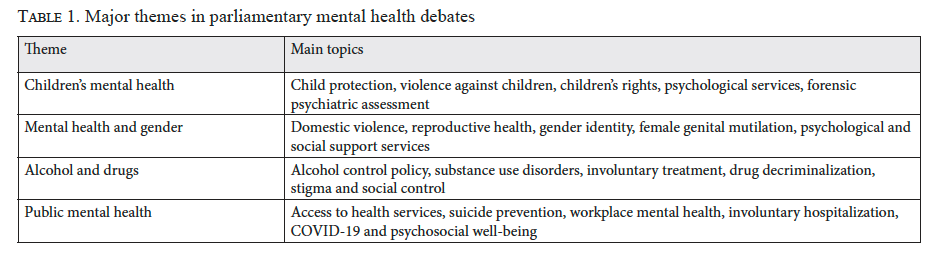
The four themes identified in the analysis represent distinct areas of parliamentary debate, but they also reveal recurring struggles over how mental health-related problems should be defined and addressed. Across these debates, parliamentarians drew on different sources of legitimacy, including scientific and professional expertise, human rights principles, political authority, and moral claims. The thematic analysis therefore also examined how these forms of authority were mobilized to support particular understandings of problems and policy responses.
Children’s mental health
Children’s mental health emerged as one of the most prominent themes in parliamentary debates during both legislative terms. Discussions focused on child protection, violence against children, access to psychological services, and child psychiatric assessments. Members of parliament frequently highlighted the shortage of psychological support services and the limited availability of child mental health specialists. Mental health was often presented as a matter of public concern extending beyond the health sector and encompassing education, family policy, and child protection.
Debates concerning children’s mental health frequently focused on the consequences of violence against children. Several parliamentarians argued that violence within families remained normalized in Lithuanian society and contributed to the intergenerational transmission of harmful behaviors. Violence was often discussed not only as a violation of children’s rights but also as a broader public mental health issue with long-term consequences for individuals and society. As one member of parliament and former psychiatrist explained:
He admitted very openly, he says: yes, I was also beaten, I was raised in the same way as I behave now in my family. But he says, at least I grew up as a normal person. This is our current understanding, this is the mentality of society, that we consider ourselves a normal society that raises normal children. (A. Veryga, plenary sitting no. 28)
Not all parliamentarians supported stronger state intervention in child protection. Opponents of legislative reforms frequently framed restrictions on physical punishment and psychological violence as excessive interference in family life. Their arguments emphasized parental authority, family autonomy, customary child-rearing practices, and the protection of traditional values. Rather than focusing on children’s rights or mental well-being, these debates often centered on the perceived limits of state intervention and concerns that expanding legal protections for children could undermine established family relationships. In some cases, support for physical punishment was explicitly justified through religious arguments. Referring to Christian teachings and biblical authority, one parliamentarian argued that certain forms of corporal punishment were compatible with child-rearing:
We are a Christian country. The Bible is the book of God’s wisdom. It is written about scolding the child and even about physical punishment with a belt. A scourge and a rebuke bring wisdom … When you pity the whip, you hate your child, and when you love, the whip corrects. (P. Gražulis, plenary sitting no. 28)
These arguments contrasted sharply with perspectives that framed physical and psychological violence against children as violations of fundamental rights requiring legal protection. The debates therefore revealed broader tensions between traditional understandings of family authority and emerging approaches emphasizing children’s rights, dignity, and protection from harm. Supporters of legislative reforms frequently drew on human rights principles, arguing that children should enjoy the same protection from violence as adults and that existing legislation failed to meet both constitutional and international human rights standards. As one parliamentarian stated:
No arguments justify today’s situation, when Lithuania, which declares respect for universally recognized human rights, has not adopted a law prohibiting all types of violence against children. (O. Valiukevičiūtė, plenary sitting no. 164)
Human rights arguments also appeared in debates concerning access to child mental health services and psychiatric assessments. Members of parliament raised concerns about lengthy waiting times for forensic psychiatric examinations involving children and argued that such delays could violate fundamental rights and expose the state to legal challenges under European human rights mechanisms. These debates reveal competing understandings of what protecting children requires. Rights-based arguments emphasized children’s dignity, protection from violence, access to support, and recognition of children as rights holders. Other interventions placed greater emphasis on parental authority, family norms, and the preservation of a particular moral order. Children’s mental health was thus an area in which different understandings of protection, authority, and rights were negotiated.
Mental health and gender
Mental health and gender emerged as a distinct theme in parliamentary debates. Discussions focused on domestic violence, reproductive health, gender identity, and access to psychological support services. Across these debates, parliamentarians frequently linked mental health to questions of human rights, bodily autonomy, discrimination, and social protection. At the same time, debates revealed tensions between rights-based approaches and more traditional understandings of gender, family, and social order.
Several debates focused on violence against women as a human rights issue. Discussions concerning the criminalization of female genital mutilation framed the practice as a violation of the dignity, bodily integrity, and fundamental rights of women and girls. While support for criminalization was grounded largely in human rights arguments, some parliamentarians questioned the necessity of regulating a practice they perceived as uncommon in Lithuania. Others questioned the rationale for criminalization by drawing comparisons with male circumcision, with one parliamentarian asking whether criminal penalties would also apply to male circumcision (R. Žemaitaitis, plenary sitting no. 331). More broadly, some members of parliament portrayed the issue as externally imposed rather than arising from domestic needs. As one parliamentarian argued:
I have not even heard that there is such a problem in Lithuania. I understand that this is probably where Europe or some movements have given the order, and we are now rushing to proceed. (M. Zasčiurinskas, plenary sitting no. 331)
These debates reflected broader tensions between universal human rights principles and arguments emphasizing national traditions, cultural particularity, and resistance to externally driven policy change. While supporters framed female genital mutilation primarily as a human rights issue, opponents often questioned its relevance to the Lithuanian context.
Debates concerning gender identity revealed some of the most explicit forms of stigmatizing language identified in the analysis. During discussions on gender reassignment and related legal regulations, transgender persons were described by some parliamentarians as suffering from “mental deviation” or as “mentally ill people who are hurting themselves.” Such statements were at times accompanied by laughter in the parliamentary chamber, reflecting broader processes of stigmatization and marginalization. In contrast, supporters of gender reassignment rights emphasized dignity, inclusion, and protection from discrimination. One parliamentarian criticized the mocking tone of the debates and argued that gender identity should be approached as a matter of human dignity rather than ridicule:
Gender reassignment is not an individual’s whim. It is not like changing shoes or socks. It is a complex aspect of human experience. Yet supposedly healthy members of parliament are mocking people who live among us. (M. A. Pavilionienė, plenary sitting no. 66)
The debates revealed a sharp contrast between stigmatizing and rights-based framings of gender identity. While some parliamentarians portrayed transgender persons through the language of pathology, deviation, or mental illness, others emphasized dignity, inclusion, and protection from discrimination. These competing narratives reflected broader disagreements regarding the relationship between mental health, gender diversity, and human rights.
A third area of discussion concerned access to psychological and social support services. Parliamentarians repeatedly highlighted the limited availability of support for women experiencing domestic violence, abortion, divorce, suicide attempts, and other major life crises. These debates emphasized the importance of accessible psychological and social services and frequently presented mental health support as an essential component of broader social protection policies.
The debates concerning gender and violence also illustrate how mental health language intersected with broader disputes over rights, identity, family, and moral order. Rights-based arguments emphasized dignity, nondiscrimination, protection from violence, and access to support, whereas other interventions invoked traditional understandings of gender and family or portrayed particular social changes as potentially harmful. In this context, mental health discourse formed part of a wider struggle over which identities, norms, and forms of protection should be recognized as legitimate.
Alcohol and drugs
Alcohol policy was one of the most frequently discussed mental health-related issues in parliamentary debates between 2012 and 2020. Discussions intensified during the period when Lithuania introduced a comprehensive package of alcohol control measures, including restrictions on alcohol availability, a ban on alcohol advertising, increases in excise taxation, and an increase in the legal drinking age. Parliamentary debates revealed a growing role of scientific evidence and public health expertise in policy discussions. Supporters of stricter alcohol control measures frequently relied on evidence-based arguments and framed alcohol-related harm as a population-level problem requiring structural interventions. Scientific evidence was presented as an important source of legitimacy for policy decisions. As one parliamentarian stated, “In the Lithuanian health system, we must be guided by science-based and proven methods” (A. Veryga, plenary sitting no. 77). Opponents of alcohol control measures rarely disputed the existence of alcohol-related harm. Instead, they questioned the proportionality of population-wide restrictions, arguing that such measures affected the entire population despite targeting problems concentrated among a relatively small group of heavy drinkers. As one parliamentarian argued:
Would you agree that, in trying to address the harms caused by the 10–15% of citizens who drink heavily, the ruling majority is effectively imposing restrictions not on that group, but on the remaining 85% of the population? (A. Mazuronis, plenary sitting no. 324)
These debates reflected broader disagreements regarding the role of the state in addressing public health problems. While supporters emphasized population health and scientific evidence, opponents stressed individual responsibility and the proportionality of regulation.
Parliamentary debates concerning addiction treatment frequently focused on the relationship between individual rights, public safety, and state intervention. Discussions surrounding proposed amendments to the Law on Narcological Supervision revealed a tendency to frame people with alcohol and substance use disorders as a source of risk to themselves, their families, and society. In this context, compulsory treatment and involuntary hospitalization were often presented as necessary measures to prevent harm and protect vulnerable family members. Supporters of expanded involuntary treatment argued that addiction may lead to violence, financial losses, and serious risks to health and well-being. These arguments emphasized the need to protect family members and the wider community from the consequences of substance use disorders. As one parliamentarian argued:
Family members and others closely associated with such individuals are subjected to constant psychological and physical violence, posing a threat to their health and even their lives. (R. Šalaševičiūtė, plenary sitting no. 76)
Overall, debates on addiction treatment were characterized by a strong emphasis on protection, risk, and public safety. Substance use disorders were frequently discussed not only as health conditions but also as social problems requiring increased regulation and control. Drug policy debates revealed some of the clearest disagreements regarding the relationship between mental health, substance use, and the role of the state. Discussions focused on criminal penalties for drug possession, access to treatment and support services, and proposals to decriminalize the possession of small quantities of drugs for personal use. These debates reflected fundamentally different understandings of people who use drugs and the most appropriate responses to substance use-related problems.
Supporters of decriminalization and expanded services frequently framed substance use as a public health issue rather than a criminal justice issue. They emphasized the importance of treatment, social support, and reducing stigma, arguing that punitive approaches may discourage people from seeking help. In these debates, addiction was often discussed as a health condition requiring services and support rather than punishment and exclusion. As one parliamentarian stated:
Western countries address these problems differently. They do not focus on stigmatizing people, locking them up, and keeping them in isolation, but instead on developing services and providing support for those who need help. (A. Armonaitė, plenary sitting no. 108)
Opponents of decriminalization frequently relied on arguments emphasizing deterrence, personal responsibility, and the potential risks associated with drug use. In some cases, debates moved beyond policy considerations and became highly personalized. Rather than discussing the potential consequences of criminalization or decriminalization, some parliamentarians questioned the personal credibility of political opponents. For example, one member of parliament publicly asked whether a supporter of decriminalization, A. Armonaitė, had used illicit drugs and whether she continued to use them (D. Gaižauskas, plenary sitting no. 133). Such arguments framed support for decriminalization as evidence of personal involvement with drug use rather than a legitimate policy position. Overall, debates on drug policy reflected a broader tension between public health-oriented approaches emphasizing support and inclusion and punitive approaches emphasizing deterrence, control, and social order.
The alcohol- and drug-related debates involved not only disagreement over specific policy measures but also competing claims about what counted as legitimate knowledge. Public health evidence, epidemiological data, and professional expertise were invoked to justify population-level interventions, while opposing arguments drew on individual choice, economic considerations, or alternative understandings of the appropriate limits of state intervention. The debates therefore reflected a broader struggle over which forms of expertise and authority should carry greatest weight in defining both the problem and legitimate policy responses.
Public mental health
Public mental health was frequently discussed as a broader societal issue extending beyond the health care system. Members of parliament linked mental health to demographic change, social cohesion, education, employment, and the long-term development of society. Mental health problems were often presented both as individual experiences and as indicators of wider social conditions. In these debates, improving public mental health was framed as a prerequisite for social well-being and sustainable development.
A recurring theme in parliamentary debates concerned the limited availability of psychological and mental health services. Members of parliament repeatedly highlighted shortages of psychological support, particularly for vulnerable groups and individuals experiencing crisis situations. Mental health services were often discussed alongside issues such as bullying, suicide prevention, addiction, and social exclusion. In her annual address to parliament, President Dalia Grybauskaitė emphasized the importance of strengthening psychological support and community-based assistance:
There is a severe shortage of psychological services throughout the country. Only nongovernmental organizations and volunteer-operated helplines are left to address bullying, suicide prevention, and addiction, and they are able to answer only one in seven calls … The state’s social policy must change so that no one is left without support. This is an investment in the future—a responsibility we cannot postpone. (D. Grybauskaitė, plenary sitting no. 252)
Parliamentary discussions also drew attention to mental health challenges faced by specific occupational groups, including teachers, health care workers, police officers, and other public servants. Bullying, workplace stress, and deteriorating psychosocial working conditions were frequently described as factors contributing to poor mental health. More broadly, some parliamentarians argued that problems observed in particular sectors reflected wider societal challenges. As one parliamentarian noted, bullying in schools should be understood as “a reflection of our society” (D. Pavalkis, plenary sitting no. 224).
Toward the end of the second term, parliamentary debates also reflected emerging concerns about the psychosocial consequences of the COVID-19 pandemic. Members of parliament, experts, and civil society representatives expressed concerns about the psychosocial consequences of isolation, reduced social contact, and restricted access to services. Debates emphasized the importance of maintaining attention to mental health alongside epidemiological and economic concerns. As one parliamentarian argued, “Especially during quarantine, when people are isolated from one another, have limited opportunities for social interaction, and do not receive the emotional support they need, attention to mental health becomes particularly important.” (M. Majauskas, plenary sitting no. 397) Similarly, concerns were raised that the long-term psychosocial consequences of the pandemic were receiving insufficient political attention and should be treated as seriously as its public health and economic impacts.
Debates on the Law on Mental Health Care revealed tensions between public safety considerations and human rights concerns. Supporters of involuntary hospitalization emphasized the need to protect individuals, family members, and property from harm. In contrast, opponents questioned the expansion of coercive measures and argued that mental health policy should prioritize voluntary rather than compulsory treatment. As one parliamentarian stated:
We should not be guided by popularity ratings or public opinion alone. We must also be guided by human rights and recognize that mental health policy should not focus exclusively on compulsory treatment; voluntary treatment must also be available. (M. Majauskas, plenary sitting no. 169)
Public mental health debates similarly involved competing understandings of state responsibility. Some interventions framed mental health as a public policy and rights issue requiring prevention, accessible services, and institutional responsibility, while others approached it primarily through narrower sectoral or individual-level responses. These differences concerned not only policy instruments but also the extent to which mental health was recognized as a collective responsibility and as part of the state’s obligations to protect and promote health.
These debates reflected broader disagreements regarding the balance between protection, public safety, and the rights of people experiencing mental health conditions. While some parliamentarians emphasized coercive interventions as necessary safeguards, others framed access to voluntary and rights-based services as a central element of mental health policy.
Discussion
This study examined how mental health issues were discussed and constructed in parliamentary debates in Lithuania between 2012 and 2020. Four major themes emerged from the analysis: children’s mental health, mental health and gender, alcohol and drugs, and public mental health. Although these themes reflected different policy areas, they were connected by recurring debates concerning rights, risk, responsibility, and the role of the state. Across all themes, mental health was discussed not only as a health care issue but also as a matter of human rights, public health, family values, public safety, and social order. These findings support previous research suggesting that mental health is socially and politically constructed rather than defined solely through medical expertise.[20]
The findings also demonstrate that parliamentary debates function as an arena in which competing understandings of mental health and appropriate policy responses are negotiated. Across the four thematic areas, we identified three recurring discursive positions: evidence-based policy advocates, human rights advocates, and moral entrepreneurs. The first two positions emerged inductively from the empirical analysis, whereas the category of moral entrepreneurs was informed by Becker’s concept of moral entrepreneurship and by Goode and Ben-Yehuda’s work on moral panic.[21] We did not treat these positions as fixed or mutually exclusive, as individual actors could draw on different discursive strategies depending on the issue under discussion. We did not systematically analyze party affiliation and therefore did not define these positions along party lines. Evidence-based policy advocates drew primarily on scientific evidence, epidemiological data, and professional expertise; human rights advocates invoked dignity, autonomy, nondiscrimination, protection from violence, and access to support; while moral entrepreneurs drew on claims concerning social norms, family, morality, and perceived threats to social order. From a Bourdieusian perspective, the interaction between these positions illustrates a symbolic struggle over who can legitimately define mental health-related problems and appropriate policy responses.[22]
The analysis revealed recurring tensions between human rights-based approaches and forms of moral regulation. More specifically, debates on child protection concerned protection from violence and the state’s protective obligations; discussions of gender identity engaged dignity and nondiscrimination; access to mental health services concerned the right to health; and involuntary treatment raised questions of autonomy and liberty.[23] At the same time, several debates relied on narratives portraying specific groups as sources of danger, deviance, or social disorder. This was especially evident in discussions concerning transgender persons, people who use drugs, and individuals with substance use disorders. These findings are consistent with previous studies showing that mental health discourse is frequently structured through distinctions between normality and deviance, inclusion and exclusion, and deserving and undeserving populations.[24] They also resonate with earlier Lithuanian studies demonstrating that people who use drugs are often portrayed as threats to social and moral order within political and public discourse.[25]
Evidence-based and human rights-based arguments were particularly visible during the 2016–2020 parliamentary term, especially in debates on alcohol control and child protection. Supporters of alcohol control measures frequently relied on scientific evidence and public health expertise, while advocates of children’s rights drew on national and international human rights standards. Several alcohol control measures adopted during this period were subsequently associated with reductions in alcohol-attributable mortality and other alcohol-related harms.[26] This illustrates the importance of scientific evidence as a source of legitimacy in parliamentary debate. However, because political affiliation and institutional position were not systematically analyzed, these discursive patterns cannot be attributed to changes in political composition or shifts in political power.
The findings should also be interpreted within a broader policy context rather than as reflecting an exclusively parliamentary process. Previous Lithuanian research has shown interactions between parliamentary debate, media attention, and wider political and international developments.[27] Positions identified in our analysis may therefore also reflect broader public, expert, human rights, and policy discourses that extend beyond the Seimas itself. At the same time, our data do not allow us to determine the direction or strength of these external influences. More broadly, mental health systems across Central and Eastern Europe continue to be shaped by legacies of institutional care, biomedical approaches, persistent stigma, and insufficient implementation of human rights principles.[28] Similar challenges have been documented in Lithuania, where studies have identified low trust in mental health services, unequal power relations within the mental health care system, and continuing barriers to rights-based care.[29] The tensions identified in parliamentary debates between human rights, public health, social control, and moral regulation should therefore be understood as part of a wider policy environment in which mental health priorities and meanings are negotiated.
This study has several limitations. First, the analysis was based exclusively on parliamentary transcripts and therefore captures parliamentary discourse rather than the broader mental health policy process. Although parliamentary debates may reflect influences from media coverage, advocacy organizations, international human rights developments, expert communities, and wider political events, our data do not allow us to determine how these external actors or processes shaped specific parliamentary positions or debates. The data also do not show how the positions expressed in Parliament were subsequently implemented or experienced in practice. Second, qualitative thematic analysis inevitably involves researcher interpretation, although systematic coding procedures were used to enhance analytical consistency. Third, the initial identification of relevant text segments relied on the search term “psich” (“mental” in Lithuanian). Consequently, some discussions relevant to mental health may not have been captured if they did not explicitly use this terminology. Finally, the study did not systematically examine party affiliation, governing status, or institutional roles; consequently, associations between parliamentary positions and particular discursive strategies cannot be established. Nevertheless, the study provides unique insight into the political construction of mental health issues in a national parliament over an eight-year period.
Based on these findings, we argue that parliamentary discourse is not merely a reflection of mental health policy but also an important mechanism through which public understandings of mental health are constructed. The language, narratives, and frames used in parliamentary debates may contribute either to reinforcing stigma and legitimizing coercive responses or to promoting dignity, inclusion, and rights-based approaches to mental health. This reinforces growing recognition that human rights-based mental health reform requires not only institutional and legislative change but also the transformation of public discourse surrounding mental health.[30]
Conclusion
Our findings reveal that parliamentary debates both reflect broader social and political understandings of mental health and provide an important arena in which future policy directions and institutional reforms are discussed and contested. For example, evidence-based arguments were particularly prominent in debates on alcohol policy, whereas human rights arguments frequently appeared in discussions on child protection, gender identity, and involuntary treatment. We identify tensions between evidence-based, human rights-based, and moralizing approaches to mental health, illustrating how political actors construct particular groups as deserving of support, protection, regulation, or control. In doing so, we contribute to sociological and human rights scholarship by demonstrating how political discourse can simultaneously challenge and reproduce stigma, exclusion, and unequal power relations through competing narratives of rights, protection, risk, and social control.
More broadly, our findings contribute to a growing body of research on mental health reform in Central and Eastern Europe. We show how global human rights and public health frameworks are interpreted, negotiated, and sometimes resisted within national political contexts, particularly when they challenge traditional understandings of family authority and gender. Consequently, we provide new empirical evidence on the political dimensions of mental health governance and offer insights relevant to researchers, policy makers, and mental health advocacy organizations working to promote rights-based approaches to mental health policy.
Acknowledgments
This research was funded by the European Social Fund under the “Development of Competences of Scientists, other Researchers and Students through Practical Research Activities” measure (number 09.3.3-LMT-K-712). OpenAI’s ChatGPT was used solely for language editing and stylistic refinement of the manuscript. It was not used for data collection, analysis, or interpretation.
Daumantas Stumbrys is an associate professor at theFaculty of Philosophy, Vilnius University, Vilnius, Lithuania.
Dainius Pūras is a professor at theFaculty of Medicine, Vilnius University, Vilnius, Lithuania.
Please address correspondence to Daumantas Stumbrys. Email: daumantas.stumbrys@fsf.vu.lt.
Competing interests: None declared.
Copyright © 2026 Stumbrys and Pūras. This is an open access article distributed under the terms of the Creative Commons Attribution-Noncommercial License (http://creativecommons.org/licenses/by-nc/4.0/), which permits unrestricted noncommercial use, distribution, and reproduction in any medium, provided the original author and source are credited.
References
[1] United Nations Human Rights Council, Report of the Special Rapporteur on the Right of Everyone to the Enjoyment of the Highest Attainable Standard of Physical and Mental Health, UN Doc. A/HRC/35/21 (2017).
[2] World Health Organization, Guidance on Community Mental Health Services: Promoting Person-Centred and Rights-Based Approaches (2021); S. Porsdam Mann, V. J. Bradley, and B. J. Sahakian, “Human Rights-Based Approaches to Mental Health: A Review of Programs,” Health and Human Rights 18/1 (2016); Human Rights Council, Mental Health and Human Rights, UN Doc. A/HRC/RES/43/13 (2020).
[3] D. Jasilionis, P. Grigoriev, D. Stumbrys, and V. Stankūnienė, “Individual and Contextual Determinants of Male Suicide in the Post-Communist Region: The Case of Lithuania,” Population, Space and Place 26/8 (2020); S. Doblytė, “Power Dynamics of the Healthcare Field: Seeking Mental Care in Lithuania,” Journal of Baltic Studies 52/3 (2021); S. Doblytė, “The Vicious Cycle of Distrust: Access, Quality, and Efficiency Within a Post-Communist Mental Health System,” Social Science and Medicine 292 (2022); D. Stumbrys, D. Jasilionis, and D. Pūras, “The Burden of Mental Health-Related Mortality in the Baltic States in 2007–2018,” BMC Public Health 22/1 (2022).
[4] D. Pūras, E. Šumskienė, M. Veniūtė, et al., Iššūkiai įgyvendinant Lietuvos psichikos sveikatos politiką [Challenges in Implementing Mental Health Policy in Lithuania] (Vilniaus universiteto leidykla, 2013).
[5] Doblytė (2021, see note 3); Doblytė (2022, see note 3).
[6] Pūras et al. (see note 4).
[7] Stumbrys et al. (2022, see note 3); D. Stumbrys, T. Telksnys, D. Jasilionis, et al., “Alcohol-Related Male Mortality in the Context of Changing Alcohol Control Policy in Lithuania 2000–2017,” Drug and Alcohol Review 39/7 (2020).
[8] S. Doblytė, “Shame in a Post-Socialist Society: A Qualitative Study of Healthcare Seeking and Utilisation in Common Mental Disorders,” Sociology of Health and Illness 42/8 (2020); P. Skruibis, O. Geležėlytė, and S. Dadašev, “The Stigma of Suicidal Behavior,” in D. Gailienė (ed), Lithuanian Faces After Transition: Psychological Consequences of Cultural Trauma (Vilnius University Press, 2015).
[9] P. Mackieson, A. Shlonsky, and M. Connolly, “Increasing Rigor and Reducing Bias in Qualitative Research: A Document Analysis of Parliamentary Debates Using Applied Thematic Analysis,” Qualitative Social Work 18/6 (2019).
[10] E. Šumskienė, G. Šumskas, J. Mataitytė-Diržienė, et al., “Media and Political Agenda Setting: The Case of Mental Health Policy in Lithuania,” Socialinė Teorija, Empirija, Politika Ir Praktika 13 (2016).
[11] R. Ohlsson, “Public Discourse on Mental Health and Psychiatry: Representations in Swedish Newspapers,” Health 22/3 (2018).
[12] J. Oute, L. Huniche, C. T. Nielsen, and A. Petersen, “The Politics of Mental Illness and Involvement: A Discourse Analysis of Danish Anti-Stigma and Social Inclusion Campaigns,” Advances in Applied Sociology 5/11 (2015).
[13] Pūras et al. (see note 4); Doblytė (2021, see note 3); Doblytė (2022, see note 3).
[14] P. Winkler, Z. Guerrero, A. Kågström, et al., “Mental Health in Central and Eastern Europe: A Comprehensive Analysis,” Lancet Regional Health – Europe 57 (2025).
[15] V. Braun and V. Clarke, “Using Thematic Analysis in Psychology,” Qualitative Research in Psychology 3/2 (2006).
[16] P. Bourdieu, The Logic of Practice (Stanford University Press, 1990); P. Bourdieu, Practical Reason: On the Theory of Action (Stanford University Press, 1998).
[17] E. Goode and N. Ben-Yehuda, “Moral Panics: Culture, Politics, and Social Construction,” Annual Review of Sociology 20 (1994); H. S. Becker, Outsiders: Studies in the Sociology of Deviance (Free Press, 1963).
[18] B. J. Deacon, “The Biomedical Model of Mental Disorder: A Critical Analysis of Its Validity, Utility, and Effects on Psychotherapy Research,” Clinical Psychology Review 33/7 (2013); F. Mahomed, J. Bhabha, M. A. Stein, and D. Pūras, “Establishing Good Practice for Human Rights-Based Approaches to Mental Health Care and Psychosocial Support in Kenya,” Health and Human Rights 22/2 (2020); Porsdam Mann et al. (see note 2).
[19] Committee on Economic, Social and Cultural Rights, General Comment No. 14, UN Doc. E/C.12/2000/4 (2000).
[20] Ohlsson (see note 11); Oute et al. (see note 12).
[21] Becker (see note 17); Goode and Ben-Yehuda (see note 17).
[22] Bourdieu (see note 16).
[23] Committee on the Rights of the Child, General Comment No. 13, UN Doc. CRC/C/GC/13 (2011); Committee on Economic, Social and Cultural Rights (see note 19).
[24] Ohlsson (see note 11); Oute (see note 12).
[25] D. Stumbrys, “Narkotikų retorikos kaita Lietuvos Respublikos Seime: atvejo tyrimas [Changes in the Rhetoric of Drugs in the Lithuanian Parliament: A Case Study],” Kultūra ir visuomenė 2/1 (2011); D. Stumbrys, “Moralinė panika dėl narkotikų internet dienraštyje Delfi.lt [Moral Panic about Drugs in the Newsportal Delfi.lt],” Santalka 20/1 (2012).
[26] Stumbrys et al. (2020, see note 7); S. Lange, H. Jiang, M. Štelemėkas, et al., “Evaluating the Impact of Alcohol Policy on Suicide Mortality: A Sex-Specific Time-Series Analysis for Lithuania,” Archives of Suicide Research 27/2 (2023); D. Stumbrys, M. Štelemėkas, D. Jasilionis, and J. Rehm, “Weekly Pattern of Alcohol-Attributable Male Mortality Before and After Imposing Limits on Hours of Alcohol Sale in Lithuania in 2018,” Scandinaviahan Journal of Public Health 52/6 (2024).
[27] Šumskienė et al. (see note 10).
[28] Winkler et al. (see note 14).
[29] Doblytė (2020, see note 8).
[30] World Health Organization (see note 2); J. Probert, “Moving Toward a Human Rights Approach to Mental Health,” Community Mental Health Journal 57/8 (2021).