

From Criminalization to Reproductive Rights: Abortion-Related Hospitalizations and Clinical Coding Across Mexico’s Staggered State Decriminalization, 2010–2024
Sofía Gutiérrez Pérez and Raúl Bermúdez Camarena
Abstract
Between 2019 and 2025, more than two-thirds of Mexican states decriminalized voluntary abortion, and in September 2023 the Supreme Court removed abortion from the Federal Penal Code. No study has yet examined what followed this transformation in the health system’s own records. We used a state-year panel covering all 32 Mexican states from 2010–2024, drawing on 39.8 million hospital discharge records and a legislative panel documenting the timing of decriminalization in each state, and compared states that decriminalized with states not yet treated. Indicators were the rate of abortion-related hospital discharges (ICD-10 O00–O08) per 100,000 women aged 15–49 and the share of those discharges coded as medical abortion (O04). Abortion-related hospitalizations fell by 44% nationally, with similar declines in decriminalizing and non-decriminalizing states, and the comparative estimate for state decriminalization was close to zero. The O04 share rose from below 1% before reform to 5%–7% in the first waves of state-level decriminalization, while remaining below 0.5% where abortion remained criminalized; the comparative estimate was 3.3 percentage points. Decriminalization was not followed by an increase in the health burden recorded by hospitals. Where the law changed, the shift was instead in how abortion-related care was coded.
Introduction
Unsafe abortion remains a leading cause of preventable maternal mortality worldwide, responsible for an estimated 4.7% to 13.2% of maternal deaths globally and disproportionately affecting women in countries that criminalize the procedure.[1] The empirical and normative literatures converge on a single conclusion: Criminalization does not reduce abortion, but it does push it underground, where it becomes more dangerous, more unequal, and more lethal.[2] The international human rights framework recognizes this. The Committee on Economic, Social and Cultural Rights, in General Comment 22, identifies access to safe abortion as a component of the right to sexual and reproductive health, and the Committee on the Elimination of Discrimination Against Women has repeatedly called on states to remove criminal penalties that obstruct women’s exercise of reproductive autonomy.[3] The Inter-American Court of Human Rights, in Artavia Murillo v. Costa Rica, established that the right to private and family life encompasses reproductive decision-making.[4] Despite this normative consensus, empirical evidence on what changes, and for whom, when a country actually decriminalizes abortion remains scarce. Most existing studies rely on pre-post comparisons within a single jurisdiction, such as South Africa after 1996 and Nepal after 2002, or on the recent reverse experiment in the United States after Dobbs v. Jackson Women’s Health Organization.[5]
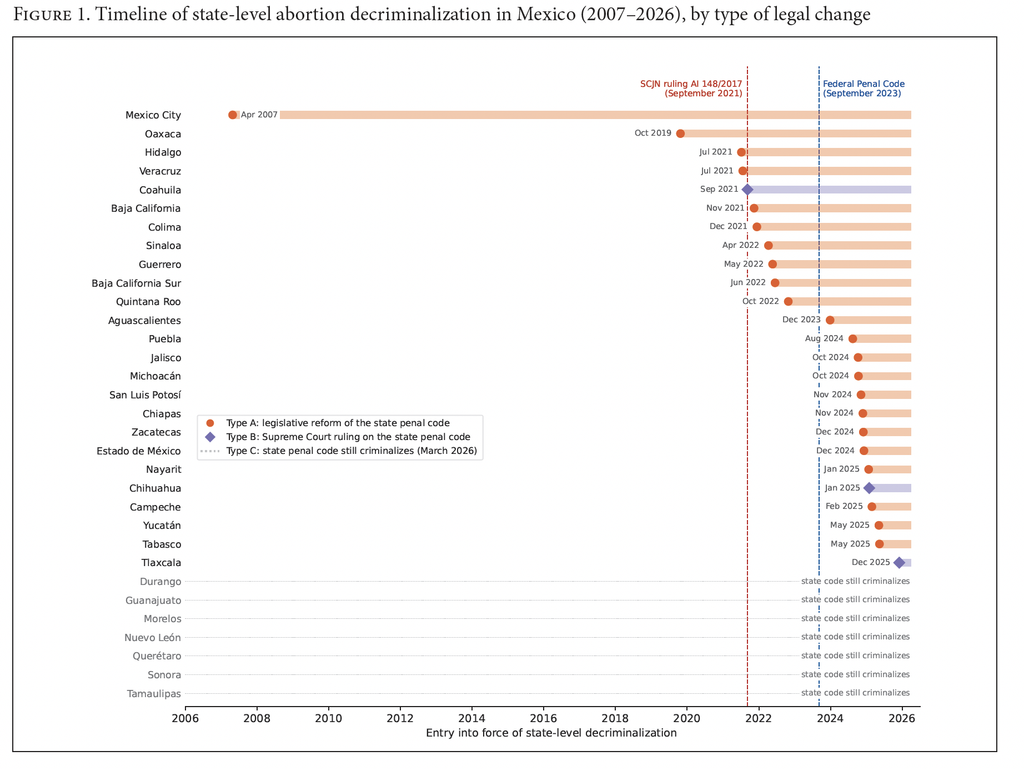
In the space of six years, Mexico has experienced a staggered wave of reforms in 25 of its 32 states, as well as a federal reform. Because these reforms took effect on different dates, they offer an unusual opportunity to observe what follows decriminalization in the health system’s own records. The country’s federal structure means that criminal law operates at both federal and state levels, producing a layered pattern of legal reform. Mexico City decriminalized voluntary abortion in 2007, followed by Oaxaca in 2019. After the Supreme Court declared in September 2021 that the absolute criminalization of abortion was unconstitutional (ruling AI 148/2017), a wave of state-level reforms accelerated: By March 2026, 25 of 32 states had either legislatively decriminalized abortion or had their penal codes invalidated by judicial order (Figure 1).[6] In September 2023, the Supreme Court further removed the abortion provisions of the Federal Penal Code (ruling AR 267/2023), with the consequence that abortion is no longer a federal crime anywhere in Mexico. The seven states that retain abortion in their local penal codes occupy a legal gray zone: Their state codes still criminalize, the federal code does not, and the binding jurisprudence of the Supreme Court protects any person who seeks an amparo (constitutional protection). In practice, decriminalization in Mexico now operates through two overlapping layers: state-level reform, which creates an affirmative obligation for state health systems to provide services, and federal-level decriminalization, which removes criminal liability nationwide but does not, by itself, compel any state to invest in service infrastructure.
This study examines the effects of this legal transformation in one measurable domain: abortion-related hospitalizations and their clinical coding. The question is normatively meaningful only if three terms are distinguished from the outset, since they operate in different domains and are routinely conflated in public debate:
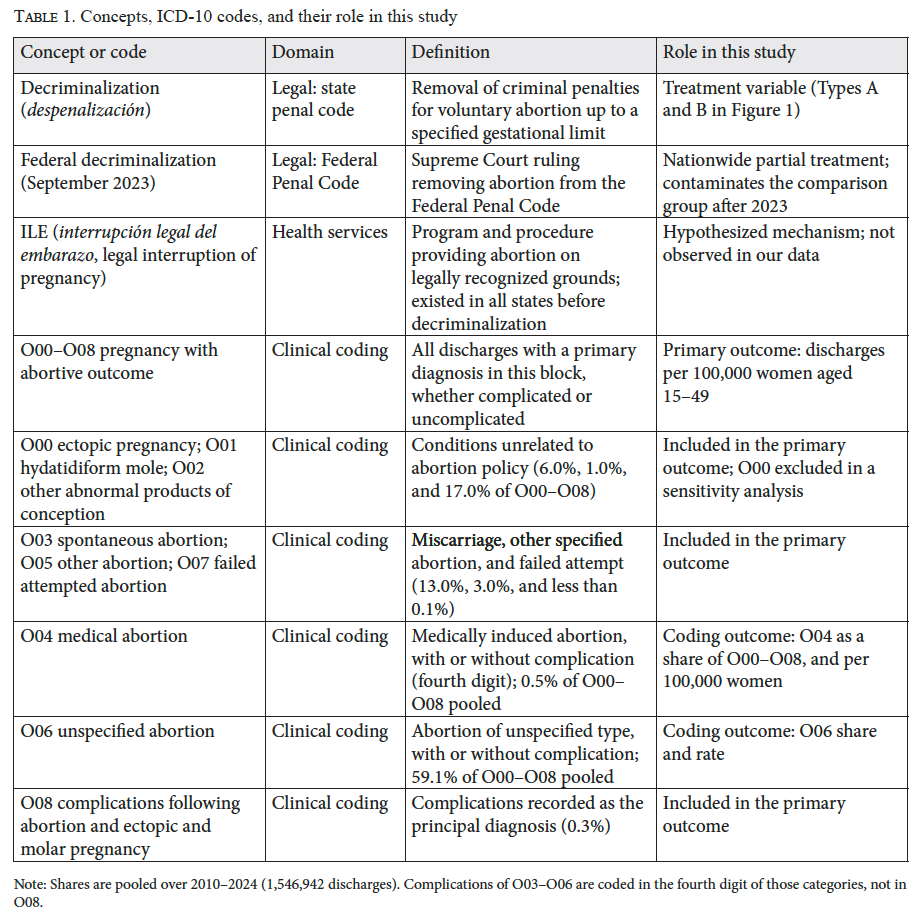
- Decriminalization (despenalización del aborto): the removal, in the criminal law domain, of penalties for voluntarily terminating a pregnancy up to a specified gestational limit. It is a necessary condition for the full exercise of reproductive autonomy, but it is not, by itself, a health service.
- Legal interruption of pregnancy (interrupción legal del embarazo, or ILE by its Spanish initials): a public health program encompassing the medical procedure and institutional infrastructure through which women access abortion under legally permitted grounds. ILE existed in all 32 Mexican states before any decriminalization, under preexisting grounds such as rape, risk to the pregnant woman’s life, or severe fetal malformations.[7] What decriminalization changes is not the existence of ILE but the breadth of the right to access it, by adding voluntary decision as a permissible ground up to a specified gestational limit (typically 12 weeks).
- ICD-10 code O04 (“medical abortion”): a clinical coding category under the International Classification of Diseases, Tenth Revision (ICD-10), used in hospital discharge records as a statistical proxy rather than a direct measure of ILE program utilization. An increase in O04 after decriminalization indicates that more abortions were recorded as medically induced, but it does not by itself tell us whether they occurred within formal ILE programs, through self-managed medication abortion, or through other pathways.
These distinctions are important to bear in mind because the right to decide over one’s own body—recognized by the Supreme Court as part of the constitutional right to free development of personality and reproductive autonomy, and by the Inter-American human rights system as a component of personal liberty and family life—cannot be reduced to a medical procedure or a hospital code.[8] Decriminalization is a precondition for the effective exercise of this right; ILE is the mechanism through which the health system fulfills its corresponding obligation; and O04 is the imperfect trace that the hospital data system leaves when these things happen (Table 1). Our analysis focuses on O04 coding and hospital discharges because these are the data available. The underlying policy question, however, is about rights, autonomy, and access.
We document what happened to abortion-related hospital care across the staggered wave of state-level decriminalization, focusing on the indicators that the available data permit us to track: the rate of abortion-related hospital discharges (ICD-10 O00–O08 per 100,000 women aged 15–49), which captures every hospital-treated event in this diagnostic block, whether complicated or uncomplicated; and the share of those discharges coded as medical abortion (O04), which, with the interpretive caveats outlined above, indicates whether hospitals record abortion as a medical event. Hospital discharge data record only the women who reached a public hospital and were admitted. They say nothing about the conditions under which women access abortion care outside hospitals.
Methods
Approach
To describe the changes that followed state-level decriminalization, we used the staggered timing of legal reform across states as a natural experiment. Because states decriminalized in different years between 2019 and 2024, at each point in time we could compare the trajectory of states that had already decriminalized to the trajectory of states that had not yet done so. This comparison, repeated across cohorts and aggregated, separates the changes that followed state-level reform from secular trends affecting the country as a whole. (Detailed technical specifications, software, and full robustness diagnostics are available from the authors upon request.)
Data sources
We constructed a balanced state-year panel covering all 32 Mexican states. Hospital discharge data span 2010–2024, mortality data span 2000–2023, and legal and demographic variables extend back to 2000. Data came from four publicly available official sources, processed in full without sampling.
Hospital discharge microdata came from the Automated Hospital Discharge System (SAEH) maintained by Mexico’s Directorate General of Health Information, which records every public sector hospital discharge nationwide. We extracted all discharges with a primary diagnosis of pregnancy with abortive outcome (ICD-10 O00–O08), disaggregated by specific code, processing 39.8 million records across 15 years. Discharges are assigned to the woman’s state of usual residence, which is what the SAEH records; we also tabulated them by the state of the treating hospital for a sensitivity analysis. Each annual file was read with a parser tolerant of malformed rows (the 2016 file contains 1.1 million rows with a trailing extra delimiter). Mortality data came from death certificate microdata maintained by the National Institute of Statistics and Geography, processed in full (15.2 million records, 2000–2023). Population denominators came from the National Population Council demographic projections, used to compute the female population aged 15–49 in each state-year. Live birth records from the Birth Information Subsystem supplied denominators for maternal mortality ratios.
We also constructed a legislative panel documenting the exact date of abortion decriminalization in each state. We distinguished three categories: states that decriminalized through legislative reform (Type A, 22 states); states whose abortion provisions were invalidated by Supreme Court rulings on their specific penal codes (Type B: Coahuila, Chihuahua, and Tlaxcala); and states that retained abortion in their state penal codes as of March 2026 (Type C: Durango, Guanajuato, Morelos, Nuevo León, Querétaro, Sonora, and Tamaulipas). Dates were verified against official state gazettes and cross-referenced with records from the Grupo de Información en Reproducción Elegida, the principal civil society organization documenting reproductive rights jurisprudence in Mexico.[9] Figure 1 shows the timeline. In the figures, we group reforming states into three waves by timing (2019–2021, 2022, and 2023–2025); “type” describes the legal route and “wave” the timing.
Indicators of hospital-treated abortion
We tracked three indicators, all by state and year. The rate of abortion-related hospital discharges (ICD-10 O00–O08) per 100,000 women aged 15–49 captures the volume of hospital-treated events in this diagnostic block: miscarriages, induced abortions managed in hospital, and complications of unsafe abortion, but not abortions managed outside a public hospital. The share of those discharges coded as medical abortion (O04) captures the composition of hospital-treated cases. A higher O04 share indicates that more of them are recorded as medically induced rather than as unspecified (O06). The third indicator is the share coded as unspecified abortion (O06), the dominant code in Mexican hospital records. We also report O04 and O06 as rates per 100,000 women. The maternal mortality ratio enters only as a predictor in the synthetic control because abortion-specific deaths are too rare nationally (about 70 per year) for precise estimation. Data that would measure access more directly—such as the number of ILE procedures or facilities by state, the dispensing of misoprostol and mifepristone, or gestational age at care—are not published as open data at the state-year level outside Mexico City, so we could not use them.
Defining who is treated
A state was classified as treated from the calendar year in which its state-level decriminalization entered into force. Mexico City, which decriminalized in 2007—before our hospital discharge data begin—was included in descriptive analyses but excluded from the comparative estimation because it lacks a pre-treatment period within the data window. The 31 remaining states formed the analytical sample. States whose reforms entered into force in 2025 have no post-reform year in the data and serve as not-yet-treated comparisons.
The September 2023 Supreme Court ruling that removed abortion from the Federal Penal Code complicates this classification. Since that date, abortion is no longer a federal crime anywhere in Mexico, even in Type C states whose state codes retain criminal penalties. Type C states therefore occupy a hybrid status after September 2023: criminalized at the state level but decriminalized at the federal level. We treat state-level decriminalization (Types A and B) as the primary treatment because state reform, not federal, triggers the obligation for state health systems to provide ILE services; service-system change is the mechanism through which legal reform reaches women. Type C states, together with states not yet treated at each time point, served as controls. The partial contamination of the control group by the 2023 federal reform is a substantive issue, and we address it by presenting two windows side by side: the full panel (2010–2024) and the years before the federal reform took effect (2010–2022). The shorter window removes the federal contamination but leaves only three cohorts with one to three post-reform years each.
Comparative estimation
We used the Callaway and Sant’Anna estimator for staggered difference-in-differences settings.[10] This estimator computes the average change in treated states relative to not-yet-treated states separately for each cohort of states (those that decriminalized in 2019, 2021, 2022, and so on) and each post-treatment year and then aggregates the cohort-time estimates into an overall average, an event-study trajectory, and cohort-specific summaries. The estimator is designed to avoid biases that arise when treatment effects vary across cohorts—a likely scenario here, since states with stronger preexisting health infrastructure may translate legal reform into health system change more quickly than states with weaker systems.[11] Confidence intervals were computed via multiplier bootstrap with simultaneous coverage, clustered by state. Event studies use the year before entry into force as the reference period, and we test jointly whether the four preceding years show differential changes; we assess sensitivity to violations of parallel trends with the relative-magnitude bounds of Rambachan and Roth, which allow post-reform confounding up to a multiple of the largest pre-reform deviation.[12] As a complement, we constructed a synthetic control for Oaxaca, the first state to decriminalize through legislative reform with a sufficiently long post-treatment window for credible estimation, using the 21 states that remained untreated through 2022.[13]
Robustness
We conducted several robustness checks by repeating the analysis under alternative specifications: excluding the COVID-19 years (2020–2021), restricting the control group to never-treated states, excluding ectopic pregnancies from the outcome, excluding the two states that border Mexico City (Estado de México and Morelos) to account for possible cross-state travel for abortion services, and measuring outcomes by the state of the treating hospital rather than the woman’s residence. We also conducted a placebo test using non-maternal mortality (which decriminalization should not affect) for 2010–2023, the period for which mortality microdata exist. Finally, we applied a permutation test and a Sun and Abraham event study as an alternative estimator, together with a conventional two-way fixed-effects regression and its Goodman-Bacon decomposition.[14] (Detailed specifications and full results are available from the authors upon request.) All analyses were conducted in R 4.5.3.
Results
Descriptive trends
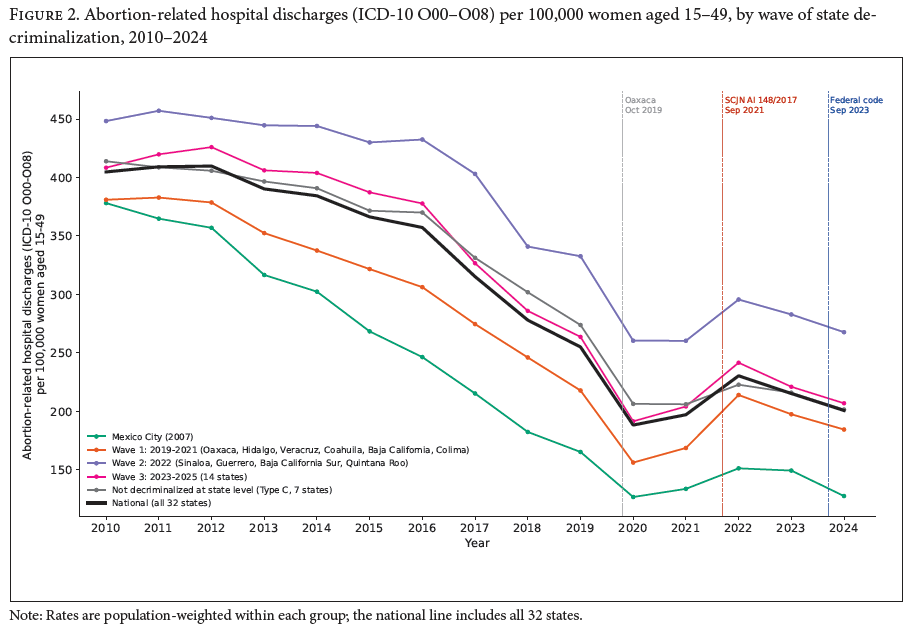
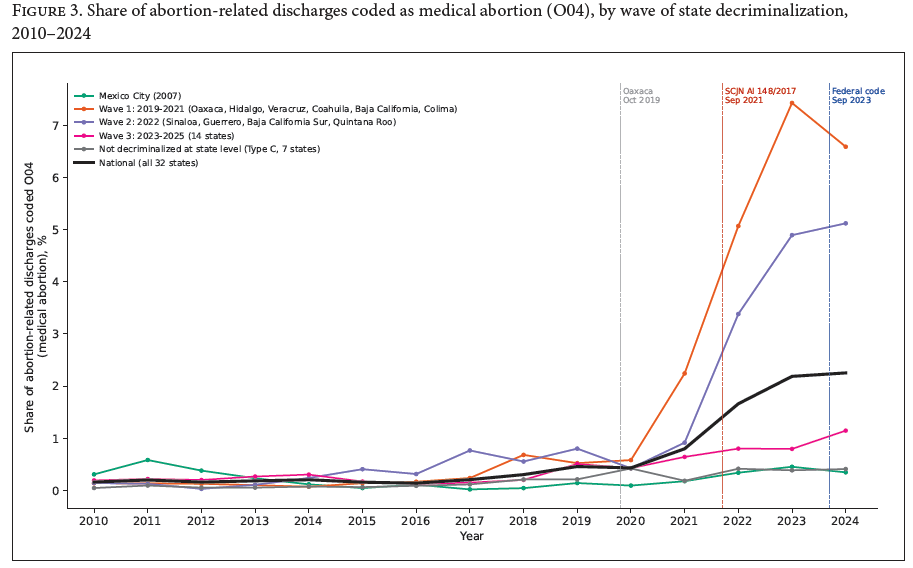
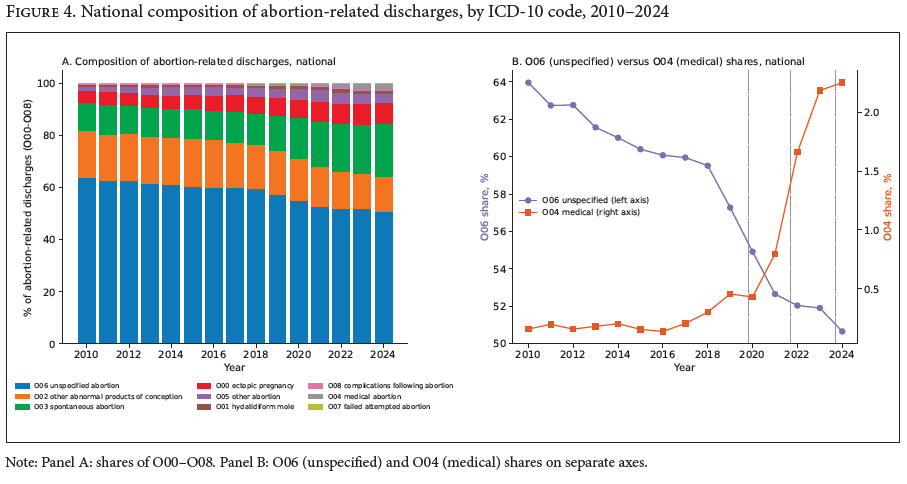
The transformation of abortion-related hospital care in Mexico over the past 15 years is visible at the descriptive level before any comparative analysis. Nationally, abortion-related hospital discharges (O00–O08) declined from 127,426 in 2010 to 71,689 in 2024, a 44% reduction in absolute terms, consistent with the broader transition toward outpatient medication abortion using misoprostol and mifepristone, a transition that feminist networks across Latin America have actively facilitated through accompaniment models and harm-reduction outreach.[15] Figure 2 shows that the decline is national: It appears in Mexico City, in each wave of decriminalizing states, and in the seven states that still criminalize, whose rate in 2024 (202 per 100,000 women aged 15–49) is indistinguishable from the national figure. The share of discharges coded as medical abortion (O04) increased eightfold over the same period, from 0.16% in 2010 to 2.25% in 2024, with the steepest acceleration occurring after 2021, coinciding with the wave of state decriminalization that followed the Supreme Court’s AI 148/2017 ruling. Figure 3 shows where the increase occurred. The O04 share was highest in the first-wave states, reaching 7.4% in 2023 and 6.6% in 2024, followed by 5.1% in the second-wave states in 2024. By comparison, it was 1.1% in the third-wave states and 0.4% in the seven Type C states in 2024. It was 0.3% in Mexico City, whose ILE program is outpatient and largely invisible in hospital discharge data.
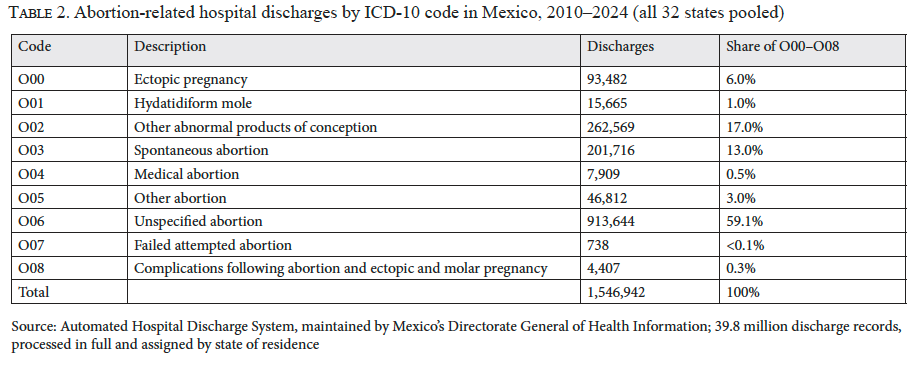
Three patterns are worth noting. First, the dominant code in Mexican hospital records remains O06 (“unspecified abortion”), which accounted for 64% of all O00–O08 discharges in 2010 and 51% in 2024 (Figure 4 and Table 2). The persistence of O06 reflects the environment that criminalization creates: When abortion is a crime, providers have reasons not to record it as such even when treating its consequences, and hospital staff in Mexico have been a documented source of criminal complaints against women seeking care for abortion complications.[16] Second, abortion-specific mortality is rare in absolute terms (about 70 deaths per year nationally), and a substantial share (43%) corresponds to ectopic pregnancy (O00), a condition unrelated to abortion policy. Third, the descriptive trends do not, by themselves, identify the changes attributable to legal reform. Many factors moved during this period, including changes in poverty, contraceptive coverage, and the COVID-19 pandemic. The comparative estimation that follows separates the changes that followed state-level legal reform from national trends.
Hospitalizations after state decriminalization
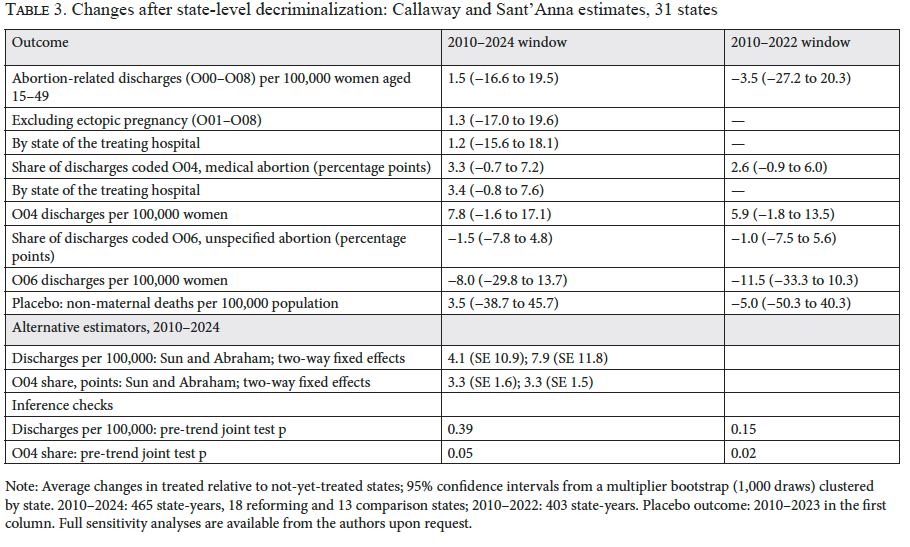
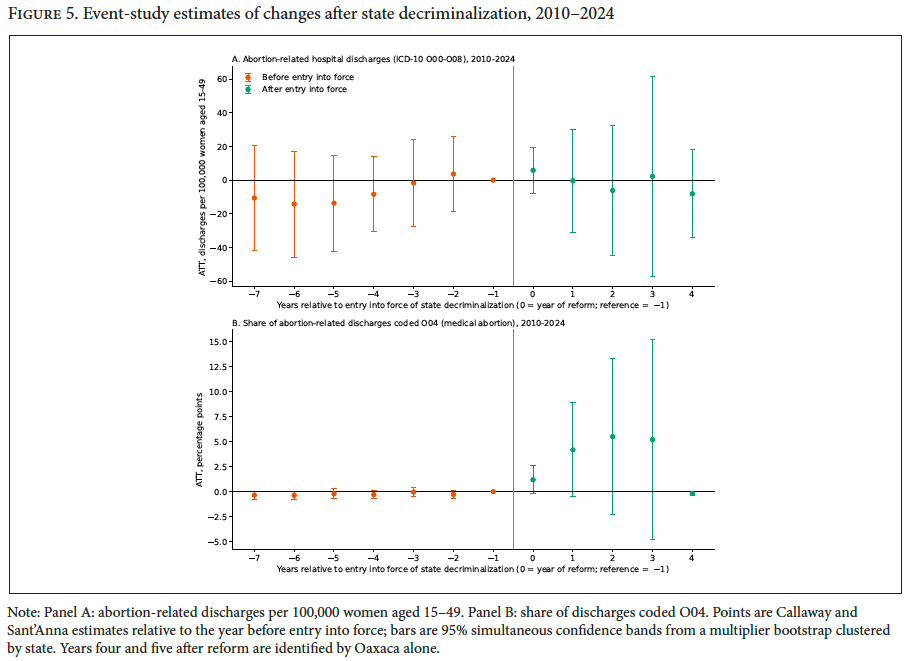
In the full sample (2010–2024), state-level decriminalization was followed by a change of 1.5 abortion-related hospital discharges per 100,000 women aged 15–49 (95% CI −16.6 to 19.5; Table 3, Figure 5A), a difference indistinguishable from zero and small relative to a pre-reform mean of 352 per 100,000 in the reforming states. Examined by cohort, only Oaxaca (decriminalized in 2019, with the longest post-treatment observation window of five years) showed a reduction: 17.7 discharges per 100,000 women in the full sample and 30.7 in the 2010–2022 window, with nominal standard errors (6.5 and 5.2) that come from a single treated state. Later cohorts (states decriminalizing in 2021–2024) had fewer post-treatment years and correspondingly wider confidence intervals, with point estimates between 3 and 10 per 100,000.
Restricting the sample to 2010–2022, before the federal ruling partially decriminalized the control group, yields −3.5 per 100,000 (95% CI −27.2 to 20.3): Removing the federal contamination does not reveal a differential decline. The event study (Figure 5A) shows no differential movement before reform (joint test of the four pre-reform years, p = 0.39) and no sustained movement after it.
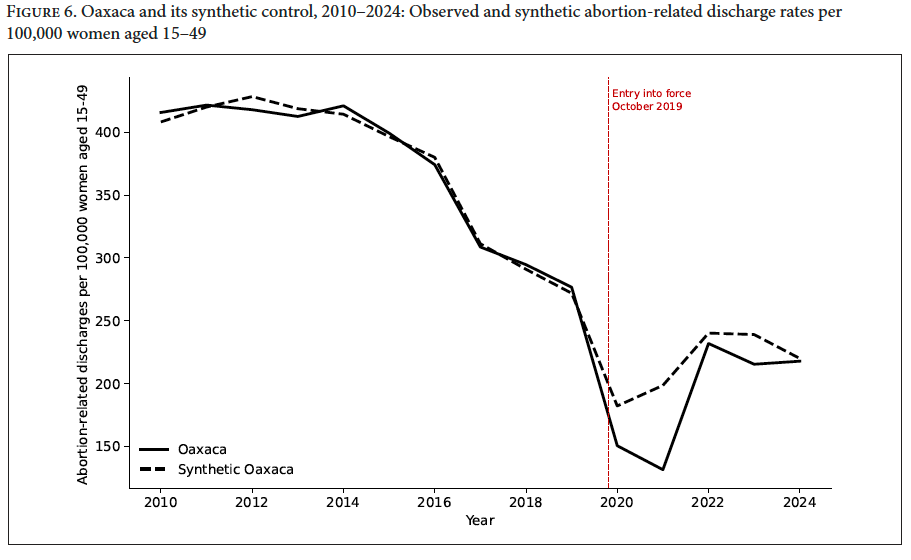
The synthetic control analysis for Oaxaca, which constructs a counterfactual trajectory using a weighted combination of donor states, points in the same direction as the cohort estimate. Synthetic Oaxaca tracked actual Oaxaca closely in the pre-treatment period (2010–2018; root mean squared prediction error 5.9 per 100,000); after decriminalization, Oaxaca fell below its synthetic counterpart by an average of 25.6 discharges per 100,000 women in 2019–2022 and 21.4 in 2019–2024, with the gap concentrated in 2020 and 2021 (Figure 6). This estimate rests on a single treated state (placebo tests for the synthetic control are available from the authors upon request).
Coding of hospital-treated abortions
The shift in the coding of hospital care toward medical abortion is the one comparative result that points in a consistent direction across specifications. The share of discharges coded as medical abortion (O04) rose by 3.3 percentage points after state-level decriminalization in the full sample (95% CI −0.7 to 7.2) and by 2.6 percentage points (95% CI −0.9 to 6.0) in the pre-2023 specification, from a pre-reform mean of 0.3%. The point estimate is stable across every sensitivity analysis (between 3.1 and 3.6 points in the full sample), but its precision depends on the inference method: The cluster bootstrap yields intervals that include zero, while the Sun and Abraham and two-way fixed-effects estimators give the same 3.3 points with p = 0.049 and 0.039. The event-study trajectory (Figure 5B) provides the clearest visual evidence in the study. Estimates remain close to zero in every pre-treatment year (all deviations between −0.4 and 0 points) and then rise after decriminalization takes effect, reaching +4.2 percentage points one year after reform and +5.5 percentage points two years after, with wide simultaneous bands. The decline in years three and four after reform is a composition effect, not a reversal: Those years are identified only by Oaxaca, where O04 barely changed (0.2 points), while the 2022 cohort (3.8 points, standard error 1.1) and the 2021 cohort (5.2 points, standard error 4.4) account for the rise in years one and two. The share of unspecified abortion (O06) did not fall differentially in reforming states (−1.5 points, 95% CI −7.8 to 4.8), and its pre-reform path is not parallel, so the growth of O04 appears as additional specific coding rather than as a one-for-one reclassification of unspecified cases.
The pattern is what one would expect if criminalization had been suppressing the formal coding of abortion care: When the legal threat is removed, providers begin to record medically supervised procedures as such, women feel safer seeking care in formal health facilities, and the statistical trace of those abortions appears in the hospital data. None of these mechanisms is testable directly with discharge data alone, but the timing—flat before, rising after—matches the prediction.
Robustness
Results were stable across alternative specifications (Table 3). Excluding the COVID-19 years (2020–2021) did not materially change the O04 estimate (+3.6 vs. +3.3 percentage points) and moved the discharge-rate estimate to +16 per 100,000, with a confidence interval that still spans zero. The remaining checks produced estimates close to the main ones. A placebo test on non-maternal mortality, which decriminalization has no plausible reason to affect, showed no differential change (3.5 per 100,000; p = 0.87). The joint test of pre-reform trends does not reject parallel trends for the discharge rate (p = 0.39); for the O04 share, it rejects at the 5% level (p = 0.047), which reflects precisely estimated deviations of less than half a point rather than a visible trend, and the Rambachan and Roth bounds indicate that the year-of-reform estimate remains positive under violations up to half the size of the largest pre-reform deviation and includes zero beyond that. (Detailed robustness diagnostics, including the Sun and Abraham event study, the permutation tests, the Goodman-Bacon decomposition, and E-values, are available from the authors upon request.[17])
The traditional two-way fixed-effects estimator returned +7.9 for the discharge rate against the modern estimator’s +1.5; both are indistinguishable from zero, and the Goodman-Bacon decomposition shows that comparisons using already-treated states as controls receive under 4% of the weight.[18] Traditional methods can still produce misleading estimates of the direction and magnitude of effects when states adopt reforms at different times and treatment effects vary across cohorts. For this reason, we used the modern estimator as our primary specification.
Discussion
This study describes, with modern comparative methods and the complete public hospital record, what changed in abortion-related hospital care in Mexico as the country decriminalized abortion. Three findings emerge, each with implications for how reproductive rights operate as a determinant of health.
First, removing criminal penalties was not followed by an increase in the health burden recorded by hospitals. Across all specifications—including the full sample, the pre-2023 sample, the synthetic control, and alternative outcome measures—none of the estimates indicate an increase in abortion-related hospitalizations after state decriminalization, and the comparative estimate is close to zero. Nationally, abortion-related hospitalizations fell by 44% between 2010 and 2024, a decline that began before the wave of state reforms and continued at a similar pace in reforming and non-reforming states. A reading consistent with this pattern is the diffusion of medication abortion outside the health system: Misoprostol has been available in Mexican pharmacies for decades, and feminist accompaniment networks across Latin America have built models that make self-managed abortion safer and more common without any change in the law.[19] An abortion managed at home with medication and without complications never enters the discharge data; a shift from clandestine surgical procedures to self-managed medication abortion would reduce O00–O08 discharges in every state regardless of its penal code, which is what we observe. Against this backdrop, state decriminalization would be expected to change the coding of hospital care more than its volume.
Second, decriminalization was associated with a shift in the composition of hospital-treated cases toward medically supervised abortion. The share of discharges coded as O04 rose by approximately three percentage points from a near-zero baseline, with an event-study trajectory that is flat before reform and rises after it. As we noted in the introduction, O04 is a clinical coding category, not a direct measure of ILE program utilization, and the observed shift is consistent with several non-exclusive mechanisms: expanded access to ILE services under new legal grounds, the wider availability of misoprostol and mifepristone for outpatient use, reduced stigma enabling women to seek care in formal facilities, and changes in coding practices once providers no longer face the threat of complicity in a crime. What these mechanisms share is that decriminalization enables them. When the state removes the threat of criminal sanction, it creates the conditions under which women can access care, providers can offer it, and the health system can record what happens. A rising O04 share is a small but concrete indicator that the health system has begun to record abortion as a medical event rather than hiding it, which is itself a condition for the state to fulfill its duty to monitor and guarantee sexual and reproductive health.[20] In Mexican legal language, this is precisely how the right to choose becomes the right to safe care—through a chain of obligations that begins in the penal code, passes through health system mandates, and ends in clinical practice, an architecture that the human rights and reproductive justice literatures have long described as the integration of legal protection with effective service provision.[21]
Third, the strength of the evidence depends on how uncertainty is quantified. With 31 states and few post-reform years per cohort, the same 3.3-point change in coding is statistically significant under some inference methods and not under others. Methodological choices in policy-relevant research are therefore not neutral.
Limitations
Several limitations merit discussion. Statistical power was constrained by the small number of clusters (31 states in the comparative analytical sample and 32, including Mexico City, in the descriptive analyses) and the compressed timeline. Most states decriminalized abortion within a three-year period (2021–2024), leaving few post-treatment observations. Two national-level judicial interventions also partially contaminated the control group: the September 2021 Supreme Court ruling (AI 148/2017), which established binding jurisprudential protection for any person seeking an amparo, and the September 2023 ruling (AR 267/2023), which removed abortion from the Federal Penal Code entirely. Since 2023, no woman in Mexico can be prosecuted for abortion under federal law, regardless of her state’s legislation. Our Type C “control” states are therefore untreated only in the sense that their state penal codes still criminalize abortion and their health systems are not required to provide ILE services; federal criminal liability has nonetheless been eliminated.
Hospital discharge data capture only women who reached a public hospital and were admitted. Safe outpatient and self-managed abortions—precisely those that decriminalization facilitates—are not observed, and the probability of appearing in the data may itself change after reform if disclosure becomes safer or care shifts to outpatient settings. Estimates for the hospitalized population therefore need not equal those in the broader population of women who have abortions, and a formal multiple-bias analysis of the kind developed for abortion mortality would require external estimates of reporting and admission probabilities that do not exist for Mexican states.[22]
Registration is also uneven across states and is likely weaker in rural and Indigenous populations. Measuring outcomes by the hospital’s state rather than the woman’s residence did not change the estimates. The pre-reform paths are parallel for the hospitalization rate but not, strictly speaking, for the coding outcomes, and the COVID-19 pandemic falls within every comparison. The dominance of O06 (unspecified abortion), which accounted for half of discharges in 2024, further limits our ability to fully disaggregate safe from unsafe procedures.
Finally, decriminalization is a necessary but not sufficient condition for access to safe abortion services. Implementation gaps, conscientious objection, and infrastructure deficits mean that the de jure reform may not translate immediately to de facto access, a pattern reflected in the heterogeneous cohort-specific estimates.
The federal dimension: Decriminalization without service provision
The September 2023 Supreme Court ruling (AR 267/2023) that removed abortion from the Federal Penal Code represents a watershed in Mexican reproductive rights, yet its practical effects differ fundamentally from state-level decriminalization. Understanding this difference illuminates both the strengths and limitations of legal reform as a tool for advancing reproductive health.
State-level decriminalization (our treatment variable) operates through two simultaneous channels. First, it removes criminal liability under the state penal code, eliminating the threat of prosecution for women and providers. Second, it creates an affirmative obligation for the state health system to provide ILE services: Once the state code recognizes voluntary interruption as a legal ground, public hospitals and clinics must offer the procedure, train personnel, stock medications, and establish protocols. The combination of these two channels—removal of penalties plus creation of services—is the mechanism through which state reform can reach women; our data cannot observe it directly.
Federal decriminalization, by contrast, operates through only the first channel. The 2023 ruling eliminated federal criminal liability for abortion nationwide, meaning that no woman can be prosecuted under federal jurisdiction regardless of where she lives. However, federal decriminalization does not compel state governments to provide ILE services. The seven states that retain abortion in their local penal codes (Durango, Guanajuato, Morelos, Nuevo León, Querétaro, Sonora, and Tamaulipas) face a legal contradiction: Their penal codes still criminalize, but federal law does not; any woman can obtain an amparo for constitutional protection, but the state health system has no formal mandate to provide services. These are, with one exception, northern and central states with above-average income and health infrastructure, so their non-reform is not a proxy for weak health systems. In Guanajuato and Querétaro, the state constitutions also protect life from conception. Their abortion-related hospitalization rate in 2024 was 202 per 100,000, the same as the national rate, and their O04 share stayed at 0.4%. In these states, the right to interrupt a pregnancy exists in jurisprudence but not necessarily in practice, a gap between de jure protection and de facto access that mirrors broader patterns of reproductive rights implementation across Latin America.
This two-layer structure has three implications for our study. First, our estimates of the changes that followed state-level decriminalization are attenuated by the partial treatment of the control group after 2023; the 2010–2022 window, which removes this contamination, gives the same answer. Second, the distinction between state and federal decriminalization underscores that legal reform without service infrastructure is insufficient. The right to choose, recognized at the federal level, becomes the right to safe care only when states build the ILE programs to guarantee it. Third, this natural experiment within a natural experiment—some states with full decriminalization plus services, others with only federal protection—offers a research opportunity to disentangle the effects of criminal liability removal from service provision once state-level data on ILE services become public.
Comparison with prior evidence
Our findings are consistent with those of Damian Clarke and Hanna Mühlrad—who found that Mexico City’s 2007 decriminalization reduced abortion-related morbidity—but more modest: By the time the wave of state-level reforms arrived, hospitalizations were already falling nationwide, and the discharge data no longer registered a differential decline.[23] Our contribution extends their two-group design to the full staggered wave using estimators that account for heterogeneous treatment effects. The South African and Nepali experiences, where liberalization was followed by declines in abortion-related mortality and severe complications, involved transitions from far more restrictive baselines and from surgical to medical methods within the health system.[24] The US post-Dobbs literature examines the mirror image—the effects of restricting access—and faces the same measurement problem from the opposite direction.
Policy implications
These results speak to the ongoing debate across Latin America, where Colombia (2022), Argentina (2020), and multiple Mexican states have recently decriminalized abortion. Decriminalization has not been followed by an increase in abortion-related hospitalizations. Where it has been followed by a change, that change has been in what the health system records.
However, our findings also reveal the limits of decriminalization as a stand-alone reform. Decriminalization removes criminal penalties, but it does not automatically guarantee effective access to ILE services. The heterogeneous effects across cohorts suggest that states with stronger health infrastructure and more developed ILE programs may translate the legal reform into health system change more quickly than states where decriminalization is merely formal. The right to choose is exercised not only in the penal code but in the clinic, the pharmacy, and the community health center. Decriminalization is a necessary first step. Building the infrastructure and eliminating the barriers, including conscientious objection, stigma, geographic isolation, and misinformation, to make ILE effectively accessible is the second.
For the seven Mexican states that have not yet decriminalized at the state level, and for countries across Latin America and beyond considering similar reforms, these findings are consistent with the policy sequence that the human rights framework already prescribes: First, remove criminal penalties to recognize reproductive autonomy as a right; then, invest in ILE service infrastructure and in the information systems that make its use visible, so that the right can be exercised safely and measured.
Conclusion
This study provides comparative evidence, using modern econometric methods and the complete public hospital record, on what followed the staggered decriminalization of abortion in a middle-income country. Three conclusions stand out.
First, the evidence is unequivocal in one direction: Decriminalization was not followed by an increase in abortion-related hospitalizations. Across every specification—including the full sample, the pre-2023 sample, the synthetic control, and alternative outcome measures—none of the estimates indicate an increase in abortion-related hospitalizations after reform, and the comparative estimate is close to zero. Hospitalizations fell by 44% nationally over the period, both in states that reformed and in those that did not.
Second, where the law changed, what changed was the coding of the hospitalizations that remained. The medical abortion code rose from near zero to several percent in the first states to decriminalize, while remaining near zero in states where abortion is still a crime. Legal reform operates through two distinct channels that must not be conflated: State-level decriminalization removes criminal penalties and creates the obligation for health systems to provide ILE services, while federal decriminalization removes criminal penalties without creating service obligations. Whether the second channel is what moves the health system’s records is the question these data leave open. The right to choose, without the infrastructure to exercise it safely, remains incomplete.
Third, Mexico’s experience offers a research setting of unusual value. The staggered adoption of decriminalization across 32 states, combined with the federal reform of 2023, allows comparisons that single-jurisdiction studies cannot make. As Colombia, Argentina, and other nations in Latin America and beyond advance similar reforms, Mexico’s data can serve as both an evidence base and a methodological template for evaluating what follows the expansion of reproductive rights.
The transition from criminalization to reproductive autonomy is not merely a legal question. It is a public health question, and it can be answered only with data that the health system is willing to produce. When the state stops punishing women for exercising their right to choose, the first thing that changes in its hospitals is that abortion can be named. Making state-level data on the legal interruption of pregnancy public, alongside the discharge records that already exist, is the step that would let the next study answer the question this one can only pose.
Ethics approval
Because the study used publicly available, de-identified administrative data aggregated to the state-year level, no ethics approval was required.
Data sharing
All data used in this study come from publicly available official sources: hospital discharges from the Directorate General of Health Information, mortality records from the National Institute of Statistics and Geography, population projections from the National Population Council, and birth records from the Birth Information Subsystem. The legislative panel of state-level decriminalization dates, processed analytical datasets, and replication code will be deposited in a public repository upon publication.
Sofía Gutiérrez Pérez, PhD, is a professor at the Centro Universitario de Tlajomulco, Universidad de Guadalajara, Mexico.
Raúl Bermúdez Camarena, LLM, is a professor at the Universidad de Guadalajara, Guadalajara, Mexico.
Please address correspondence to Sofía Gutiérrez Pérez. Email: sofia.gutierrez@academicos.udg.mx
Competing interests: None declared.
Copyright © 2026 Gutiérrez Pérez and Bermúdez Camarena. This is an open access article distributed under the terms of the Creative Commons Attribution-Noncommercial License (http://creativecommons.org/licenses/by-nc/4.0/), which permits unrestricted noncommercial use, distribution, and reproduction in any medium, provided the original author and source are credited.
References
[1] L. Say, D. Chou, A. Gemmill, et al., “Global Causes of Maternal Death: A WHO Systematic Analysis,” Lancet Global Health 2/6 (2014).
[2] J. Bearak, A. Popinchalk, B. Ganatra, et al., “Unintended Pregnancy and Abortion by Income, Region, and the Legal Status of Abortion: Estimates from a Comprehensive Model for 1990–2019,” Lancet Global Health 8/9 (2020); B. Ganatra, C. Gerdts, C. Rossier, et al., “Global, Regional, and Subregional Classification of Abortions by Safety, 2010–14: Estimates from a Bayesian Hierarchical Model,” Lancet 390/10110 (2017).
[3] Committee on Economic, Social and Cultural Rights, General Comment No. 22, UN Doc. E/C.12/GC/22 (2016); Committee on the Elimination of Discrimination Against Women, General Recommendation No. 24, UN Doc. A/54/38/Rev.1 (1999).
[4] Artavia Murillo et al. (“In Vitro Fertilization”) v. Costa Rica, Inter-American Court of Human Rights, judgment of November 28, 2012.
[5] R. Jewkes and H. Rees, “Dramatic Decline in Abortion Mortality Due to the Choice on Termination of Pregnancy Act,” South African Medical Journal 95/4 (2005); J. T. Henderson, M. Puri, M. Blum, et al., “Effects of Abortion Legalization in Nepal, 2001–2010,” PLOS One 8/5 (2013).
[6] Suprema Corte de Justicia de la Nación, Acción de Inconstitucionalidad 148/2017, judgment of September 7, 2021.
[7] Grupo de Información en Reproducción Elegida, Maternidad o castigo: La criminalización del aborto en México (2018).
[8] Suprema Corte de Justicia de la Nación (see note 6); Grupo de Información en Reproducción Elegida, La pieza faltante: Justicia reproductiva (2018).
[9] Grupo de Información en Reproducción Elegida, La pieza faltante (see note 8).
[10] B. Callaway and P. H. C. Sant’Anna, “Difference-in-Differences with Multiple Time Periods,” Journal of Econometrics 225/2 (2021).
[11] C. de Chaisemartin and X. D’Haultfœuille, “Two-Way Fixed Effects Estimators with Heterogeneous Treatment Effects,” American Economic Review 110/9 (2020); J. Roth, P. H. C. Sant’Anna, A. Bilinski, and J. Poe, “What’s Trending in Difference-in-Differences? A Synthesis of the Recent Econometrics Literature,” Journal of Econometrics 235/2 (2023).
[12] A. Rambachan and J. Roth, “A More Credible Approach to Parallel Trends,” Review of Economic Studies 90/5 (2023).
[13] A. Abadie, “Using Synthetic Controls: Feasibility, Data Requirements, and Methodological Aspects,” Journal of Economic Literature 59/2 (2021).
[14] L. Sun and S. Abraham, “Estimating Dynamic Treatment Effects in Event Studies with Heterogeneous Treatment Effects,” Journal of Econometrics 225/2 (2021); A. Goodman-Bacon, “Difference-in-Differences with Variation in Treatment Timing,” Journal of Econometrics 225/2 (2021).
[15] R. Zurbriggen, B. Keefe-Oates, and C. Gerdts, “Accompaniment of Second-Trimester Abortions: The Model of the Feminist Socorrista Network of Argentina,” Contraception 97/2 (2018).
[16] Grupo de Información en Reproducción Elegida, Maternidad o castigo (see note 7).
[17] T. J. VanderWeele and P. Ding, “Sensitivity Analysis in Observational Research: Introducing the E-Value,” Annals of Internal Medicine 167/4 (2017).
[18] Callaway and Sant’Anna (see note 10); Goodman-Bacon (see note 14).
[19] Zurbriggen et al. (see note 15).
[20] Committee on Economic, Social and Cultural Rights (see note 3).
[21] A. E. Yamin, Power, Suffering, and the Struggle for Dignity: Human Rights Frameworks for Health and Why They Matter (University of Pennsylvania Press, 2016); R. J. Cook, B. M. Dickens, and M. F. Fathalla, Reproductive Health and Human Rights: Integrating Medicine, Ethics, and Law (Oxford University Press, 2003).
[22] C. Gerdts and J. Ahern, “Multiple-Bias Analysis as a Technique to Address Systematic Error in Measures of Abortion-Related Mortality,” Population Health Metrics 14 (2016).
[23] D. Clarke and H. Mühlrad, “Abortion Laws and Women’s Health,” Journal of Health Economics 76 (2021).
[24] Jewkes and Rees (see note 5); Henderson et al. (see note 5).