

Attacks on Emergency Medical Services in Lebanon: Protecting the Right to Health in Armed Conflict
VIEWPOINT
Samar Al-Hajj and Rakan Nassereldine
In the early months of 2026, renewed hostilities in Lebanon once again placed the country’s emergency medical services directly in the line of fire. Figure 1 shows a Lebanese Civil Defense ambulance, unit 2261, after it sustained extensive damage during an Israeli attack on emergency medical services. The labeled photograph identifies the protective emblem on the right body panel, the vehicle identification number on the rear door, penetrating fragmentation across the rear and right panels, and blast-related deformation with extensive tearing of the body structure. That the protective emblem remains legible amid the wreckage is precisely the point: This was an identifiable medical vehicle.
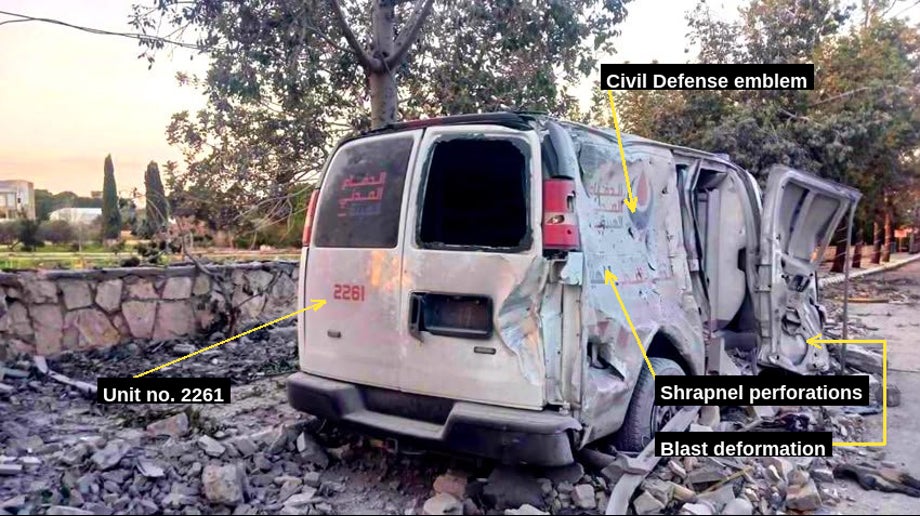
Figure 1. Civil Defense ambulance damaged during an attack on emergency medical services in Lebanon in 2026(photograph courtesy of the Lebanese Civil Defense and reproduced with permission)
This vehicle is not an isolated case. According to the Lebanese Ministry of Public Health Emergency Operations Center, 154 attacks on emergency medical services were recorded between March 3 and May 25, 2026, resulting in the deaths of 129 emergency medical and health care workers.[1] Behind each recorded attack is a crew that did not return, an ambulance withdrawn from service, and a community whose access to urgent care narrowed. We write as a public health researcher and as the minister of public health of Lebanon to document this pattern and to insist that it be understood not only as a violation of the laws of war but as an assault on the right to health itself.
A protected space under international humanitarian law
International humanitarian law is unambiguous. Medical personnel, facilities, and transport displaying recognized protective emblems are afforded special protection during armed conflict, and this protection may be lost only in narrowly defined circumstances that must be established, not presumed.[2] In 2016, the United Nations Security Council reaffirmed these obligations in Resolution 2286, condemning attacks on medical facilities and personnel in conflict and demanding that all parties protect the wounded and sick, medical personnel, and medical transport.[3] A decade later, the wreckage of unit 2261 shows how far practice has drifted from that demand. When a clearly marked ambulance can be struck and destroyed, the protective value of the emblem itself is eroded, and with it one of the oldest and most fundamental bargains of the laws of war.
An assault on the right to health
The human rights framing adds an obligation that the humanitarian law framing does not capture on its own. The right of everyone to the enjoyment of the highest attainable standard of physical and mental health is codified in article 12 of the International Covenant on Economic, Social and Cultural Rights.[4] The Committee on Economic, Social and Cultural Rights has made clear that the obligation to respect this right requires states to refrain from denying or limiting access to health services and that violations include the denial of access to health facilities and services as a punitive or military measure.[5] Emergency medical services sit at the sharpest edge of this right. In conflict, prehospital care is frequently the first and only point of contact between a wounded civilian and the health system; when ambulances are attacked, the right to health is denied at the very moment it matters most. Emergency medical workers are also rights holders themselves, entitled to protection as they perform work that makes the right to health real for others.
Consequences for an already fragile health system
These attacks landed on a health system with little remaining capacity to absorb them. Lebanon entered the 2026 hostilities after years of compounding crises that had strained health financing, depleted the health workforce, and disrupted supply chains. Against this backdrop, the killing of 129 emergency medical and health care workers in under three months, alongside the destruction of ambulances and equipment, has reduced ambulance availability, lengthened response times, and forced emergency crews to weigh their own safety against their duty to respond.[6] The consequences extend well beyond the immediate victims of each strike: Injured civilians face delayed or absent prehospital care, patients with time-critical conditions such as obstetric emergencies lose access to safe transport, and the deterrent effect on volunteers and paramedics compounds the workforce losses. Damage to medical transport is damage to the entire chain of survival.
Documentation, protection, and accountability
Documentation is a precondition for both protection and accountability and is itself an act within the human rights tradition. The Emergency Operations Center of the Ministry of Public Health has systematically recorded Israeli attacks on emergency medical services throughout the hostilities, and photographic evidence of the kind presented here preserves the material record: the emblem, the unit number, the fragmentation pattern.[7] Such records should feed into international mechanisms, including the World Health Organization’s Surveillance System for Attacks on Health Care, so that the scale of Israeli attacks in Lebanon is visible in the global record and comparable across conflicts.[8] But surveillance alone is not accountability. States and international bodies must move from counting attacks to investigating them, attributing responsibility, and providing remedy to victims and their families. The Safeguarding Health in Conflict Coalition has given this demand specificity: The United Nations Secretary-General should use the authority of the office to direct global attention to attacks on health care and to reject reinterpretations of international humanitarian law that defeat its protective purpose, and member states should be held to the commitments they made in Resolution 2286, including reforming military doctrine, strengthening protections in domestic law, investigating violations, and bringing perpetrators to justice.[9] Lebanon has pursued the avenues available to it: The Ministry of Public Health documents every incident through its Emergency Operations Center, shares its data with international surveillance mechanisms, and, together with Jordan, Qatar, and Türkiye, brought the health emergency before the 79th World Health Assembly, which adopted a resolution calling for the full protection of health personnel, facilities, and transport.[10] International attention is growing, as the dedicated side event on protecting health care in conflict at the Economic and Social Council’s 2026 Humanitarian Affairs Segment suggests, but awareness without enforcement has been the pattern for a decade. The persistent gap between documentation and consequence is itself a driver of recurrence; where attacks on health care carry no cost, the protective emblem becomes a target marker rather than a shield.
Conclusion
The photograph of unit 2261 is a small piece of evidence from a much larger pattern, and we present it because the erosion of protection for health care in conflict advances one strike at a time and must be resisted the same way. Protecting emergency medical services is not a matter of charity or military discretion. It is a legal obligation under international humanitarian law and a human rights imperative under the right to health. We call on all parties to conflict to respect the protective emblem, on the international community to enforce the obligations it has already articulated, and on the health and human rights community to treat every attack on an ambulance as what it is: an attack on the right to health of every person that vehicle would have reached.
Acknowledgments
We thank the Lebanese Civil Defense for permission to use the photograph and for its efforts in documenting Israeli attacks on health care and emergency medical services during the conflict.
Funding
The authors received no specific grant for this work from any funding agency in the public, commercial, or not-for-profit sectors.
Use of artificial intelligence
An artificial intelligence tool (Claude, Anthropic) was used to assist in editing and formatting this manuscript to journal style, under the direction of the authors. The authors reviewed, revised, and approved all content and take full responsibility for the accuracy and integrity of the work.
Samar Al-Hajj, PhD, is an assistant research professor in the Department of Epidemiology and Biostatistics, Faculty of Health Sciences, American University of Beirut, Lebanon.
Rakan Nassereldine is the minister of public health of Lebanon, Ministry of Public Health, Beirut, Lebanon.
Please address correspondence to Samar Al-Hajj. Email: sh137@aub.edu.lb.
Competing interests: None declared.
Copyright © 2026 Al-Hajj and Nassereldine. This is an open access article distributed under the terms of the Creative Commons Attribution-Noncommercial License (http://creativecommons.org/licenses/by-nc/4.0/), which permits unrestricted noncommercial use, distribution, and reproduction in any medium, provided the original author and source are credited.
References
[1] Ministry of Public Health, Public Health Emergency Operations Center, Emergency Operations Data on Attacks on Emergency Medical Services and Health Care Workers in Lebanon, March 3–May 25, 2026 (2026), unpublished data.
[2] Protocol Additional to the Geneva Conventions of 12 August 1949, and Relating to the Protection of Victims of International Armed Conflicts (Protocol I) (1977), arts. 12, 21.
[3] United Nations Security Council, Resolution 2286, UN Doc. S/RES/2286 (2016).
[4] International Covenant on Economic, Social and Cultural Rights, G.A. Res. 2200A (XXI) (1966), art. 12.
[5] Committee on Economic, Social and Cultural Rights, General Comment No. 14, UN Doc. E/C.12/2000/4 (2000), para. 34.
[6] Ministry of Public Health (see note 1).
[7] Ibid.
[8] World Health Organization, “Surveillance System for Attacks on Health Care (SSA),” https://extranet.who.int/ssa.
[9] Safeguarding Health in Conflict Coalition, Epidemic of Violence: Violence Against Health Care in Conflict 2024 (2025).
[10] World Health Organization, Health Emergency in Lebanon, 79th World Health Assembly, Doc. A79/A/CONF./3 (2026).