

Defending Informed Consent: Civil Society’s Victory Against Emergency Research Deregulation in South Korea
Vol 28/1, 2026, pp. 155-166 PDF
Young Su Park, Doris Schroeder, Orla Drummond, and Ock-Joo Kim
Abstract
Informed consent is both a foundational principle of research ethics and a human right grounded in self-determination and bodily integrity. During the COVID-19 pandemic, legislative attempts were made in South Korea to bypass informed consent and ethics review requirements for research involving patients with infectious diseases. Framed as emergency measures to accelerate biomedical innovation, the proposals sparked resistance from a broad coalition of civil society actors, including human rights advocates, patient organizations, labor unions, medical professionals, and bioethics scholars. This coalition, drawing on international bioethics norms and lessons from past research ethics controversies, mounted a coordinated public response, warning that such deregulation could erode fundamental ethical safeguards and set a concerning precedent. Their efforts helped prevent the proposed legislation from advancing in the parliamentary process. This defense of informed consent must be understood within the context of South Korea’s post-authoritarian democratic evolution. Decades of civic struggle—from resistance to military dictatorship to the response to a constitutional crisis triggered by a martial law declaration in 2024—have shaped a politically conscious and ethically engaged public. This case study illustrates how informed consent can function not simply as a technical or procedural requirement but as a hard-won civil right anchored in democratic participation. South Korea’s experience offers globally relevant insights into the role of civic vigilance in safeguarding human rights, especially during public health crises and emergency rule.
Introduction
Informed consent is a cornerstone of ethical research and a pillar of human rights, as affirmed in both the Declaration of Helsinki and the Universal Declaration on Bioethics and Human Rights.[1] Yet in times of public health crisis, it can be among the first ethical safeguards to be called into question.[2] The COVID-19 pandemic saw many countries re-evaluate long-standing protections in the name of urgency, efficiency, and the public good.[3] Among them was South Korea, an internationally praised model for pandemic response that nevertheless struggled with the boundaries of consent and the reach of state authority.[4] The legislative proposals at the center of the South Korean case directly implicated internationally recognized human rights—including the rights to self-determination, bodily integrity, and participation in health-related decision-making—raising important questions about the limits of emergency powers and the obligations of states under international human rights law.
In 2021, a South Korean legislative proposal sought to permit the use of biospecimens collected during infectious disease outbreaks without individual informed consent.[5] The proposal, framed as a pragmatic step to enhance research readiness, sparked an intense and coordinated backlash from bioethicists, civic organizations, and human rights advocates.[6] While the proposed bill lapsed at the end of the parliamentary session and was ultimately never enacted, the opposition it triggered highlighted broader concerns about the erosion of democratic accountability and ethical governance.
This paper examines how South Korean civil society successfully defended informed consent against legislative attempts at deregulation during the COVID-19 pandemic. In this paper, we define “civil society” as a broad constellation of nonstate actors—including professional associations, advocacy organizations, and grassroots groups such as labor unions, women’s groups, health justice advocates, and environmental organizations—engaged in public advocacy and collective action. We argue that the South Korean defense of informed consent occurred at the intersection of research ethics, human rights, and democratic governance—three domains that are analytically distinct yet deeply interdependent in practice. Informed consent, as the case demonstrates, is simultaneously a procedural safeguard in research ethics, a legal expression of the right to self-determination under international human rights law, and a marker of democratic accountability. South Korea’s civic mobilization in defense of informed consent suggests how these dimensions may converge in practice when a society draws on its history of democratic struggle to defend ethical and human rights norms, even under conditions of national emergency.
The human rights and ethical stakes of emergency research deregulation
Informed consent is not merely a procedural norm within biomedical research governance—it is a right grounded in international human rights law and constitutional protections. Establishing this legal and normative foundation is essential to understanding why the legislative proposals described below were met with such immediate and organized opposition.
International human rights framework
Free, prior, and informed consent is a human rights norm that derives from the fundamental rights to self-determination and to be free from discrimination guaranteed by the International Covenant on Civil and Political Rights, the International Covenant on Economic, Social and Cultural Rights, and the International Convention on the Elimination of All Forms of Racial Discrimination.[7]
Constructed as a pillar right, self-determination ensures the rights of peoples and nations to be free from coercion of any sort and to live in dignity.[8] Essentially, this entails the right to be fully informed and the freedom to either accept or refuse, without coercion, any offers, plans, projects, programs, or proposals affecting individuals or their resources.[9]
From a global human rights perspective, the pandemic tested the contemporary understanding of the right to the highest attainable standard of health, enshrined in article 12 of the International Covenant on Economic, Social and Cultural Rights, to which South Korea is a signatory. The Committee on Economic, Social and Cultural Rights had previously noted in General Comment 14 that the right to the highest attainable standard of health explicitly grants both freedoms and entitlements, including the right to control one’s health and body and the right to be free from nonconsensual medical treatment and experimentation.[10] There is a further requirement that health services be culturally acceptable to individuals and communities.[11] The World Health Organization similarly identifies informed consent, bodily integrity, and participation in health-related decision-making as core state obligations under the right to health.[12]
It is widely accepted that the rights to self-determination, dignity, and bodily integrity underpin the fundamental aspects of informed consent from a legal perspective. As Antonio Sandu has argued, informed consent constitutes the normative basis for human rights protection in medical and biomedical research, having developed from a narrow civil law concept into an indispensable instrument in human rights protection.[13] Informed consent is presented as a legal expression of autonomy or self-determination, representing an act through which the patient or research participant expresses agreement for a medical intervention or participation in a study—a complex process of communication and deliberation, not merely a procedural formality.[14]
South Korea’s constitutional protections
The aforementioned global norms are reinforced by South Korea’s constitutional order.[15] Article 36(3) of the South Korean Constitution does not explicitly declare a fundamental right to health, but it has been interpreted by courts and scholars as providing constitutional support for such a right through the state’s duty to protect citizens’ health.[16] Article 10 clearly sets the legal grounds for the right to self-determination, expressed explicitly around human dignity and values (존엄과 가치)—the exact formulation of the constitutional text.[17] As Chaihark Hahm has observed, the current South Korean Constitution of 1987 stands as the culmination of the hard-won fruit of generations of democratic struggle—a testament to the enduring resolve of South Korean citizens who steadfastly endeavored to subordinate state power to constitutional rule.[18]
Why the 2021 proposals were perceived as rights‑threatening
Against this backdrop, the 2021 legislative proposals to permit the use of biospecimens collected during infectious disease outbreaks without individual informed consent were not just viewed as technical adjustments to research governance. They were understood as potential infringements on human rights that had been hard‑won through democratic mobilization. Allowing the use of biospecimens without consent, or exempting such research from ethics review, appeared to conflict with constitutional values grounded in human rights and with international human rights obligations, as discussed below.
For many civil society actors, the proposals signaled a troubling precedent: that emergency conditions could be used to justify bypassing fundamental protections. This concern—rooted in both legal principle and historical experience—became a central driver of the civic mobilization that followed.
The legislative proposals and their ethical implications
On March 2, 2021, Representative Byun Jae-il and 10 lawmakers introduced two legislative proposals aimed at facilitating infectious disease research in South Korea. The first, an amendment to the Infectious Disease Control and Prevention Act (Bill No. 2108444), would have authorized the Korea Disease Control and Prevention Agency to permit research on pathogens derived from infectious disease patients without written informed consent.[19] The Ministry of Health and Welfare justified the proposal by arguing that obtaining written consent during emergencies is “realistically impossible for frontline healthcare workers,” and cited the United States’ Health Insurance Portability and Accountability Act, the European General Data Protection Regulation, and Japan’s Next-Generation Medical Infrastructure Act as examples of systems that allow limited research use of pseudonymized data without consent.
However, these foreign frameworks include strict safeguards—such as proportionality, necessity, anonymization, and independent oversight—that were absent from the Korean proposal. Critics argued that the bill selectively imported the exceptions while omitting the protective mechanisms that give those exceptions ethical and legal legitimacy.[20] Indeed, the US Health Insurance Portability and Accountability Act and the Common Rule permit consent waivers only upon independent ethics review confirming minimal risk, practical necessity, and adequate de-identification protections.[21] The European General Data Protection Regulation similarly conditions research exceptions on proportionality, necessity, data minimization, and independent supervisory oversight.[22] Japan’s Next-Generation Medical Infrastructure Act, far from eliminating consent, requires all medical data to be processed by government-certified anonymization agents and covers only anonymized data, not physical biospecimens.[23] The Korean proposal, by contrast, authorized consent-free research on biospecimens without mandatory ethics review, proportionality assessment, or certified anonymization, reproducing the deregulatory outcome of these foreign frameworks while dispensing with the ethical architecture that makes such exceptions internationally defensible.
The second proposal, an amendment to the Act on the Promotion of Collection, Management and Utilization of Pathogenic Resources (Bill No. 2108443), sought to redefine “pathogenic resources” to include specimens such as blood, plasma, serum, saliva, urine, and sputum collected from infectious disease patients.[24] By shifting these materials from the Bioethics and Safety Act to the Pathogenic Resources Act, the amendment would have removed them from the category of “human-derived materials” and thereby exempted related research from ethics review oversight.
Taken together, the two proposals reflected a technocratic logic that prioritized research speed and administrative efficiency over established ethical safeguards such as the right to self-determination, informed consent, and ethics review. Although framed as temporary crisis measures, they risked normalizing a legal environment in which core protections could be bypassed. The absence of clear limitations, safeguards, and accountability mechanisms raised serious concerns among bioethics scholars, patient advocacy groups, and human rights organizations.
Civil society’s ethical reasoning and advocacy
The legislative proposals introduced in early 2021 sparked swift and organized opposition from academic and civic sectors in South Korea. On March 19, four major scholarly societies—the Korean Bioethics Association, the Korean Association of Medical Law, the Korean Society for Medical Ethics, and the Korean Association of Institutional Review Boards—released an exceptional joint statement denouncing the proposed bills.[25] The statement warned that the legislation undermined internationally recognized ethical standards, including standards promoted through the Declaration of Helsinki and South Korea’s own Bioethics and Safety Act. In particular, it highlighted article 8 of the 2013 version of the Declaration of Helsinki, which states that while the primary purpose of medical research is to generate new knowledge, “this goal can never take precedence over the rights and interests of individual research subjects.”[26] In the view of the professional organizations, the bypassing of informed consent—even under emergency conditions—represented a dangerous precedent that could erode public trust and institutional integrity.
Just 11 days later, a broad civil society coalition—including disability rights groups, labor unions, health justice advocates, and civil society organizations—issued their own public statement.[27] This coalition emphasized that public health emergencies do not justify the suspension of ethical norms.
Their opposition was grounded in the view that the proposed bills violated core principles of biomedical ethics—particularly informed consent and prior ethics review—as enshrined in international standards. The joint statement warned that exempting infectious disease samples from these safeguards could lead to the exploitation of patients who are already in vulnerable situations. Signatory organizations, including those representing infectious disease patients, people with disabilities, low-income groups, and other marginalized populations, stressed that public health emergencies must not be used to justify the erosion of fundamental human rights.
Beyond their legal critiques, the two academic and civil society statements addressed the broader ethical and social implications of the proposed legislation. The statement issued by professional organizations drew on established bioethical and legal standards, emphasizing the importance of informed consent and prior ethics review within internationally recognized frameworks. By contrast, the civil society statement framed its opposition in terms of lived experience, social vulnerability, and the potential consequences of weakening protections for those most at risk.
Taken together, these statements combined formal legal and ethical critique with broader concerns about public accountability and the rights to self-determination and dignity. They highlighted specific risks associated with the proposed legislation, including the normalization of research without informed consent, the disproportionate impact on marginalized populations, and the erosion of trust in public health institutions during a time of crisis.
The statements also referred to South Korea’s past experiences with authoritarian governance, during which science and public health policies were implemented without sufficient public consultation. These references served to situate the proposed legislative changes within a wider historical and political context, rather than as purely technical regulatory adjustments.
A broad-based coalition beyond the academic sphere
What made the resistance to the legislative proposals particularly significant was the breadth and diversity of the coalition that emerged. Beyond academic societies, 29 civil society organizations opposed the deregulation bills. As noted above, this coalition included medical professionals (e.g., the Association of Physicians for Humanism), grassroots health and justice advocates (e.g., the Center for Health and Social Change and the Network for the Right to Health), and groups representing people with disabilities and consumer rights.
The coalition’s unified message was that public health emergencies do not justify circumventing informed consent or weakening research oversight. Instead, crisis conditions demand stronger ethical protections, not weaker ones. Drawing from their organizational histories rooted in South Korea’s democratization movements, these groups emphasized civic participation, government accountability, and the centrality of human rights in public health governance.
The coalition demonstrated impressive organizational coordination. Joint statements were carefully worded to bridge professional ethics and grassroots human rights concerns. Press releases were published, media coverage followed, and a substantial number of public comments were submitted through official legislative channels. These activities indicate that the issue moved beyond expert debate and entered broader public discussion. This expansive coalition showed that informed consent was not merely a technical safeguard but a symbol of democratic governance. In uniting diverse voices under a common ethical banner, the campaign set a precedent for rights-based civil resistance in the bioethical domain.
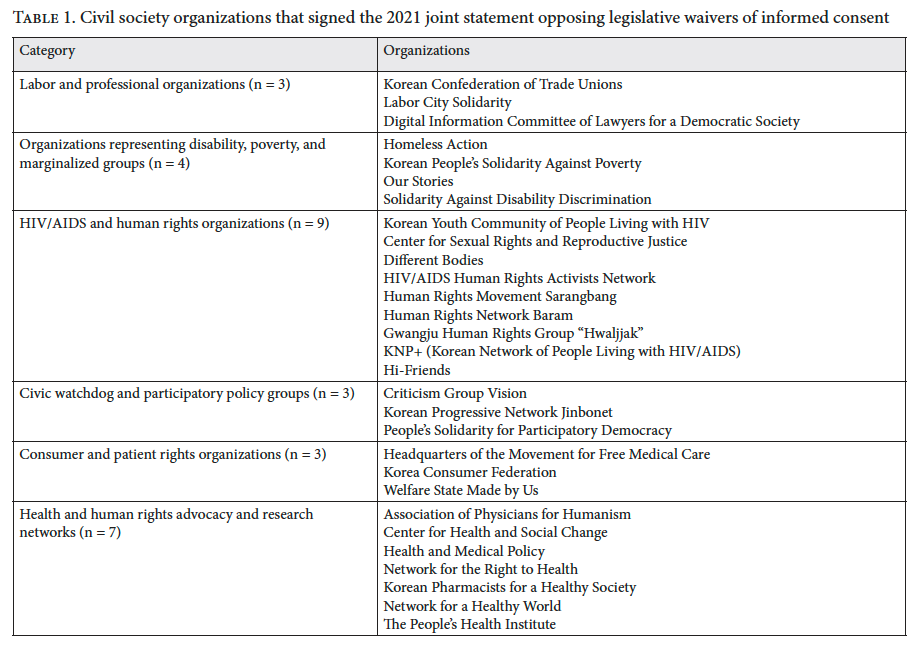
The 29 organizations represent a broad spectrum of Korean society, categorized into six types by locus of ethical concern and civic engagement.
First, labor and professional organizations (n = 3), including the Korean Confederation of Trade Unions—one of the country’s largest and most influential labor unions—demonstrated that concerns about informed consent extended beyond traditional bioethics communities. Their support reflected a broader worker-rights framework that emphasizes human rights and democratic participation in decision-making processes.
Second, organizations representing disability, poverty, and marginalized groups (n = 4) brought perspectives rooted in lived experiences of structural exclusion. Organizations such as Solidarity Against Disability Discrimination and Homeless Action have historically challenged medical paternalism and emphasized the importance of informed consent and rights-based service delivery for those whose voices are often disregarded in policymaking.
Third, HIV/AIDS and human rights organizations (n = 9) formed the largest category of signatories. These groups—including KNP+ (the Korean Network of People Living with HIV/AIDS), the Korean Youth Community of People Living with HIV, and Hi-Friends—have long been at the forefront of the struggle for medical rights, privacy, and protection from stigma. Their opposition to the legislative waiver proposals drew on decades of advocacy defending the bodily integrity and autonomy of sexual minorities and people living with HIV/AIDS. The proposed consent waiver was perceived as a direct threat to people already living with stigmatized infectious conditions, for whom the nonconsensual use of biological samples carried particular historical and personal weight.
Fourth, civic watchdog and participatory policy organizations (n = 3), such as People’s Solidarity for Participatory Democracy and the Korean Progressive Network Jinbonet, framed the issue within a larger critique of state overreach and democratic erosion. These groups emphasized procedural justice and the need for public accountability when revising legal frameworks that affect human rights, particularly in emergencies.
Fifth, consumer and patient rights organizations (n = 3), including the Korea Consumer Federation, highlighted the ethical and legal expectations that citizens hold toward the health care system. Their inclusion signaled that informed consent is not merely a professional guideline but a social contract grounded in trust and transparency between institutions and the public.
Finally, health and human rights advocacy and research networks (n = 7), such as the Center for Health and Social Change, the Association of Physicians for Humanism, and the Network for the Right to Health, contributed expert knowledge and long-standing commitment to public health ethics. These organizations provided the conceptual and empirical foundation for the joint statement, drawing from both domestic and international standards, including global human rights norms.
Taken together, the diversity and breadth of these organizations show that resistance to the legislative waivers was not limited to academic bioethicists or legal professionals. Rather, it reflected a deeply rooted civic ethic in South Korea—an ethic grounded in lived experience, participatory democracy, and transnational ethical norms.
Public objections and media engagement
In addition to formal statements by academic and civic organizations, individual citizens also played an active role in opposing the legislative proposals. During the official public comment period on the National Assembly’s website (March 3–12, 2021), the two bills attracted strikingly different levels of public response. The proposed amendment to the Infectious Disease Control and Prevention Act (Bill No. 2108444)—which would have permitted research on infectious disease pathogens without written consent—received 2,654 individual objections, an exceptionally high number in the context of South Korean legislative processes. This volume of participation reflected in part the digital organizing capacity of civil society networks, whose coordinated use of the National Assembly’s online comment system amplified public opposition at scale.[28]
By contrast, the proposed amendment to the Pathogenic Resources Act (Bill No. 2108443), which concerned ethics review oversight, received only seven comments. This disparity is significant: It reflects the fact that the consent waiver provision was immediately legible to the public as a direct threat to self-determination and bodily integrity, while the ethics review exemption—a more technical governance matter—generated far less public concern. For communities already living under the stigma of infectious disease, particularly people living with HIV/AIDS, the prospect of nonconsensual use of their biological materials was experienced as an existential threat, not an abstract policy question.
Most bioethics- or health-related bills typically receive only a handful of comments, and it is not uncommon for such amendments to pass without any public input. This unusually high volume of engagement signaled widespread public concern over the ethical implications of the proposed deregulatory changes and reflected a broader consensus that the human right to self-determination must remain nonnegotiable, even in emergencies.
The controversy also drew notable media attention—an uncommon development for technical amendments concerning research governance. National outlets such as Medipana News and Korea Biomedical Review not only reported the legal details but also highlighted the intensity of civic backlash, framing the issue in both ethical and constitutional terms.[29] Rather than offering uncritical coverage, many articles incorporated civic commentary and ethical critique, thereby helping mobilize public awareness beyond academic and professional spheres.
This convergence of citizen protest and media engagement was rare in South Korea’s legislative landscape, where many laws are revised with minimal public scrutiny. In this case, however, the synergy between digital activism, civil society advocacy, and press coverage generated a robust democratic response. Ultimately, both bills failed to reach a committee vote and lapsed automatically at the end of the parliamentary session—a procedural outcome that itself reflected the weight of sustained public and professional opposition. The event serves as a compelling reminder that public ethics and civic agency can meaningfully influence lawmaking, even during a global crisis.
Discussion: Historical roots and global implications
The speed, breadth, and effectiveness of South Korea’s civic mobilization raises an important question: What made this response possible? The answer lies not in the specific circumstances of 2021 but in the longer arc of South Korean democratic and ethical development. This section contextualizes the case within South Korea’s political history and draws out its implications for global debates on research ethics, human rights, and democratic governance.
South Korea’s historical path to ethical vigilance and civic resistance
South Korea’s contemporary civic and ethical landscape cannot be understood without considering its turbulent modern history. Prior to Japanese colonization in the early 20th century, the Korean peninsula had been governed by a succession of unified dynasties—including Unified Silla, Goryeo, and Joseon—for over a millennium, fostering a deep sense of cultural and political continuity.[30] From 1910 to 1945, Korea was under Japanese colonial rule, a period marked by severe cultural, political, and institutional suppression. In the aftermath of World War II, the country was forcibly divided along the 38th parallel. This division crystallized into two separate states in 1948, making the Korean peninsula one of the last enduring vestiges of the Cold War.
Shortly after its founding, South Korea was devastated by the Korean War (1950–1953), which left millions dead and the country in ruins. Amid postwar poverty, the country embarked on a rapid process of economic modernization. However, this came at a high cost to civil liberties. From 1961 to 1987, South Korea was ruled by successive military regimes. Under Presidents Park Chung-hee and Chun Doo-hwan, dissent was violently suppressed. The 1980 Gwangju Uprising, in which civilian protesters were massacred under martial law, became a symbol of the brutal cost of authoritarian rule.[31] During this period, many students, labor organizers, and intellectuals were imprisoned, tortured, or disappeared. A generation of South Koreans—including this paper’s corresponding author—came of age during this era, witnessing firsthand the fear and repression of a government willing to sacrifice human rights for state power and economic growth.
South Korea’s democratic transformation began in earnest with mass protests in 1987, leading to constitutional reforms and the election of a civilian president in 1992. Since then, democratic institutions and civil society organizations have expanded significantly.
The country’s ethical governance infrastructure developed more slowly. It was not until the Hwang Woo-Suk scandal of 2005–2006 that South Korea experienced a reckoning with research ethics.[32] Hwang, a nationally celebrated stem cell researcher, was found to have fabricated data in two landmark papers published in Science, while also obtaining eggs from female junior researchers under ethically compromised conditions. The scandal—which unraveled despite initial state backing and intense national pride—exposed deep structural failures in research oversight and triggered a public debate about the relationship between scientific ambition, state support, and ethical accountability.
The public’s response was profound, reflecting a renewed demand for scientific integrity and the recognition of human rights and contributing to legislative and institutional reforms in bioethics. This shift has been described by Korean scholars as an “ethical modernization.”[33] The incident catalyzed the establishment of new oversight bodies and, in 2013, prompted South Korea to amend its Bioethics and Safety Act to bring domestic regulations into closer alignment with internationally recognized bioethical standards, including the principles articulated in the Declaration of Helsinki regarding informed consent. This foundational legal reform would later provide the normative anchor for the academic and civic coalition statements of 2021.[34] The scandal also marked a pivotal moment in public engagement with biomedical ethics and highlighted the role of media and civil society in demanding accountability from the scientific community.
A decade later, the 2015 outbreak of Middle East respiratory syndrome (MERS) provided an additional formative experience that further shaped public expectations regarding ethical governance. The government’s initial response was widely criticized for a lack of transparency, particularly its failure to disclose information about affected hospitals and transmission pathways.[35] This was perceived as prioritizing institutional and political interests over public trust, leading to widespread criticism and a rapid erosion of confidence in public health authorities.[36]
The MERS experience underscored the ethical and political importance of transparency, accountability, and effective risk communication in public health crises. In its aftermath, reforms were introduced to improve information disclosure, public engagement, and participatory governance in epidemic response.[37]
During the COVID-19 pandemic, South Korea’s prior experience with MERS initially prompted a transparent and participatory response.[38] The government emphasized open communication and citizen cooperation rather than coercion or lockdowns.[39] This established a high standard of public trust and ethical responsiveness. South Korea’s reliance on digital contact tracing and public disclosure of movement data did raise privacy concerns, but these measures were subject to public debate and oversight.[40] The balance struck between technological surveillance and democratic accountability reflected a maturing ethical infrastructure shaped by earlier public health crises and civic engagement.[41]
The layers of historical trauma and civic awakening provide the necessary context to understand the powerful civil society response to the 2021 legislative proposals aimed at waiving informed consent for infectious disease research. The proposed amendments were not merely technical revisions—they triggered historical memory, ethical commitments, and constitutional instincts. South Korea’s civil society, forged through decades of struggle against authoritarianism, acted decisively to defend human rights norms, even during a global emergency.[42] Their success underscores the enduring connection between democracy, ethics, and public health.
Governance lessons and global significance
South Korea’s experience also speaks to wider concerns about the relationship between emergency powers and democratic erosion, in particular the absence of meaningful prior public consultation before the legislative proposals were introduced. In South Korea, as in many democracies, major legislative changes affecting health and research governance are typically subject to stakeholder consultation and parliamentary deliberation. The 2021 bills were introduced without such a process, which itself became a focal point of civil society criticism. The coalition statements explicitly demanded participatory policymaking—not merely the withdrawal of the bills, but a commitment to future co-deliberation.[43] This points to a broader governance lesson: The legitimacy of research ethics frameworks depends not only on their substance but on the process by which they are made.
South Korea’s case illuminates the relationship between three analytically distinct but deeply interconnected domains: research ethics, human rights, and democratic governance. Research ethics norms—particularly informed consent and ethics review—provided the immediate grounds for opposition. Human rights law, both international and constitutional, supplied the normative authority that gave those norms legal weight and political force. And democratic governance, forged through decades of civic struggle, provided the institutional capacity and collective will to act.
The 2021 mobilization can be understood as having been effective in part because these three domains converged, enabling civil society actors to simultaneously invoke bioethical standards, human rights obligations, and constitutional principles in a single coherent argument. It is this convergence that distinguishes the South Korean case from technocratic policy debates and gives it broader significance for wider discussions on research governance, democratic resilience, and the protection of human rights during public health emergencies.
At the level of global research governance, the concerns articulated in the South Korean case resonate with broader international efforts to address the ethical challenges of public health emergencies. The 2024 revision of the Declaration of Helsinki, which includes expanded attention to research in emergency contexts and the role of community engagement, reflects an ongoing attempt to clarify the conditions under which research may proceed without undermining fundamental protections.[44] Similarly, the PREPARED Code: A Global Code of Conduct for Research During Pandemics provides practical guidance for researchers and ethics committees navigating these tensions, including a dedicated chapter on the code’s core principles.[45] The analysis presented in this paper contributed to discussions that informed aspects of this broader work, situating the South Korean experience within an evolving global conversation about pandemic ethics.
Conclusion
Giorgio Agamben’s theory of the “state of exception,” Michel Foucault’s analysis of biopolitics, and Hannah Arendt’s warnings about the conditions that give rise to totalitarianism all caution against the instrumental use of insecurity to justify authoritarian measures.[46] As Erich Fromm has observed, fear and instability can lead citizens to relinquish autonomy in exchange for a false sense of protection.[47] The Korean example underscores how even democracies, when gripped by national emergencies, may veer toward exceptionalism, undermining the very ethical and legal safeguards that define open societies.[48] Importantly, South Korea’s overall COVID-19 governance had been recognized internationally as a model response, which makes the 2021 legislative proposals all the more striking.[49] The South Korean resistance to deregulatory reforms serves as a reminder that ethical norms must not be suspended but rather reinforced during moments of national vulnerability.
At the domestic level, the events examined in this paper may be understood within a longer trajectory of democratic development and civic engagement in South Korea. Historical experiences of authoritarian governance, together with subsequent processes of democratization, have contributed to a political culture in which public scrutiny and participation play an important role in shaping policy decisions. In this context, the 2021 mobilization can be interpreted as one instance of a broader pattern of civic vigilance in the face of perceived threats to rights and accountability.
This pattern is further illuminated by two pivotal episodes that bracket the case examined here. In 2016–2017, sustained mass candlelight protests—drawing millions of citizens across South Korea—led to the constitutional impeachment and removal of President Park Geun-hye, demonstrating that institutional accountability mechanisms could be activated through organized civic pressure even in the face of entrenched political power.[50] In December 2024, when the sitting president declared martial law in an attempt to suspend parliamentary governance, citizens and lawmakers once again mobilized with remarkable speed, and the declaration was overturned within hours.[51] These episodes, though distinct in domain—constitutional governance, bioethics, and research regulation—reflect a shared democratic infrastructure: South Korean civil society possesses both the institutional memory and the organizational capacity to recognize, name, and resist perceived violations of rights. The 2021 defense of informed consent is best understood as part of this same tradition of civic vigilance—one in which the protection of rights, whether in the research ethics arena or in the constitutional order, is treated as a nonnegotiable civic obligation.
South Korea’s experience offers a set of insights that may be relevant beyond the specific case examined here. It suggests that the resilience of ethical and legal protections during crises depends both on formal regulatory frameworks and on the presence of engaged civil society actors, institutional accountability, and public trust. In this sense, informed consent is not merely a technical requirement but part of a broader normative architecture that supports democratic governance.
In times of crisis, the challenge lies in upholding ethical standards under conditions of uncertainty and urgency. The South Korean case indicates that sustained civic engagement and adherence to internationally recognized ethical principles can help ensure that responses to public health emergencies remain aligned with human rights and democratic values.
Funding
The Pro-Active Pandemic Crisis Ethics and Integrity Framework (PREPARED) project, which led to these results, received funding from the European Commission (grant agreement no. 101058094).
Translation
All Korean-language primary sources cited in this manuscript—including legislative documents, civil society statements, and news articles—were translated into English by Ock-Joo Kim.
Young Su Park, MD, PhD, is an assistant professor in the Department of the History of Medicine and Medical Humanities at Seoul National University, Republic of Korea.
Doris Schroeder, PhD, is the director of the Centre for Professional Ethics at the University of Lancashire, Preston, United Kingdom, and a professor at the School of Law at UCLan Cyprus, Larnaca, Cyprus.
Orla Drummond, PhD, is a research manager at Trilateral Research, Waterford, Ireland.
Ock-Joo Kim, MD, PhD, is a professor and chair in the Department of the History of Medicine and Medical Humanities at Seoul National University College of Medicine, Republic of Korea.
Please address correspondence to Ock-Joo Kim. Email: okim9646@snu.ac.kr.
Competing interests: None declared.
Copyright © 2026 Park, Schroeder, Drummond, and Kim. This is an open access article distributed under the terms of the Creative Commons Attribution-Noncommercial License (http://creativecommons.org/licenses/by-nc/4.0/), which permits unrestricted noncommercial use, distribution, and reproduction in any medium, provided the original author and source are credited.
References
[1] World Medical Association, Declaration of Helsinki: Ethical Principles for Medical Research Involving Human Subjects (adopted 1964, last amended 2024); United Nations Educational, Scientific and Cultural Organization, Universal Declaration on Bioethics and Human Rights (2005).
[2] World Health Organization, Ethics in Epidemics, Emergencies and Disasters: Research, Surveillance and Patient Care: Training Manual (2015), pp. 7–8; Nuffield Council on Bioethics, Research in Global Health Emergencies: Ethical Issues (2020), pp. 9–11; National Academies of Sciences, Engineering, and Medicine, Integrating Clinical Research into Epidemic Response: The Ebola Experience (National Academies Press, 2017), pp. 3–5.
[3] S. A. Zweig, A. J. Zapf, C. Beyrer, et al., “Ensuring Rights While Protecting Health: The Importance of Using a Human Rights Approach in Implementing Public Health Responses to COVID-19,” Health and Human Rights 23/2 (2021).
[4] D. Lee, K. Heo, Y. Seo, et al., “Flattening the Curve on COVID-19: South Korea’s Measures in Tackling Initial Outbreak of Coronavirus,” American Journal of Epidemiology 190/4 (2021); J. Park and E. Chung, “Learning from Past Pandemic Governance: Early Response and Public-Private Partnerships in Testing of COVID-19 in South Korea,” World Development 137 (2021); J. Jeon, H. Kim, and K. S. Yu, “The Impact of COVID-19 on Conduct of Clinical Trials for Medical Products in Korea,” Journal of Korean Medical Science 35/36 (2020); Y. Park and O. Kim, “Government Initiatives for Research Ethics During COVID-19 Pandemic in Korea,” Journal of Korean Medical Science 39/12 (2024).
[5] National Assembly of the Republic of Korea, “Partial Amendment to the Infectious Disease Control and Prevention Act,” Bill No. 2108444, sponsored by Representative Byun Jae-il et al. (March 2, 2021) (Korean-language source).
[6] People’s Solidarity for Participatory Democracy et al., “Joint Civil Society Statement Opposing Legislative Efforts to Undermine Bioethical Standards during Public Health Crises” (March 30, 2021) (Korean-language source).
[7] Human Rights Council, Free, Prior and Informed Consent: A Human Rights-Based Approach, UN Doc. A/HRC/39/62 (2018).
[8] Ibid.
[9] Ibid.
[10] Committee on Economic, Social and Cultural Rights, General Comment No. 14, UN Doc. E/C.12/2000/4 (2000), paras. 12–13, 43(a).
[11] Ibid.
[12] World Health Organization, “Human Rights,” https://www.who.int/health-topics/human-rights.
[13] A. Sandu, “Ethical and Legal Perspectives on Informed Consent in the Context of International Human Rights Law,” Logos Universality Mentality Education Novelty: Law 13/1 (2025).
[14] Ibid.
[15] Constitution of the Republic of Korea (1987).
[16] S. Jeon, “Public Health and Constitutional Rights During the COVID-19 Pandemic,” Journal of Korean Law 20/2 (2021).
[17] M. Kim, “Enhancing Professional Awareness of Informed Consent: Safeguarding the Rights of Patients and Practitioners,” Journal of Korean Neurosurgical Society 67/6 (2024).
[18] C. Hahm, The Constitution of South Korea: A Contextual Analysis (Hart Publishing, 2024).
[19] National Assembly of the Republic of Korea, Bill No. 2108444 (see note 5).
[20] Korean Bioethics Association et al., Joint Statement Opposing Legal Amendments That Undermine Informed Consent and Ethical Standards in Infectious Disease Research (March 19, 2021) (Korean-language source).
[21] United States, 45 Code of Federal Regulations (CFR) §164.512(i)(2)(ii); 45 CFR §46.116(f)(3).
[22] European Union, General Data Protection Regulation Article 89, Regulation (EU) 2016/679 (2016); European Data Protection Board, Guidelines 03/2020 on the Processing of Data Concerning Health for the Purpose of Scientific Research in the Context of the COVID-19 Outbreak (2020); C. Staunton, S. Slokenberga, A. Parziale, and D. Mascalzoni, “Appropriate Safeguards and Article 89 of the GDPR: Considerations for Biobank, Databank and Genetic Research,” Frontiers in Genetics 13/719317 (2022).
[23] Y. Wakabayashi, H. Asai, T. Horimatsu, et al., “Next-Generation Medical Infrastructure Law in Japan: Appropriate Use of Individual Medical Information,” DIA Global Forum (2023), https://globalforum.diaglobal.org/issue/february-2023/next-generation-medical-infrastructure-law-in-japan.
[24] National Assembly of the Republic of Korea, “Partial Amendment to the Act on the Promotion of Collection, Management and Utilization of Pathogenic Resources,” Bill No. 2108443, sponsored by Representative Byun Jae-il et al. (March 2, 2021) (Korean-language source).
[25] Korean Bioethics Association et al. (see note 20).
[26] World Medical Association, Declaration of Helsinki (2013), art. 8.
[27] People’s Solidarity for Participatory Democracy et al. (see note 6).
[28] National Assembly of the Republic of Korea, Bill No. 2108444 (see note 5); H. Lee and J. Oh (eds), Digital Media, Online Activism, and Social Movements in Korea (Lexington Books, 2021).
[29] Medipana News (March 23, 2021); Korea Biomedical Review (March 23, 2021); Daily Medi (March 17, 2021); Doctor’s News (March 23, 2021); Hankyung Medical (March 23, 2021); Health Korea News (March 23, 2021); Korea Medical Times (March 23, 2021) (Korean-language sources).
[30] B. Cumings, Korea’s Place in the Sun: A Modern History (W. W. Norton & Company, 2005), chs. 1–3.
[31] Ibid.; B. Cumings, The Korean War: A History (Modern Library, 2010).
[32] T. Kim, “How Could a Scientist Become a National Celebrity?,” East Asian Science, Technology and Society 2/1 (2008); H. Gottweis and B. Kim, “Explaining Hwang-Gate,” Science, Technology and Human Values 35/4 (2010).
[33] J. Kim and K. Park, “Ethical Modernization: Research Misconduct and Research Ethics Reforms in Korea Following the Hwang Affair,” Science and Engineering Ethics 19/2 (2013).
[34] O. Kim, “Bioethics and Research Ethics in Korea After the Hwang Woo-Suk Scandal,” in The Hwang Woo-Suk Scandal 10 Years Ago from the Present Perspective (Park Young-Sa, 2018) (Korean-language source).
[35] S. Lee, “Costly Lessons from the 2015 MERS Coronavirus Outbreak in Korea,” Journal of Preventive Medicine and Public Health 48/6 (2015).
[36] O. Kim, “Ethical Perspectives on the Middle East Respiratory Syndrome Coronavirus Epidemic in Korea,” Journal of Preventive Medicine and Public Health 49/1 (2016).
[37] Lee, “Costly Lessons” (see note 35); Kim, “Ethical Perspectives” (see note 36).
[38] Lee, “Costly Lessons” (see note 35); Kim, “Ethical Perspectives” (see note 36).
[39] Park and Kim (see note 4).
[40] M. Ryan, “In Defence of Digital Contact-Tracing: Human Rights, South Korea and COVID-19,” International Journal of Pervasive Computing and Communications 16/4 (2020).
[41] M. Moon, “Fighting COVID-19 with Agility, Transparency, and Participation: Wicked Policy Problems and New Governance Challenges,” Public Administration Review 80/4 (2020).
[42] Cumings (2005, see note 30), ch. 7.
[43] People’s Solidarity for Participatory Democracy et al. (see note 6).
[44] Y. Park, D. Schroeder, and O. Kim, “Research Ethics Challenges in Pandemic Korea and Their Implications for the Revised 2024 Declaration of Helsinki,” Journal of Korean Medical Science 40/42 (2025).
[45] PREPARED, “The PREPARED Code: A Global Code of Conduct for Research During Pandemics,” https://www.globalcodeofconduct.org/prepared-code/; K. Chatfield and M. Singh (eds), Research Ethics and Integrity During Pandemics: Developing the PREPARED Code (Springer, 2025).
[46] G. Agamben, State of Exception (University of Chicago Press, 2005); M. Foucault, Society Must Be Defended: Lectures at the Collège de France, 1975–1976 (Picador, 2003); H. Arendt, The Origins of Totalitarianism (Harcourt, 1951).
[47] E. Fromm, Escape from Freedom (Holt Paperbacks, 1994).
[48] A. J. London and J. Kimmelman, “Against Pandemic Research Exceptionalism,” Science 368/6490 (2020).
[49] S. Lee and T. Kim, “South Korea’s Combating COVID-19 Under the Rule of Law,” Verfassungsblog (April 8, 2021).
[50] W. Kang, “Determinants of Unaffiliated Citizen Protests: The Korean Candlelight Protests of 2016–2017,” Korea Journal 59/1 (2019).
[51] B. A. Engel, “Making Sense of South Korea’s Senseless Martial Law Declaration,” Asia Pacific Journal: Japan Focus 22/12 (2024).